
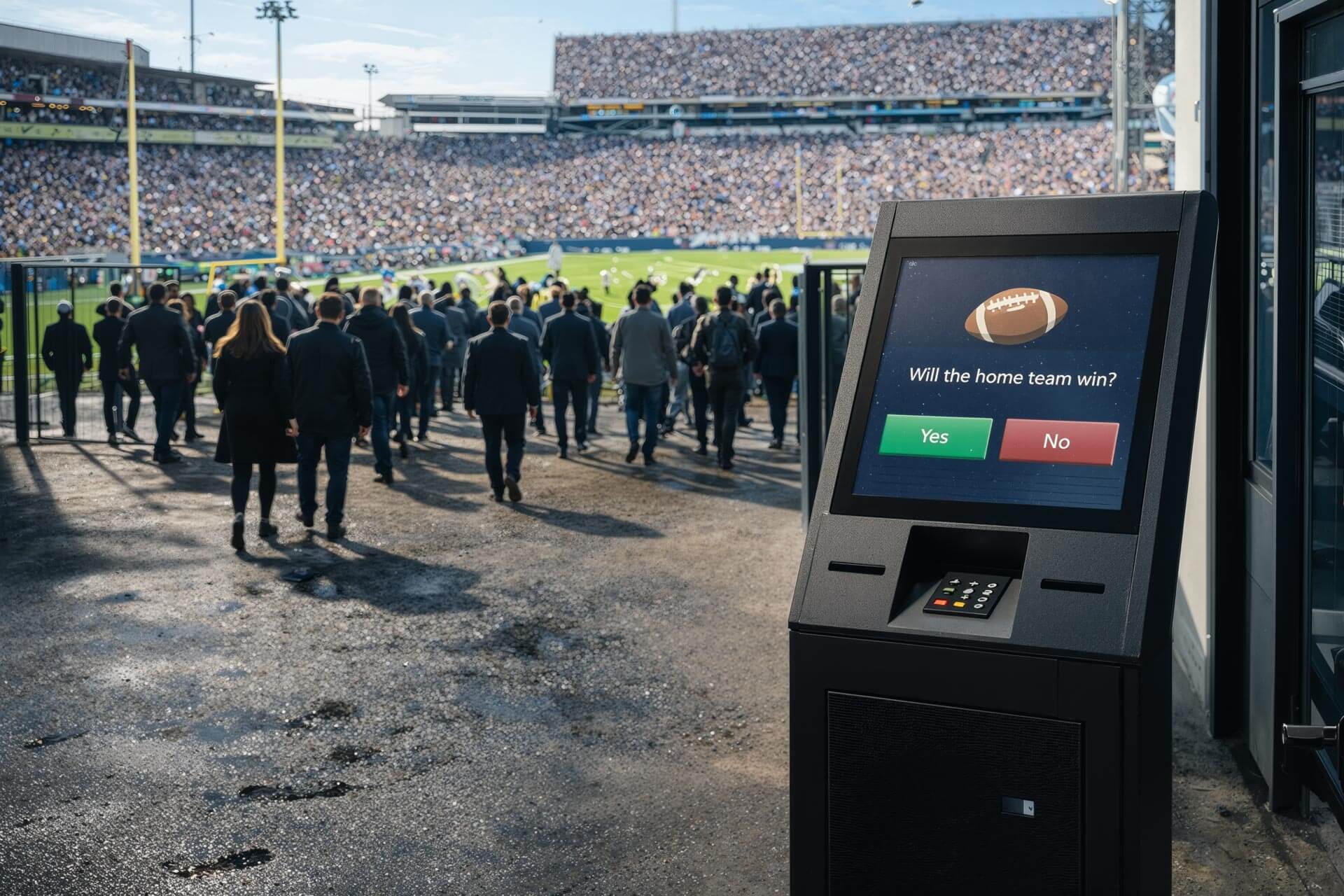

Prediction markets spent years trying to present themselves as smarter, better, and more useful than straight-out gambling.
Then sports arrived and did what elections, inflation contracts, and policy wagers never quite managed: it brought scale. They turned what was essentially a niche event trading activity into a mass product, and pushed the industry into a dangerous identity crisis.
Sports made prediction markets popular, but they also made them politically vulnerable.
On March 12, the CFTC opened a formal rulemaking process for prediction markets, putting manipulation, oversight, and contract structure under the federal spotlight.
Since then, Arizona has also filed criminal charges against Kalshi, while a Nevada judge temporarily blocked the company from operating there without a state license. Massachusetts had already moved against Kalshi’s sports contracts.
Now Congress is moving, too.
A bipartisan group of senators is preparing legislation that would ban sports bets and casino-style contracts on CFTC-regulated prediction markets, arguing that they’re exploiting a legal loophole to bypass state gambling rules and cut across tribal sovereignty.
It’s now safe to say that the dispute is no longer confined to a few test cases.
The industry now faces an awkward fact. Its fastest route to growth came through contracts that look, feel, and are marketed a lot like sports bets. But, its legal defense depends on persuading courts and regulators that those same contracts belong in the world of federally supervised derivatives. The more popular sports became, the harder it became to sustain that argument.
This stopped being a niche fight between startups and gaming boards a long time ago. It’s now a national argument over whether a business that behaves like sports betting can claim the legal privileges of financial market law and bypass the state-by-state gambling system that sportsbooks have spent years and billions of dollars entering.
What began as a jurisdiction fight over who regulates these contracts is now turning into something wider and more dangerous for the industry: a fight over whether sports prediction markets should exist in this form at all.
The whole fight turns on one question: bet or swap?
When you strip the dispute down to its core, you get to the main question all current and future regulation efforts are attempting to answer: Are prediction markets bets or swaps?
Linda Goldstein, a partner at CM Law, says that the answer to this question determines who regulates them. If these transactions are bets, states regulate them. If they’re swaps or derivatives, then the CFTC has the lead role, she told CryptoSlate.
States argue that the contracts may have the form of derivatives, but function as wagers in substance. This is especially true where there’s no credible commercial hedging use, and users are just staking money on the outcome of a game for a payout.
On the other hand, operators say that event contracts have long belonged inside commodities law and that a national market can’t function if every state is free to classify the same federal product as illegal gambling.
That’s one of the many reasons this fight feels so unstable.
The consumer activity we see on prediction markets is straightforward and familiar. People put money down on uncertain outcomes and get paid if they’re right.
The main dispute here is abstract and sits one level higher, in the legal classification of the contract itself. At the center of the fight is a simple problem: the same product can be framed as a derivative by federal regulators and as gambling by the states.
We’re now seeing a battle over whether states will keep authority over activity that looks and works like gambling, or whether that authority will get absorbed into federal financial oversight. The legal dispute has gone past Kalshi or one set of contracts, and is now about who governs event-based wagering once it’s packaged as a federally supervised market product.
That turns the debate from a branding argument into a real legal conflict over who gets to regulate these markets. Once sports became the dominant use case for prediction platforms, this became a fight over whether a national sports-betting business can operate under commodities law without ever entering the state licensing systems built for sportsbooks.
That’s why states such as Utah, Arizona, and Nevada are pushing so hard. They are trying to stop gambling-like activity from migrating into a federal regime they have no control over.
Why product design matters for prediction markets
A significant part of this issue will be resolved in court. However, people underestimate the effect that product design will have on this.
One of the reasons prediction markets run into issues is when they loosen their criteria about what makes a good event contract. The hype that surrounds them makes it tempting to list fast-moving and popular events, because that’s what drives volume.
But if these products don’t have precise definitions and irrefutable settlement, they quickly turn into entertainment wagering.
This means prediction markets can start acting like sportsbooks even before regulators notice. They start drifting there when spectacle and volume outrun precision, and when contracts are built for attention first, with the settlement depending too much on interpretation.
Binary contracts look simple until users start contesting the settlement. A yes-or-no contract is only as good as the definition inside it. Once the terms that define its outcome become elastic, the market starts depending on judgment calls, arguments, and eventually litigation.
Ross Weingarten, a partner and co-chair of the Sports Integrity Group at Steptoe, said that from the consumer standpoint, prediction markets work differently from traditional sportsbooks because users are trading “yes” or “no” positions against each other, not against a house.
But when the question gets murky, or the answer is not clear, the binary question suddenly isn’t so binary.
“We saw an example of this with bets on whether Cardi B would perform at the Super Bowl. She was on stage, but didn’t have a microphone. Did she perform? The answer probably depends on which side of the bet you took. For the prediction markets, bets like this often lead to litigation.”
That’s why sports contracts vary so much in defensibility.
Simple, hard-to-manipulate outcomes are easier to defend, which is why contracts on game winners are so popular. In-game props, performance claims, officiating-dependent outcomes, and anything vulnerable to insider knowledge or integrity distortions sit on thin ice.
It’s where the industry’s credibility will be won or lost. A platform that looks like a neutral exchange with visible order books, transparent pricing, independent settlement sources, and strong abuse detection has a stronger claim to a federal market status. A platform that looks like a bookmaker has a much weaker one.
The legal question will be resolved in court, but the legitimacy question will be resolved by the architecture of the actual product.
States started this fight, but Congress will decide where it ends
States present this as a consumer-protection and public-policy fight, and there is substance to that claim. Licensed sportsbooks sit inside a regime built around age controls, responsible-gambling funding, integrity monitoring, tax collection, and rules tailored to each jurisdiction. Prediction markets threaten to route the same activity through a federal channel that bypasses much of that system.
Goldstein is especially clear on the states’ incentives, saying it’s mostly about money and competition.
“Event contracts on sporting events account for the vast majority of transactions on prediction platforms like Kalshi and Polymarket, with some data estimating that it could be as much as 90% of the event contracts,” she explained.
“These contracts are directly competing with licensed sportsbooks. Traditional sports betting generates significant tax revenue for the states because the states receive taxes on the gross gaming revenue. The American Association of Gaming has estimated that, since the beginning of 2025, sports betting platforms have lost over $600 million to prediction markets.”
However, states are also adamant on keeping strict safeguards on all of these platforms. Goldstein explained that prediction markets circumvent many of the safeguards designed to protect consumers, such as age verifications, oversight over the integrity of the games, and mandatory contributions to gambling funds.
The American Gaming Association has made that case bluntly, accusing sports-related prediction markets of bypassing the state-based system that legal sports betting was built on. The leagues are adapting in real time as well. MLB’s deal with Polymarket and its memorandum with the CFTC on integrity cooperation amount to an acknowledgment that these markets are now too large to ignore.
The escalation in Arizona and Nevada shows how serious this has become. Arizona’s criminal case moved the dispute out of the familiar zone of cease-and-desist letters and into prosecutorial territory. Nevada’s restraining order showed that at least one court, for now, is willing to treat these products as unlicensed sports pools under state law. These are both attempts to force the industry back inside state control before federal market law hardens into a permanent workaround.
However, Weingarten explained that not all courts agree that sports event contracts amount to unlicensed sports betting subject to state law.
“Some courts have agreed; others have not,” he told CryptoSlate.
“Courts in New Jersey, California, and Tennessee have found that the contracts qualify as ‘swaps’ under the Commodity Exchange Act. But courts in Maryland, Nevada, Massachusetts, and Ohio have emphasized the historic role of states in regulating gambling. As a result, how and by whom prediction markets are regulated is very much in flux.”
That’s why the endgame probably won’t produce a clean blessing or a clean ban. CFTC has stated unequivocally that it believes it has exclusive jurisdiction over prediction markets like Kalshi and Polymarket, and states continue to claim their oversight.
But the newest turn in the story matters more than all of this, because it now widens the backlash well beyond just individual states. The bipartisan bill announced on Mar. 23 argues that sports and casino-style contracts should be carved out of federally regulated prediction markets altogether.
That’s a much more dangerous proposition for the industry because it breaks one of its core assumptions: that if prediction markets win the federal vs. state fight, sports contracts will survive them.
This changes the terrain in a much more fundamental way. The industry will no longer have to worry about whether courts will treat sports contracts as gambling under state laws, but whether Congress will decide whether they should be offered on regulated prediction markets at all.
The endgame is now a fight over categories, not just jurisdiction. States are suing, the CFTC is writing its own rules, and lawmakers have decided that some event contracts shouldn’t be allowed in the first place.
That’s why the most plausible destination we’ll get to is a hybrid regime, with tighter federal rules, more category restrictions, more surveillance demands, more pressure around contract clarity, and tougher expectations around how these products are marketed.
Platforms may still call themselves exchanges, but they’ll have to prove it in the way they design, settle, surveil, and present their contracts.
This isn’t a temporary flare-up in a niche product that will go away in the next cycle, because, like it or not, prediction markets are here to stay. We’re at the beginning of a foundational fight over where finance ends, and gambling begins, and the process could drag on for years.
Prediction markets found their mass audience by moving closer to sports betting. Now they have to answer the question that success created: can they keep that audience while persuading courts, regulators, and the public that they are still something meaningfully different?
Analysis,Featured,Regulation,CFTC,federal regulation,gambling,Kalshi,Polymarket,prediction markets,regulation,sports bettingCFTC,federal regulation,gambling,Kalshi,Polymarket,prediction markets,regulation,sports betting#Sports #blew #prediction #markets #destroy1774692759
