
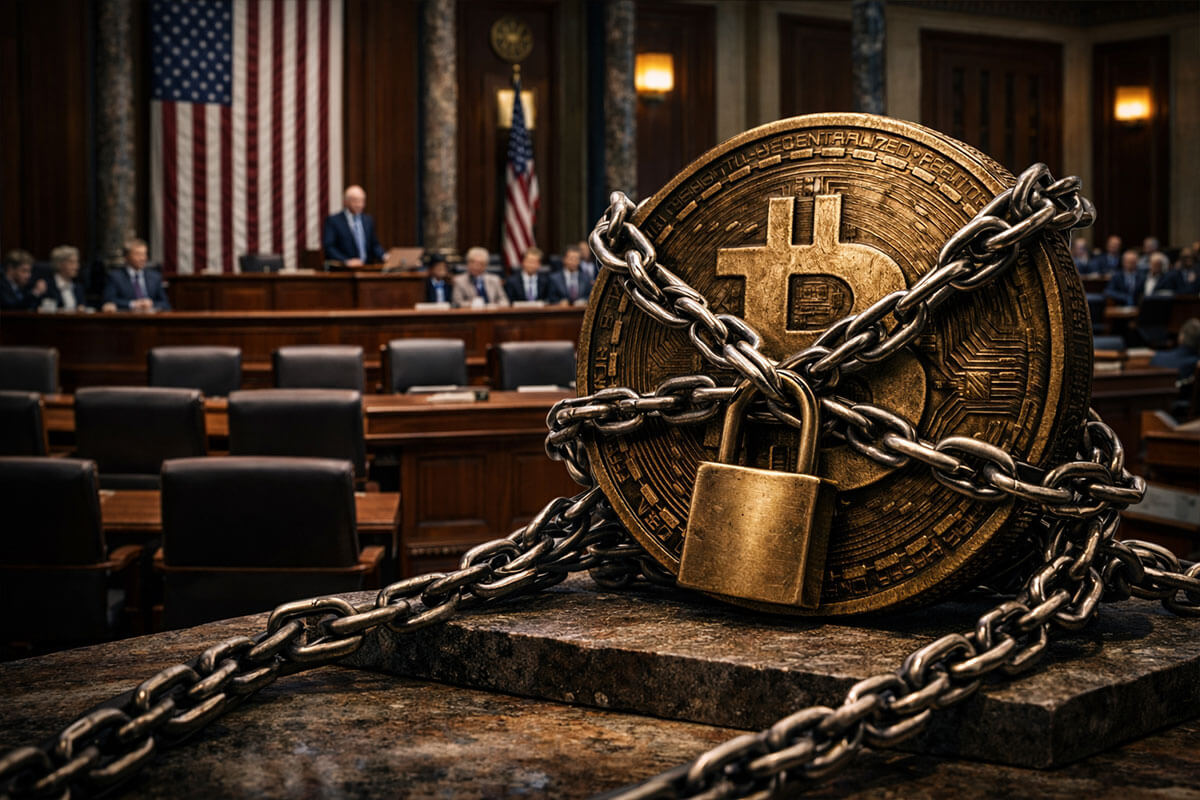

Washington is building a cleaner lane for digital dollars, and the consequence for Bitcoin is becoming easier to map.
Over the past year, U.S. lawmakers, regulators, and the White House have moved in the same direction. The GENIUS Act framework advanced in the Senate with language built around payment stablecoins, reserve backing, consumer protection, and cross-border efficiency.
The White House’s digital assets report described dollar-backed stablecoins as the “next wave of innovation in payments” and tied them directly to U.S. monetary reach. Treasury Secretary Scott Bessent later said the law gives the dollar an “internet-native payment rail.”
Then the OCC’s February proposed rule translated that political direction into operating architecture, spelling out how permitted issuers, reserves, redemption, custody, supervision, and approval processes would fit together under federal oversight.
The alignment is hard to miss.
Washington wants a regulated digital dollar product that can move through familiar legal channels, support demand for Treasuries, and extend dollar settlement into faster, cheaper, and more globally portable rails. That preference does not erase Bitcoin. It sorts Bitcoin into a different lane.
Stablecoins are being shaped as money-like instruments. Bitcoin remains the scarce external asset, valuable because it sits outside the state’s liabilities and outside the dollar’s direct monetary stack.
That leaves a more interesting question for markets.
If the U.S. state is building better legal and tax plumbing for digital dollars, what happens to the long-running ambition that Bitcoin could become everyday transactional money in major developed markets?
The answer increasingly looks uncomfortable for that use case. Bitcoin still carries scarcity, portability, censorship resistance, and reserve-like appeal. Its recent price behavior also complicates any simplistic “digital gold” slogan.
Yet policy direction keeps reinforcing the same split, stablecoins for spending, Bitcoin for savings, collateral, treasury reserve exposure, and macro expression. That is a narrower role than some early Bitcoin advocates imagined, though it is also a cleaner one, and potentially a more durable one.
Washington’s stablecoin push is building digital cash around the dollar
The first layer of the structure is explicit state interest. The White House report frames dollar-backed stablecoins as a strategic payments technology. The language is direct.
Dollar stablecoins can reinforce U.S. financial leadership, support real-time cross-border transfers, and preserve dollar relevance as digital finance globalizes.
Treasury’s post-enactment statement on GENIUS pushes the same line from a market structure angle, presenting stablecoins as a new rail for the dollar economy and a mechanism that can increase demand for U.S. government debt through reserve holdings.
A Richmond Fed economic brief reaches a similar conclusion, arguing that reserve-backed stablecoins can deepen, rather than dilute, demand for dollars and Treasuries.

The second layer is implementation. The OCC’s proposed rule gives this direction operational shape.
It sets out who can issue payment stablecoins in the United States, how reserves should be handled, how redemption works, what supervisory standards apply, and how custody and approvals fit into the regime. This framework signals institutionalization. Markets usually respond to legal clarity with capital formation, product design, and distribution buildout.
A payments instrument becomes far more credible when issuers, banks, custodians, and service providers can see the rails in advance.
The third layer is tax treatment. The PARITY Act discussion draft creates a special rule for qualifying regulated payment stablecoins pegged solely to the U.S. dollar, with explanatory language that points toward a de minimis approach for routine transactions. In the same draft, lawmakers move to apply wash-sale rules across digital assets.
The sequencing is telling. The product being simplified for ordinary use is the regulated digital dollar. The asset class facing tighter tax discipline is the broader digital asset field, including Bitcoin exposure.
BDO’s analysis highlights the exact direction, noting both the expansion of wash-sale treatment and the specialized relief contemplated for regulated payment stablecoins.
Set those layers together, and a pattern emerges.
The United States is promoting a version of crypto that can extend the dollar’s reach, deepen Treasury demand, and fit within conventional oversight. That policy mix naturally favors instruments with price stability, issuer accountability, reserve transparency, and redemption design.
Bitcoin offers almost none of those features, as governments typically define payment infrastructure. It offers an exogenous monetary asset with a fixed supply and no sovereign issuer.
That distinction sits at the center of the debate.
Washington’s current path gives digital dollars better odds of becoming normalized money on-chain. Bitcoin, by comparison, keeps its claim on scarcity and neutrality, while losing ground in the race to become frictionless everyday currency within the U.S. regulated perimeter.
Bitcoin’s payments role is narrowing, while its scarcity case remains intact
Bitcoin’s position in this framework is more nuanced than either side of the ideological debate.
The maximalist reading says state preference for dollar stablecoins vindicates Bitcoin by proving that governments will always privilege sovereign money. The dismissive reading says stablecoin progress leaves Bitcoin stranded as a speculative relic. Current evidence supports neither extreme.
Bitcoin still carries a large and durable monetary proposition as a scarce bearer asset. It still offers settlement outside banking hours, resistance to debasement over long horizons, and portability across borders without issuer risk. Yet the conditions needed for Bitcoin to become easy, routine, tax-light money for mainstream U.S. consumers are moving further away.
Senator Cynthia Lummis’s 2025 digital asset tax proposal showed that at least some lawmakers understand the compliance burden created when everyday transactions in digital assets trigger taxable events.
That recognition captures a practical barrier rather than an ideological one. People do not spend assets easily when every small transaction creates a reporting calculation.
The more recent PARITY draft starts from a narrower base and gives the initial relief lane to regulated payment stablecoins. The draft also leaves the door open to future treatment for other digital assets, which keeps the long-term map fluid.
Even so, the immediate preference is clear. Washington is standardizing the payment token first, and that payment token is designed around the dollar.
This has direct implications for Bitcoin’s narrative. The phrase “digital gold” has always done several jobs at once.
It expresses scarcity. It signals distance from sovereign monetary systems. It points to long-duration holding behavior rather than transactional use. It also invites comparison with an asset that can hold value across regimes, even when short-term performance is uneven.
Recent Bitcoin market action complicates any lazy use of that label. Gold and Bitcoin do not move in lockstep through every risk window. Bitcoin remains more volatile, more liquidity-sensitive, and more exposed to cross-asset de-risking than physical gold.

Those differences deserve clear treatment. At the same time, the state’s stablecoin agenda may end up strengthening the core of the “digital gold” frame by stripping away one of Bitcoin’s most contested ambitions, becoming regulated digital cash for ordinary commerce.
That shift could clarify Bitcoin’s role for mainstream users with some market exposure.
A cleaner framework would look like this. Stablecoins become the transactional layer, optimized for payments, remittances, exchange settlement, and digital-dollar mobility. Bitcoin becomes the savings and reserve layer, held for scarcity, sovereign distance, treasury diversification, collateral, and macro hedging across long arcs rather than everyday checkout flows.
The market already leans in that direction. Corporate treasury adoption, ETF flows, and reserve-asset rhetoric all sit closer to the savings side than the payments side. U.S. policy now appears to be reinforcing that separation rather than blurring it.
Stablecoins serve monetary reach, Bitcoin serves monetary distance
There is a tension inside that outcome.
Bitcoin’s broadest monetary dream loses range when states and banks build a far smoother digital-dollar stack. Bitcoin’s scarcity proposition gains clarity when its role becomes cleaner. Investors can hold both truths at once.
A narrower use case can still support huge value when the remaining use case is global, legible, and increasingly institutional. Gold itself offers the obvious parallel. It does not dominate payments. It still occupies a major place in reserves, savings psychology, and macro hedging.
Bitcoin’s volatility, liquidity profile, and technology stack make it a different asset from gold, though the structural comparison remains useful when thinking about role assignment rather than short-term price symmetry.
The deeper significance here sits beyond crypto branding.
Washington’s preference for digital dollars is also a preference for monetary reach. A regulated payment stablecoin extends the dollar into software, settlements, wallets, and cross-border networks while preserving reserve backing, redemption rights, and supervisory control.
That architecture serves the state. It supports financial influence abroad. It helps defend demand for dollar instruments. It keeps the center of gravity inside regulated intermediaries.
Senate Banking Committee language around faster, cheaper transactions and the White House’s emphasis on payment innovation and dollar leadership fit that objective exactly.
Bitcoin serves a different demand function. Its value proposition begins where state monetary control ends.
It is scarce by design. It settles without issuer redemption promises. It sits outside the Treasury market instead of helping fund it.
From a government perspective, those traits make Bitcoin far less useful as a tool of monetary extension. From an investor perspective, those same traits can make Bitcoin attractive in a world where sovereign systems keep expanding digital reach.
That is why the emerging split carries weight. Stablecoins and Bitcoin are increasingly being sorted into complementary rather than competing roles, one closer to money under sovereign sponsorship, one closer to an external reserve asset living alongside sovereign money.
For crypto markets, that sorting could reduce a long-standing ambiguity. For years, the sector tried to sell the same broad category as payment network, savings technology, speculative instrument, and anti-sovereign monetary alternative all at once.
Capital ultimately prices cleaner categories more efficiently. Regulators also regulate cleaner categories more confidently.
In that sense, the U.S. push around stablecoins could do two things at the same time. It could make digital dollars dramatically easier to use in normal economic life, and it could leave Bitcoin with a more concentrated identity anchored in scarcity, reserve behavior, and monetary independence.
That identity still faces tests. Bitcoin has to show that scarcity alone can support large and durable value through changing macro regimes. It has to show that its correlations with risk assets can loosen enough over time to sustain reserve-like demand. It has to absorb the fact that governments increasingly welcome blockchain-based dollars while offering far less enthusiasm for Bitcoin-based payments.
Those are real constraints. They also sharpen the core analytical question. The issue is no longer whether Washington embraces crypto in the abstract. The issue is which part of crypto Washington wants to scale.
Right now the answer points in one direction.
The United States is building policy for digital dollars because digital dollars extend the dollar system. Bitcoin sits outside that ambition. That leaves Bitcoin with a harder, narrower, and in some ways stronger proposition.
It remains scarce. It remains globally legible. It remains outside sovereign issuance.
If U.S. policy keeps making digital dollars easier to issue, hold, settle, and spend, Bitcoin’s role as digital gold gains clearer edges, even if its price behavior continues to challenge any simple slogan. The next test is whether markets start valuing that clarity as a feature rather than a limitation.
Analysis,Featured,Market,Payments,Stablecoins,Taxes#Congress #aims #digital #dollars #easier #Bitcoin #solidifying #digital #gold #narrative1774894118
