

What's Hot

    Tether’s Georgia stablecoin plan moves early on national payment rails

    May 25, 2026

    CFTC may gain broader crypto oversight as staff who questioned major firms were reportedly sidelined

    May 25, 2026

    Bitcoin and Ethereum ETF outflows expose rotation into HYPE, XRP and Solana

    May 25, 2026
    Facebook Twitter Instagram
    • Business
    • Markets
    • Get In Touch
    • Our Authors
    Facebook Twitter Instagram
    Crypto News: Latest Cryptocurrency News and Analysis
    • Home
    • Business

      Fidelity Buys 7.4% Of Bitcoin Mining Company Marathon Digital Holdings

      February 11, 2021

      Twitter Reacts as Auto Driver Begins Accepting Crypto as Payment

      February 11, 2021

      HSBC Becomes Latest Bank to Suspend Payments to Crypto

      February 4, 2021

      Bitcoin Holds Support; Approaching $50K Resistance

      February 4, 2021

      Cryptocurrency Prices Today: Bitcoin Up Over $47,000, Ether Rises 3%

      February 3, 2021
    • Technology
      1. Business
      2. Insights
      3. View All

      Fidelity Buys 7.4% Of Bitcoin Mining Company Marathon Digital Holdings

      February 11, 2021

      Twitter Reacts as Auto Driver Begins Accepting Crypto as Payment

      February 11, 2021

      HSBC Becomes Latest Bank to Suspend Payments to Crypto

      February 4, 2021

      Bitcoin Holds Support; Approaching $50K Resistance

      February 4, 2021

      Tether’s Georgia stablecoin plan moves early on national payment rails

      May 25, 2026

      CFTC may gain broader crypto oversight as staff who questioned major firms were reportedly sidelined

      May 25, 2026

      Bitcoin and Ethereum ETF outflows expose rotation into HYPE, XRP and Solana

      May 25, 2026

      Nasdaq’s Bitcoin options win SEC approval, but Wall Street’s real battle is still ahead

      May 25, 2026

      Bitcoin Climbs as Elon Musk Says Tesla ‘Likely’ to Accept it Again

      March 16, 2021

      Can Cryptocurrency Be Hacked, Stolen Or Scammed? How Can You Be Safe?

      February 11, 2021

      How Investors Can Get In On Crypto Without Actually Buying Any

      February 4, 2021

      Ethereum Just Underwent a Major Change – Hence, The 25% Jump in a Week!

      February 4, 2021
    • Insights
      1. Bitcoin
      2. Ethereum
      3. Eurozone
      4. Monero
      5. View All

      Binance Australia’s New Crypto Rules Mean Every Transfer Comes With ID Checks

      May 25, 2026

      CFTC Officials Who Questioned Crypto Firms Were Suspended, NYT Reports

      May 25, 2026

      AI Agents Are Starting to Spend Money Online — And Big Tech Wants the Rails

      May 25, 2026

      Crypto Markets Bounce Back as Trump Signals Iran Peace Deal Progress

      May 25, 2026

      Tether’s Georgia stablecoin plan moves early on national payment rails

      May 25, 2026

      CFTC may gain broader crypto oversight as staff who questioned major firms were reportedly sidelined

      May 25, 2026

      Bitcoin and Ethereum ETF outflows expose rotation into HYPE, XRP and Solana

      May 25, 2026

      Nasdaq’s Bitcoin options win SEC approval, but Wall Street’s real battle is still ahead

      May 25, 2026

      Bitcoin price prediction: BTC faces critical resistance at $78,000 as ETF outflows mount

      May 25, 2026

      TrapDoor attack targets crypto wallets, AWS keys and GitHub tokens

      May 25, 2026

      Celestia (TIA) extends recovery above $0.44 as retail traders fuel rally

      May 22, 2026

      Pi Network holds above $0.1500 as exchange outflows hint at recovery

      May 22, 2026

      Kelleher to Present $20M Exhibit at Boston 2026 World Expo

      May 22, 2026

      U.S. Mint 2026 Semiquincentennial Coin Production Explodes

      May 22, 2026

      Whitman’s Double Eagle Gold Coins Guide Returns in Full Color

      May 19, 2026

      Australian Bullion Sales Mixed in April, Perth Mint Reports

      May 19, 2026

      Tether’s Georgia stablecoin plan moves early on national payment rails

      May 25, 2026

      CFTC may gain broader crypto oversight as staff who questioned major firms were reportedly sidelined

      May 25, 2026

      Bitcoin and Ethereum ETF outflows expose rotation into HYPE, XRP and Solana

      May 25, 2026

      Nasdaq’s Bitcoin options win SEC approval, but Wall Street’s real battle is still ahead

      May 25, 2026
    • Markets
    • Get In Touch
    Crypto News: Latest Cryptocurrency News and Analysis
    Home » Tether’s Georgia stablecoin plan moves early on national payment rails
    Ethereum

    Tether’s Georgia stablecoin plan moves early on national payment rails

    行政By 行政May 25, 2026No Comments8 Mins Read
    Share
    Facebook Twitter LinkedIn Pinterest Email

    Make CryptoSlate logoCryptoSlate logo CryptoSlate preferred on Google logoGoogle logo

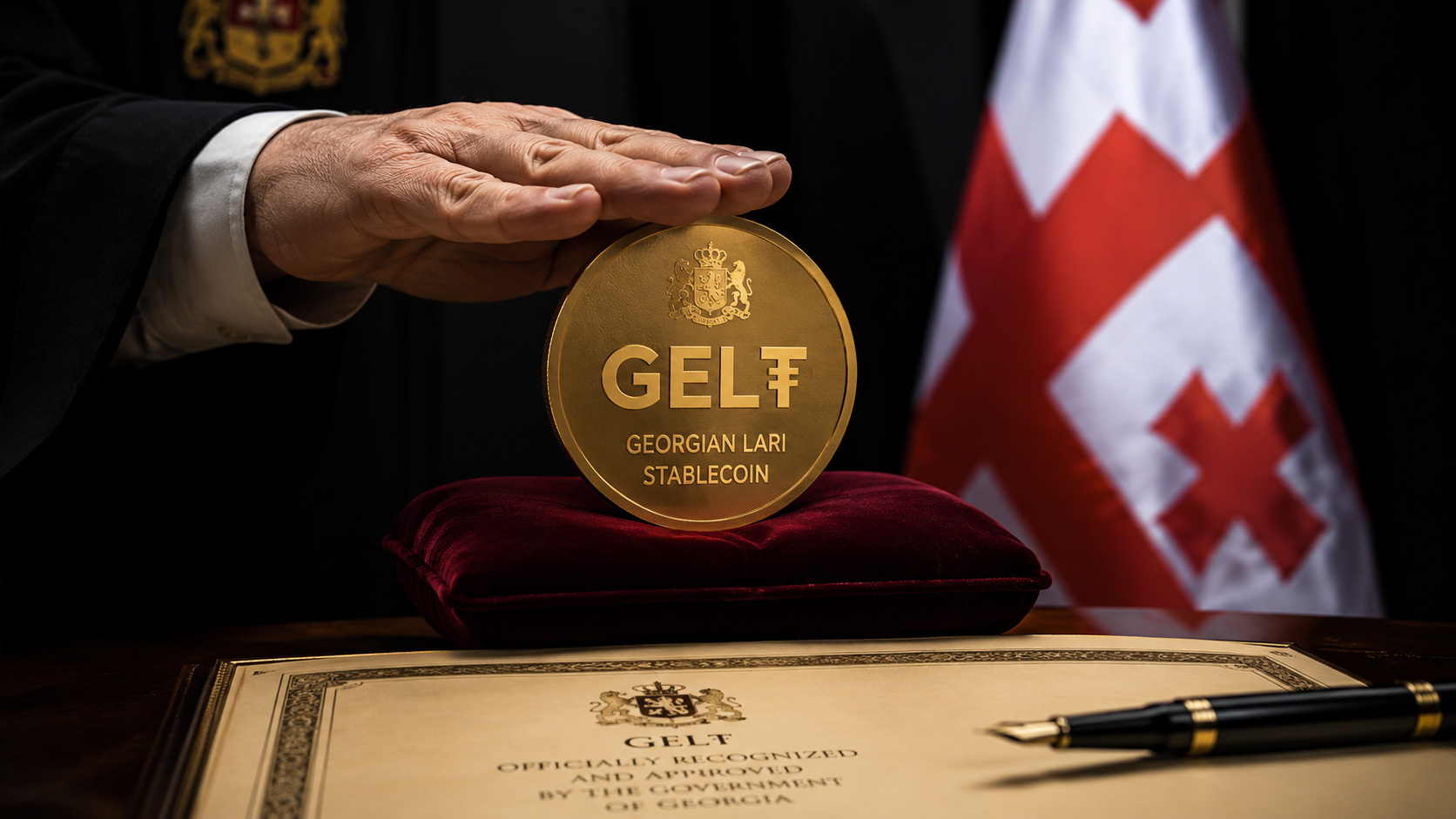
    Tether and the Government of Georgia plan to launch a stablecoin, pushing a national currency directly onto private stablecoin rails before most governments have settled on how that model should work. The Tether Georgia stablecoin plan centers on GEL₮, a stablecoin representing the Georgian lari.

    The May 25 announcement describes GEL₮ as the official stablecoin of Georgia and ties the project to the country’s digital asset framework. It says the token is intended to lower transaction costs, settle near instantly, support programmable payments, and improve cross-border commerce, fintech development, and digital payments.

    That makes the Tether Georgia stablecoin plan larger than a single new token. Georgia is trying to turn lari-denominated value into a payment infrastructure while presenting its rulebook as compatible with the emerging U.S. stablecoin framework created under the GENIUS Act.

    Tether gives the plan scale and distribution credibility, but the announcement leaves the practical architecture unresolved: who issues GEL₮, where the reserves sit, who can redeem, which networks support it, and how far official oversight reaches.
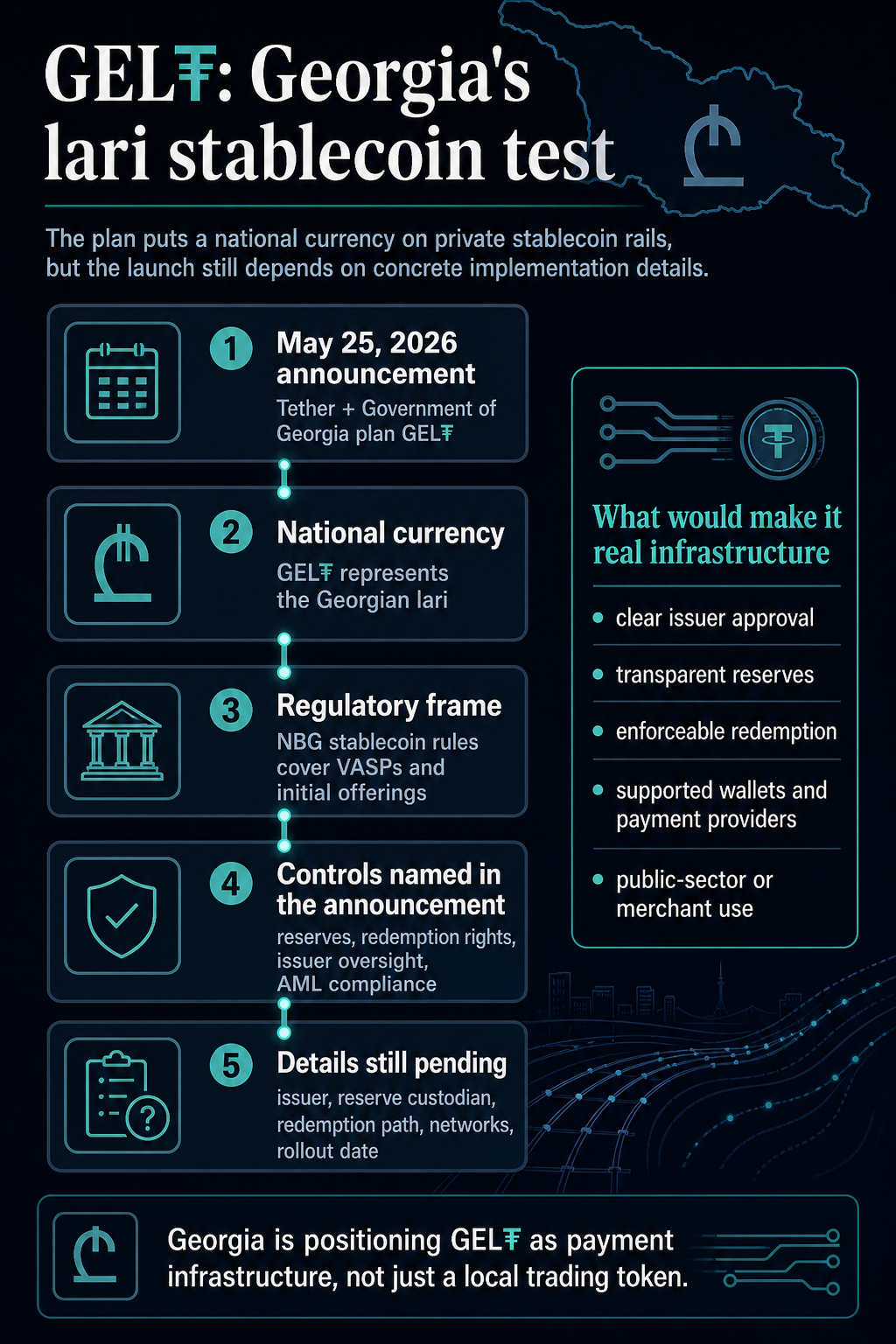
    Infographic showing the Tether Georgia stablecoin GEL₮, also rendered as the GELT stablecoin, as a lari payment rail test.Infographic showing the Tether Georgia stablecoin GEL₮, also rendered as the GELT stablecoin, as a lari payment rail test.

    A national currency on private stablecoin rails

    GEL₮ lands at the intersection of two trends that have mostly developed separately: governments are writing stablecoin rules, while private issuers are building the payment rails people actually use.

    Georgia’s announcement tries to join those tracks. The token is meant to represent the Georgian lari rather than the U.S. dollar, which makes it different from the dominant stablecoin model in crypto markets.

    It also comes with government support, giving it a public-sector policy frame that most local-currency stablecoins lack.

    The National Bank of Georgia had already moved in that direction. In March, the central bank said it had developed a regulation for the initial offering of stable virtual assets as part of a broader effort to strengthen consumer protection, risk management, and alignment with international standards.

    That gives the Georgia stablecoin framework a regulatory anchor alongside Tether’s private infrastructure.

    The underlying rule applies to registered virtual asset service providers that want to offer stablecoins and bars stablecoin initial offerings in Georgia outside the National Bank’s framework.

    The distinction is practical. GEL₮ is being pitched as infrastructure, not just as a trading instrument.

    A stablecoin can promise fast settlement, but it becomes useful only when the legal claim, reserve model, redemption process, and payment access are clear enough for businesses, wallets, exchanges, and payment processors to rely on it.

    For Georgia, the benefit is obvious if the structure works. A lari stablecoin could let domestic fintechs and cross-border businesses move GEL value through blockchain networks without waiting for older bank settlement paths.

    It could also make Georgia a regional test case for how smaller national currencies plug into crypto payment systems without surrendering the entire rails layer to dollar tokens.

    The risk is equally direct. If the token depends too heavily on a private issuer’s infrastructure, users may get speed and reach at the cost of new dependencies around custody, freeze powers, redemption access, chain support, and reserve disclosure.

    Why the Tether Georgia stablecoin plan matters

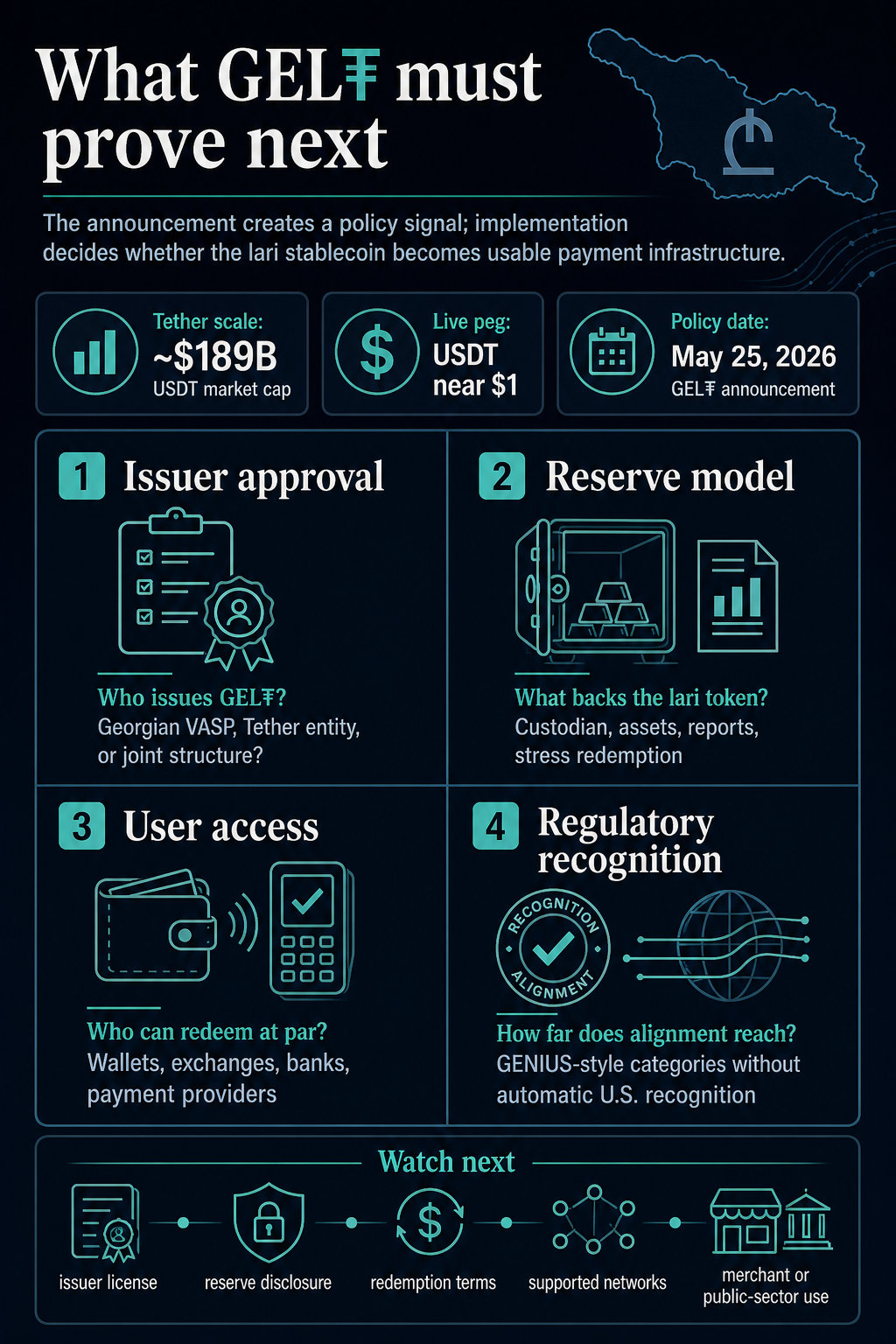
    Tether’s role is the reason this announcement carries more weight than a local pilot. CryptoSlate data lists USDT near $1 on May 25, with roughly $189 billion in market capitalization and tens of billions of dollars in 24-hour volume.

    USDT is also one of crypto’s main liquidity rails for trading pairs, dollar settlement, DeFi liquidity, payments, remittances, and on-chain transfers.
    Tether’s $141 billion Treasury pile reveals the stablecoin risk now embedded in US debtTether’s $141 billion Treasury pile reveals the stablecoin risk now embedded in US debt
    Related Reading

    Tether’s $141 billion Treasury pile reveals the stablecoin risk now embedded in US debt

    Tether’s $141 billion Treasury exposure has turned the world’s largest stablecoin into an unlikely pillar of America’s debt machine.

    May 24, 2026 · Andjela Radmilac

    That scale gives Tether operational experience that a government pilot would struggle to match on its own. Tether already manages tokens across multiple blockchain networks and serves users who treat stablecoins as working payment and settlement tools rather than speculative assets.

    But scale is not the same as public accountability. The same market context lists USDT’s key risk areas as peg stability, reserves, redemption access, issuer controls, regulation, chain-specific transfer risk, and market confidence.

    Those are precisely the categories that become more sensitive when the token is tied to a national currency and backed by government support.

    The announcement says Georgia’s framework was developed with reserve management, redemption rights, issuer oversight, and AML compliance in mind. It also says further details on GEL₮’s structure, rollout, and regulatory implementation will come later.

    Until those details arrive, the project is best understood as a policy-forward launch plan rather than a finished payment system.

    The missing details are not minor technicalities. They define who has the claim on reserves, how quickly holders can redeem at par, whether retail users have direct rights or depend on intermediaries, and how law enforcement or sanctions requests are handled.

    They also define what happens if a supported blockchain becomes congested, compromised, or commercially irrelevant.

    Georgia and Tether are also using the language of regulatory interoperability. The announcement says Georgia’s framework was designed to achieve substantive compatibility with emerging U.S. stablecoin regulation, including the GENIUS Act. Treasury announced the law’s enactment in July 2025.

    That makes GENIUS Act stablecoin regulation a reference point for Georgia’s claim of compatibility, even without formal U.S. recognition,

    CryptoSlate Daily Brief

    Daily signals, zero noise.

    Market-moving headlines and context delivered every morning in one tight read.

    5-minute digest 100k+ readers

    Free. No spam. Unsubscribe any time.

    Whoops, looks like there was a problem. Please try again.

    You’re subscribed. Welcome aboard.

    The Congress.gov text requires permitted payment stablecoin issuers to maintain identifiable reserves backing outstanding payment stablecoins on at least a one-to-one basis with specified liquid assets.

    Treasury’s first GENIUS rule tightens Washington’s grip on who can scale stablecoinsTreasury’s first GENIUS rule tightens Washington’s grip on who can scale stablecoins
    Related Reading

    Treasury’s first GENIUS rule tightens Washington’s grip on who can scale stablecoins

    The proposal leaves states with a narrow lane while pushing large stablecoin issuers toward federal control.

    Apr 2, 2026 · Gino Matos

    Recent U.S. implementation has shifted attention toward issuer qualification, scale, and who controls the terms under which stablecoins can grow. That context is central for Georgia because compatibility is only meaningful if it translates into usable recognition by counterparties, exchanges, banks, and payment providers.

    A Georgian framework can mirror U.S. categories around reserves, redemption, oversight, and compliance without being formally recognized by U.S. authorities.

    The key distinction sits there: Georgia can design for alignment, but market participants will still want to know whether the framework creates enforceable rights and whether foreign counterparties treat GEL₮ as credible payment infrastructure.

    For readers, the practical issue is whether a national-currency stablecoin can give users faster payment rails without making them depend on a weaker legal claim than they would have through regulated bank money.

    Congress on verge of making regulated dollar stablecoins act almost like digital cashCongress on verge of making regulated dollar stablecoins act almost like digital cash
    Related Reading

    Congress on verge of making regulated dollar stablecoins act almost like digital cash

    The GENIUS act has already defined what a legal payment stablecoin looks like. Now lawmakers are trying to make those digital dollars practical to use.

    Apr 18, 2026 · Andjela Radmilac

    Infographic showing the issuer, reserve, user access, and regulatory recognition tests GEL₮ must prove nextInfographic showing the issuer, reserve, user access, and regulatory recognition tests GEL₮ must prove next

    The next test is implementation

    GEL₮ will be judged by the parts of the announcement that remain blank.

    The first is issuance. The National Bank’s stablecoin rule points to registered VASPs and regulator consent, but the announcement does not say which entity will issue GEL₮ or how responsibilities will be divided between Tether, Georgian authorities, and any local partners.

    The second is reserves. If GEL₮ is meant to represent the lari, users and payment firms will need to know what stablecoin reserves back it, where those assets are held, how frequently reserves are reported, and what happens during heavy redemptions.

    The third is access. A stablecoin can settle quickly on-chain, but it still needs reliable entry and exit points.

    Businesses will care which wallets, exchanges, banks, payment processors, and public-sector services support the token. Retail users will care whether they can move from GEL₮ back to lari at par without hidden spreads or institutional-only redemption gates.

    The fourth is legal durability. Tether’s infrastructure can make GEL₮ more immediately useful than a central-bank sandbox token, but it also places a private issuer at the center of a national-currency payment experiment.

    That may be the model stablecoin adoption needs, or it may expose the unresolved tension between public money and private rails.

    Georgia is moving early. That gives it a chance to shape regional stablecoin infrastructure while larger jurisdictions are still turning laws into supervisory systems.

    It also means the burden shifts quickly from announcement to execution.

    If GEL₮ launches with clear issuer approval, transparent reserves, enforceable redemption rights, and real payment access, it could become one of the more important examples of a national currency entering stablecoin circulation through a private global issuer.

    If those details remain vague, the project will say more about the direction governments want to travel than about whether national-currency stablecoins are ready to work at scale.

    Adoption,Banking,Culture,Featured,Legal,Politics,Regulation#Tethers #Georgia #stablecoin #plan #moves #early #national #payment #rails1779742795

    Early Georgia Moves National payment plan Rails Stablecoin Tethers
    Share. Facebook Twitter Pinterest LinkedIn Tumblr Email
    行政
    • Website

    Related Posts

    CFTC may gain broader crypto oversight as staff who questioned major firms were reportedly sidelined

    May 25, 2026

    Bitcoin and Ethereum ETF outflows expose rotation into HYPE, XRP and Solana

    May 25, 2026

    Nasdaq’s Bitcoin options win SEC approval, but Wall Street’s real battle is still ahead

    May 25, 2026

    Vitalik’s smaller Ethereum Foundation tests ETH holders’ demand for execution

    May 25, 2026
    Add A Comment

    Leave A Reply Cancel Reply

    Top Posts

    Millennials Are Quitting Job to Become Day Traders

    January 20, 2021

    Jack Dorsey Says Bitcoin Will Unite The World

    January 15, 2021

    Hong Kong Customs Arrest Four in Crypto Laundering Bust

    January 15, 2021

    Subscribe to Updates

    Get the latest sports news from SportsSite about soccer, football and tennis.

    Advertisement
    Demo

    Your source for the serious news. This demo is crafted specifically to exhibit the use of the theme as a news site. Visit our main page for more demos.

    We're social. Connect with us:

    Facebook Twitter Instagram Pinterest YouTube
    Top Insights

    Tether’s Georgia stablecoin plan moves early on national payment rails

    May 25, 2026

    CFTC may gain broader crypto oversight as staff who questioned major firms were reportedly sidelined

    May 25, 2026

    Bitcoin and Ethereum ETF outflows expose rotation into HYPE, XRP and Solana

    May 25, 2026
    Get Informed

    Subscribe to Updates

    Get the latest creative news from FooBar about art, design and business.

    Facebook Twitter Instagram Pinterest
    • Home
    • Business
    • Markets
    • Technology
    • Contact us
    © 2026 ThemeSphere. Designed by WPfastworld.

    Type above and press Enter to search. Press Esc to cancel.