
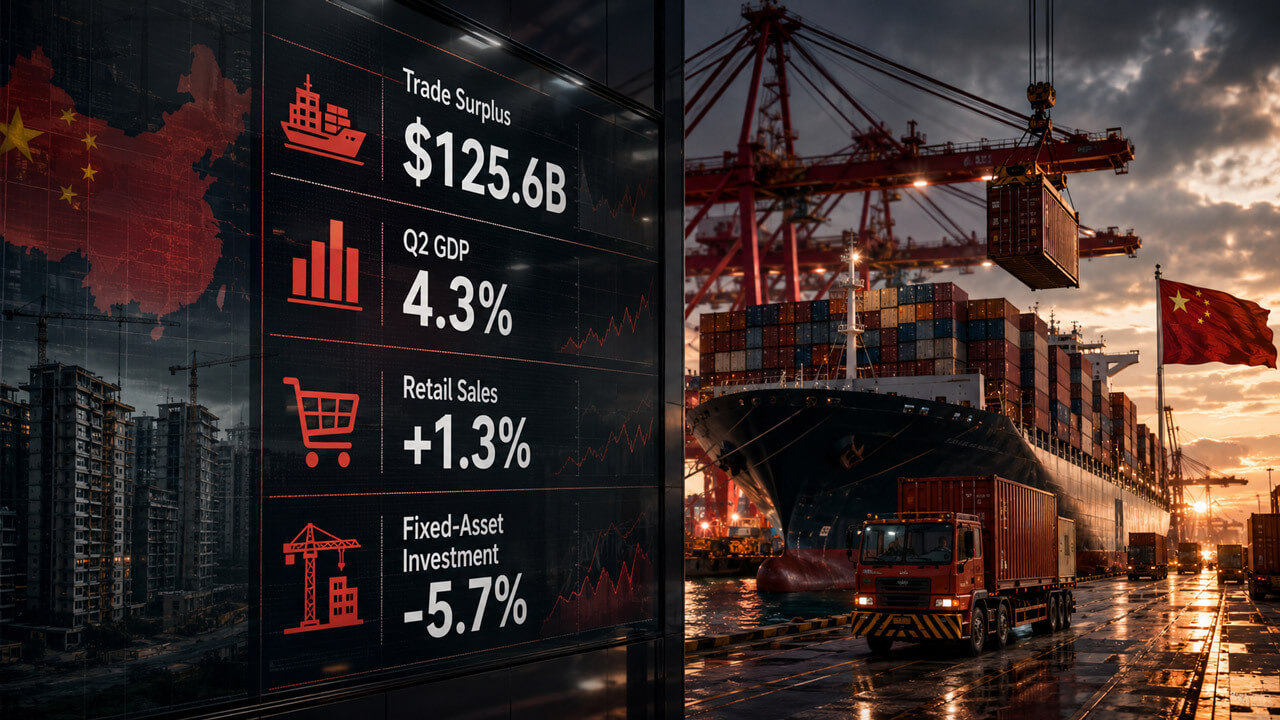

China’s June trade numbers and second-quarter growth numbers looked strong if you look at them one at a time. However, when you put them together, they describe an economy with a very specific problem: factories are still finding buyers abroad, especially for higher-value industrial goods, while demand at home remains too weak to absorb what the country is producing.
That’s how China could post a reported $125.6 billion monthly trade surplus and still deliver a second quarter that disappointed markets. According to the official National Bureau of Statistics release, GDP grew 4.3% year over year in the second quarter, down from 5.0% in the first quarter and below the 4.5% economists had expected. On a quarter-over-quarter basis, growth was just 0.9%.
For a system that still depends heavily on investment, construction, and industrial throughput, that’s a significant loss of momentum.
The State Council’s English-language summary of the official data said June imports and exports rose 24.2% year over year, with exports up 20.8% and imports up 29.4%. Over the first half of the year, total imports and exports reached 25.47 trillion yuan, up 16.9%, while exports rose 13.4%. Mechanical and electrical exports rose 20.1% and accounted for 63.5% of total goods trade. Private enterprises accounted for 57% of total trade, and trade with Belt and Road partners rose 14.8%.
While those are certainly strong numbers, they don’t solve the weakness in the parts of the economy that depend on domestic confidence.
The same official release showed fixed-asset investment down 5.7% in the first half, infrastructure investment down 2.4%, manufacturing investment down 1.2%, and real-estate development investment down 18%. Retail sales rose only 1.3% over the same period. Private investment fell 8.5%. Floor space sold fell 11.6%, and the value of newly built commercial property sales fell 13.6%.
China might be able to sell aggressively to the world, but that doesn’t mean Chinese households, developers, and local governments are ready to spend again.
| What is still growing | Official first-half or June data | What is still weak | Official first-half or Q2 data |
|---|---|---|---|
| Total goods trade in June | +24.2% year over year | Q2 GDP growth | 4.3% year over year |
| Exports in June | +20.8% | Q2 GDP growth, quarter over quarter | 0.9% |
| Imports in June | +29.4% | Fixed-asset investment | -5.7% |
| H1 exports | +13.4% | Infrastructure investment | -2.4% |
| Mechanical and electrical exports | +20.1% | Manufacturing investment | -1.2% |
| Trade with Belt and Road partners | +14.8% | Real estate development investment | -18.0% |
| Share of trade by private enterprises | 57.0% | Private investment | -8.5% |
| Investment in high-tech industries | +4.6% | Retail sales | +1.3% |
This is a dangerous discrepancy for China’s economy because production isn’t the same thing as demand.
GDP doesn’t rise because ports are busy, but when output connects to income, investment, and spending across the economy. Exports can keep factories running, industrial employment stronger than it might otherwise be, and bring foreign earnings into the country. They can’t, on their own, rebuild confidence in a housing market that has been shrinking for years or persuade cautious households to spend more freely.
Property is one of the most important data points here because home prices and sales affect household wealth, land sales affect local government finances, and construction affects demand for steel, cement, machinery, transport, and a wide range of upstream industrial inputs.
When development investment falls 18%, and newly built commercial floor space sold falls 11.6%, the effect quickly spreads well beyond the property sector. It takes no time for consumers to feel poorer and for developers to pull back. This leads to a loss of revenue for local governments, and infrastructure spending becomes harder to sustain.
That helps explain why we saw weak property numbers with weak private investment and soft retail demand. Households that are worried about job security, home values, and the broader direction of the economy tend to spend carefully. Private businesses that are unsure about future demand tend to hold back on expansion.
Local governments that are managing debt pressure have less room to compensate through large infrastructure pushes. Each one of those decisions feeds the others, which is why weak domestic demand can become self-reinforcing.
Exports managed to fill part of that gap. The strongest gains are clustered in higher-value industrial categories rather than broad-based consumer recovery. The official data shows investment in high-tech industries up 4.6%, with especially strong gains in aerospace vehicle and equipment manufacturing, computer and office device manufacturing, and information services.
That’s a healthier mix than the old property-heavy model, and China clearly wants more of it, but it’s still not better than a genuine household-led recovery. A country can ship more advanced equipment abroad while still dealing with weak retail sales, a shrinking property sector, and private firms that remain reluctant to invest at home.
That’s why the trade surplus now looks like a pressure valve. Selling more abroad helps absorb excess industrial output and keeps growth from slowing even faster, but it also shifts the internal imbalance outward. The more China depends on foreign buyers to carry industrial activity, the more exposed it becomes to tariff policy, anti-subsidy cases, and political resistance in export markets that are already wary of Chinese overcapacity.
Beijing can try to stabilize growth with more investment-led stimulus, which would keep the old model going longer and add to debt burdens in a system already struggling with too much property, too much local-government leverage, and too much reliance on industrial supply.
It can move more directly toward household support through income transfers, consumer subsidies, and broader efforts to repair confidence. Or it can accept slower growth while the economy works through the hangover from the property boom and the slow restructuring of local-government finance.
None of those options is easy to implement. More infrastructure and industrial stimulus would support activity in the short run, though it would also risk producing even more supply in an economy already dependent on external demand. Household support would address the demand problem more directly, though it would require a larger break from the investment-first model that has defined Chinese growth for decades.
Doing too little would leave the economy exposed to a longer period of slow internal demand, with growth leaning more and more heavily on exports just as foreign resistance to those exports is building.
That is why investors are now focused on the late-July Politburo meeting, which Reuters has described as the next major moment for policy direction. The market is trying to judge whether Beijing will answer a domestic-demand problem with another round of targeted industrial support, a broader push to stabilize households, or a more restrained posture that tolerates slower growth while debt repair continues.
Premier Li Qiang’s call for stronger counter-cyclical adjustment suggests officials understand the pressure, but he gave no sign as to where the support will go.
China’s own capital controls and restrictions keep most mainland households away from direct crypto speculation, so the effects this could have on the crypto market run through liquidity, the yuan, and global risk appetite.
When China eases aggressively, the effect often reaches the rest of the world through easier financial conditions, stronger growth expectations, and weaker demand for the dollar. CryptoSlate has tracked that before, especially when People’s Bank of China liquidity injections line up with shifts in risk assets. The same framework also helps explain why China’s retreat from US bonds has carried weight with macro traders watching Bitcoin.
If Beijing chooses meaningful support for domestic demand, global investors are likely to read it as another source of liquidity and another argument for a softer dollar at the margin. That usually improves the backdrop for speculative assets, including Bitcoin. If it chooses restraint while export friction rises, the opposite chain becomes easier to imagine. Growth expectations weaken, the yuan comes under pressure, the dollar strengthens, and global financial conditions tighten.
Crypto tends to struggle in that environment before any later discussion of capital flight or currency hedging enters the picture.
The biggest problem isn’t one quarter’s miss but the shape of the recovery China is trying to build. Exports can keep the industrial machine active, and they can even buy time. But they can’t create a durable domestic recovery on their own, because a durable recovery requires households that want to spend, businesses that want to invest, and local governments that are able to support activity without deepening the same debt problems they are already trying to repair.
Until those pieces improve together, every strong trade month will carry the same caveat: China is still producing more confidently than it is consuming.
Analysis,Featured,Macro,Market,beijing,China,exports,imports,slow economy,trade surplusbeijing,China,exports,imports,slow economy,trade surplus#China #billion #escape #valve #economy #running #momentum1784388023
