
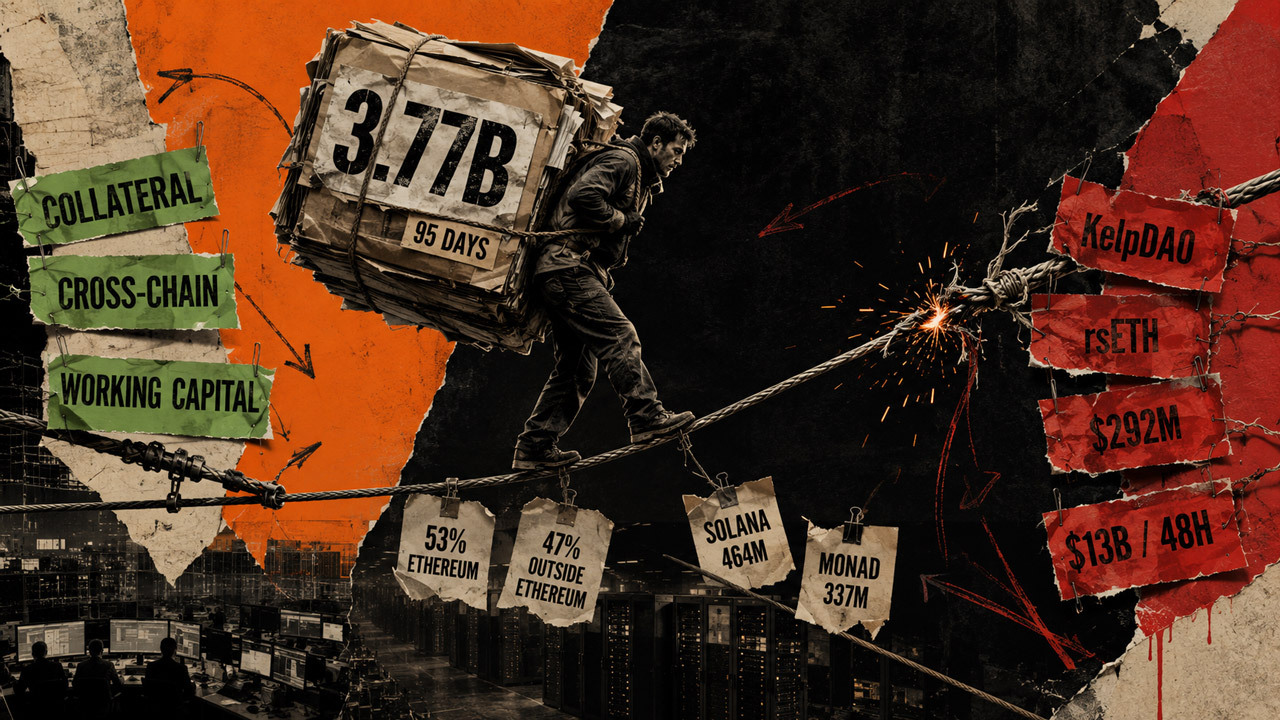

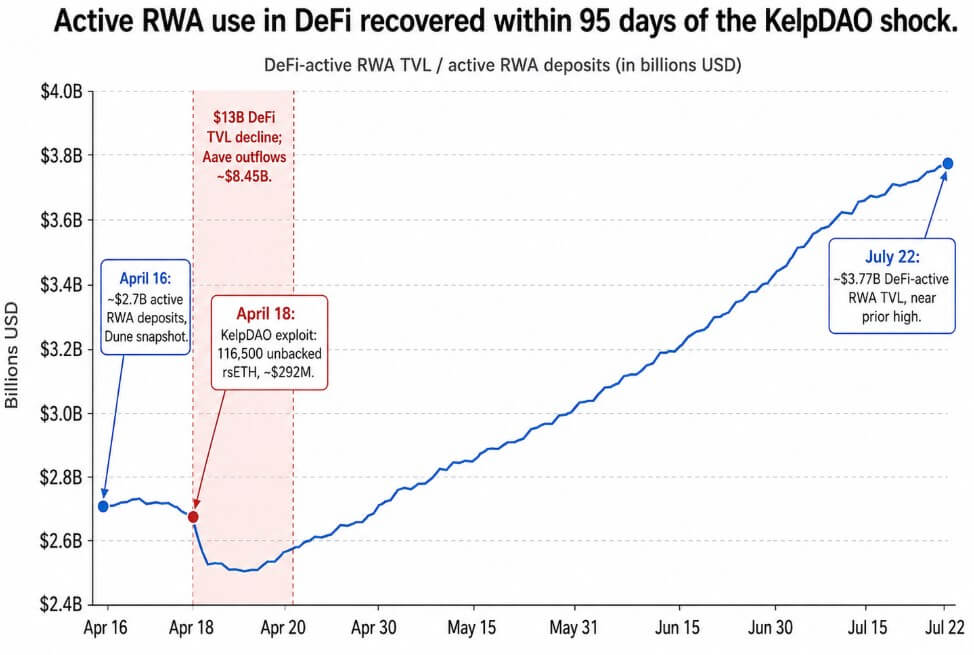
Active use of tokenized real-world assets in DeFi has returned to about $3.77 billion, close to the level visible before an April 18 exploit triggered a $13 billion decline across DeFi as a whole in 48 hours.
DefiLlama’s tracking puts that recovery at roughly 95 days from the shock to July 22.
The failure consisted of a compromised verification setup that let attackers forge a cross-chain message and release roughly 116,500 unbacked rsETH, worth about $292 million, through KelpDAO’s LayerZero multichain infrastructure.
Aave accepted the token as collateral, the attacker borrowed against it, and the resulting run pulled $8.45 billion out of Aave within two days, spreading to lending markets with little or no exposure to rsETH.
Posting a tokenized fund as collateral on Aave, Morpho, or Kamino allows the token to back a loan, supply a vault, or move through a cross-chain strategy, turning a static balance into working capital.
Dune’s own framing describes this as a flywheel: each integration makes an asset more useful, more use draws in capital, and new capital funds further integration. Maple’s syrupUSDC and syrupUSDT are good examples, now deployed across Ethereum, Solana, Monad, Base, Arbitrum, and Plasma.
DefiLlama tracks roughly $51.9 billion in total tokenized RWA value, and only about 7% of it sits inside the active DeFi figure quoted above.
The chains behind the recovery
Ethereum still anchors the recovered market, holding about $1.98 billion, or 53% of the active total. Its balance spreads across syrupUSDC at roughly $415 million, syrupUSDT at about $323 million, gold-backed XAUT near $235 million, reUSD at $157 million, PRIME at $155 million, JAAA at $152 million, and USTB at $134 million.
Roughly 47% of active value now sits outside Ethereum. Even after setting aside Provenance’s unusual $212 million blockchain-native equity position, that non-Ethereum share still runs close to 42%.
Solana holds the most varied non-Ethereum market, with about $464 million active. Reinsurance token ONyc accounts for $166 million, private-credit token PRIME for $144 million, and syrupUSDC for $79 million, alongside tokenized equities such as SPYx, TSLAx, NVDAx, and QQQx serving as collateral through Kamino.
Monad has emerged as a new deployment center, holding about $337 million. Nearly all of it sits in three products: syrupUSDC at $174 million, VUSD private credit at $110 million, and aHYPER’s delta-neutral fund exposure at $46 million.
Avalanche shows how a single institutional allocation can activate a chain: its $261 million in active RWA value comes almost entirely from JAAA, the Janus Henderson CLO fund, deployed through Grove Finance.
Plasma tells a similar concentration story, with about $211 million active and $206 million of that in Maple’s syrupUSDT alone.
| Chain | Active RWA TVL | Share / role | Main assets | Concentration read |
|---|---|---|---|---|
| Ethereum | ~$1.98B | ~53% of active total | syrupUSDC, syrupUSDT, XAUT, reUSD, PRIME, JAAA, USTB | Largest and most diversified base |
| Solana | ~$464M | Largest varied non-Ethereum market | ONyc, PRIME, syrupUSDC, SPYx, TSLAx, NVDAx, QQQx | Diversified across credit, reinsurance, and equities |
| Monad | ~$337M | New deployment center | syrupUSDC, VUSD, aHYPER | Fast-growing but concentrated |
| Avalanche | ~$261M | Institutional allocation case study | JAAA via Grove Finance | Almost entirely one CLO fund |
| Plasma | ~$211M | Concentrated credit venue | syrupUSDT | Almost entirely one Maple asset |
| Other / Provenance-adjusted share | Remaining active TVL | Non-Ethereum total near 47%; ~42% excluding Provenance | Mixed | Shows recovery is broader than Ethereum alone |
Private credit is the largest active category, led by Maple’s two credit tokens alone, which hold about $1.3 billion across every chain that lists them. JAAA adds roughly $412 million in CLO exposure, reinsurance token ONyc and Ethereum’s reUSD together carry over $330 million, and gold-backed XAUT contributes about $235 million.
Tokenized Treasury and money market funds lag behind that pace, with USTB holding about $137 million active and WTGXX about $67 million.
Dune’s April breakdown noted credit made up only 17% of tokenized asset value at the time, and accounted for roughly 80% of DeFi deposits, because higher-yielding collateral supports borrowing and looping strategies that low-yield assets cannot match as easily.
A market can post $3.77 billion in active total value locked (TVL) and still stay thin, concentrated, or hard to exit in a stress event, the exact profile that let one compromised bridge drain markets with no direct exposure to it in April.
LayerZero has since said its verification network will no longer sign as the sole required attestor on any channel, and Aave’s governance coordinated with partners across the market to restore rsETH backing and cover the resulting bad debt.
Those steps close the specific gap the April exploit exposed. Whether the rest of the recovered market’s bridges, wrappers, and collateral lists price cross-chain risk with the same rigor stays unresolved.
The next stress test
In the bull case, lending markets keep tightening collateral standards, RWA issuers spread deployments across more chains and asset types, and active TVL pushes past $4 billion as credit, reinsurance, and equity collateral all expand together.
| Scenario | What happens next | Active RWA TVL range | What it proves |
|---|---|---|---|
| Bull case: composability hardens | Protocols tighten collateral standards, issuers diversify deployments, and credit, reinsurance, and equity collateral expand together | Above $4B | Public chains are becoming durable financial infrastructure, not just tokenization ledgers |
| Base case: recovery holds, concentration remains | Active TVL stays near current levels, but credit and a few large deployments still dominate usage | $3.4B–$4.0B | RWA composability survived the shock, but depth and diversification remain incomplete |
| Bear case: risk reprices | Another bridge, wrapper, or collateral-listing failure forces supply-cap cuts and liquidity exits | $2.5B–$3.2B | Capital still wants RWAs, but not aggressive DeFi composability |
| Stress failure | A major RWA-backed collateral product creates bad debt or redemption stress | Below $2.5B | The market separates tokenized issuance from usable, liquid collateral |
In the bear case, another bridge or collateral-onboarding failure forces protocols to cut supply caps or freeze markets, and active RWA value pulls back toward $2.5 billion to $3.2 billion as capital retreats from aggressive composability strategies.
The market’s composition, how spread out, how liquid, and how carefully underwritten the new $3.77 billion turns out to be, will decide whether the resilience shown in the fast recovery holds the next time a bridge or collateral list fails.
DeFi,Featured,Tokenization#Latest #billion #RWA #recovery #shows #quickly #DeFi #absorbed #KelpDAO #shock1784812626
