

Thailand is proposing a crypto exchange-traded fund (ETF) framework that would give domestic fund managers, the Stock Exchange of Thailand and locally regulated custodians a structural advantage as the country opens the market to Bitcoin and Ethereum products.
On Aug. 24, Thailand’s Securities and Exchange Commission (SEC) opened public comment on rules that would initially allow passive, single-asset funds focused on Bitcoin or Ethereum. Each fund would need to maintain an average net exposure of at least 80% of net asset value to its chosen asset over an accounting year.
The proposed products would enter a market already validated by the success of crypto ETFs in the United States, where funds have attracted more than $60 billion in net inflows since launch.
Bitcoin ETFs dominate with about $54 billion, followed by Ethereum products with roughly $12 billion, while newer crypto ETF offerings account for the balance.
Thailand’s proposal would bring that model onshore while keeping much of the first-wave value chain inside the country.
Local Thai firms would get the first advantage
Locally established crypto ETFs would trade only on the Stock Exchange of Thailand, while their assets would initially need to be held primarily by digital-asset custodians regulated by the Thai SEC.
The proposal does not amount to a ban on foreign crypto products. Mutual and private funds can already invest in overseas crypto ETFs under existing rules, while the SEC is separately consulting on a framework that could eventually allow qualified foreign custodians.
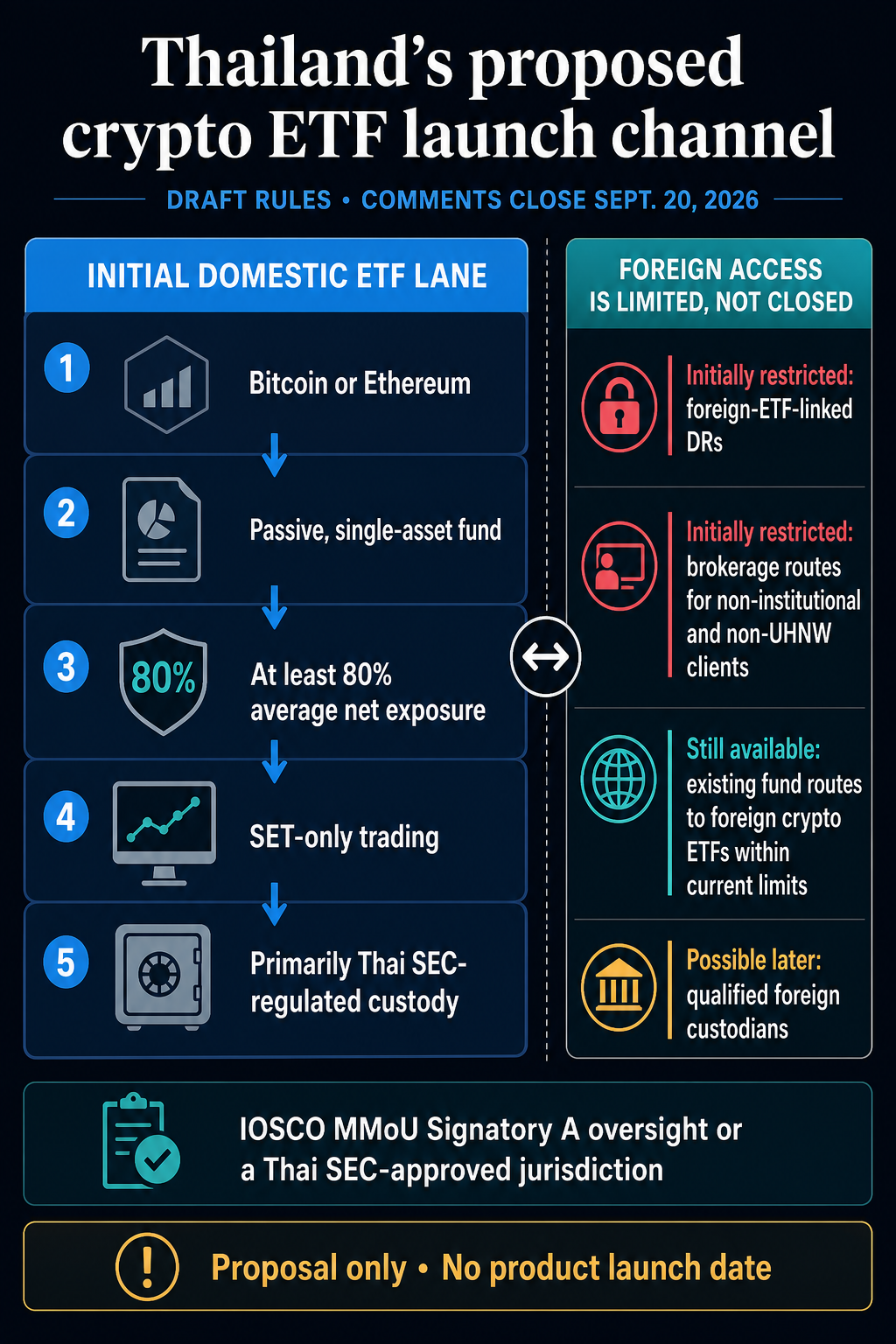
Thailand would also initially restrict some alternative products tied to foreign crypto ETFs, including depositary receipts referencing them and certain securities-company arrangements for customers outside institutional and ultra-high-net-worth categories.
That would make locally domiciled ETFs the most direct retail-facing route under the proposed framework while preserving some existing access to foreign products.
The SEC’s current registry lists Rakkar Digital and Orbix Custodian among licensed custodial wallet providers, while Soberin, Orbix Invest and Merkle are registered digital-asset fund managers. Thailand also has 24 licensed mutual-fund management companies.
Those firms are positioned to compete for roles if the framework is finalized, though the consultation does not identify an ETF applicant, custodian mandate or likely beneficiary.
Investors would also face product-risk education and acknowledgment requirements before trading, while intermediaries would be expected to assess diversification, risk tolerance and financial capacity.
Comments close Sept. 20. The SEC expects related rules to take effect later in 2026, but no ETF launch date has been set.
The proposal therefore opens the door to local Bitcoin and Ethereum ETFs while deliberately centering the initial market around Thai-regulated institutions.
ETF,Featured,TradFi,Bitcoin,BTC,ETH,EtherBitcoin,BTC,ETH,Ether#Thailand #rewriting #stock #exchange #rules #trap #billions #Bitcoin #ETF #wealth #strictly #borders1787781073
