
What's Hot

    The next currency crisis may be harder to contain because of stablecoins

    August 27, 2026

    It just got 25 times easier to move self-custody Bitcoin directly onto Wall Street, and $5 billion already has

    August 27, 2026

    Bitcoin and gold ETFs just pulled a record $7 billion inflow in 5 days

    August 27, 2026
    Facebook Twitter Instagram
    • Business
    • Markets
    • Get In Touch
    • Our Authors
    Facebook Twitter Instagram
    Crypto News: Latest Cryptocurrency News and Analysis
    • Home
    • Business

      Fidelity Buys 7.4% Of Bitcoin Mining Company Marathon Digital Holdings

      February 11, 2021

      Twitter Reacts as Auto Driver Begins Accepting Crypto as Payment

      February 11, 2021

      HSBC Becomes Latest Bank to Suspend Payments to Crypto

      February 4, 2021

      Bitcoin Holds Support; Approaching $50K Resistance

      February 4, 2021

      Cryptocurrency Prices Today: Bitcoin Up Over $47,000, Ether Rises 3%

      February 3, 2021
    • Technology
      1. Business
      2. Insights
      3. View All

      Fidelity Buys 7.4% Of Bitcoin Mining Company Marathon Digital Holdings

      February 11, 2021

      Twitter Reacts as Auto Driver Begins Accepting Crypto as Payment

      February 11, 2021

      HSBC Becomes Latest Bank to Suspend Payments to Crypto

      February 4, 2021

      Bitcoin Holds Support; Approaching $50K Resistance

      February 4, 2021

      The next currency crisis may be harder to contain because of stablecoins

      August 27, 2026

      It just got 25 times easier to move self-custody Bitcoin directly onto Wall Street, and $5 billion already has

      August 27, 2026

      Bitcoin and gold ETFs just pulled a record $7 billion inflow in 5 days

      August 27, 2026

      Solana is up 43% and ETF money is suddenly pouring in

      August 27, 2026

      Bitcoin Climbs as Elon Musk Says Tesla ‘Likely’ to Accept it Again

      March 16, 2021

      Can Cryptocurrency Be Hacked, Stolen Or Scammed? How Can You Be Safe?

      February 11, 2021

      How Investors Can Get In On Crypto Without Actually Buying Any

      February 4, 2021

      Ethereum Just Underwent a Major Change – Hence, The 25% Jump in a Week!

      February 4, 2021
    • Insights
      1. Bitcoin
      2. Ethereum
      3. Eurozone
      4. Monero
      5. View All

      Revolut’s EURR Stablecoin Goes Live in Limited Pilot, Takes Aim at Circle’s EURC

      August 27, 2026

      Most Onchain Activity May Escape Global Reporting Rules

      August 27, 2026

      Bitcoin Eyes $83K Confirmation as Bernstein Bets on $1M by 2033

      August 27, 2026

      Americans Reject Crypto in Retirement Plans as 77% Call It Risky

      August 27, 2026

      The next currency crisis may be harder to contain because of stablecoins

      August 27, 2026

      It just got 25 times easier to move self-custody Bitcoin directly onto Wall Street, and $5 billion already has

      August 27, 2026

      Bitcoin and gold ETFs just pulled a record $7 billion inflow in 5 days

      August 27, 2026

      Solana is up 43% and ETF money is suddenly pouring in

      August 27, 2026

      Ethereum price outlook turns bullish as ETF inflows support $2,800 target

      August 27, 2026

      Pi holds above $0.085 support as crypto market recovery loses momentum

      August 26, 2026

      Bitcoin hits $80k for the first time since May as rally continues

      August 25, 2026

      BTC consolidates near $77,000 as traders take $1.72B in profits

      August 24, 2026

      1804 Dollar Returns in New U.S. Mint Gold and Silver Set

      August 27, 2026

      Race Medal Leads, Morgan and Peace Gain

      August 26, 2026

      U.S. Mint Offers 1776-2026 Constitution Quarter Rolls and Bags

      August 26, 2026

      US Mint Launches First Enhanced Uncirculated Morgan & Peace Dollars

      August 25, 2026

      The next currency crisis may be harder to contain because of stablecoins

      August 27, 2026

      It just got 25 times easier to move self-custody Bitcoin directly onto Wall Street, and $5 billion already has

      August 27, 2026

      Bitcoin and gold ETFs just pulled a record $7 billion inflow in 5 days

      August 27, 2026

      Solana is up 43% and ETF money is suddenly pouring in

      August 27, 2026
    • Markets
    • Get In Touch
    Crypto News: Latest Cryptocurrency News and Analysis
    Home » The next currency crisis may be harder to contain because of stablecoins
    Ethereum

    The next currency crisis may be harder to contain because of stablecoins

    行政By 行政August 27, 2026No Comments6 Mins Read
    Share
    Facebook Twitter LinkedIn Pinterest Email

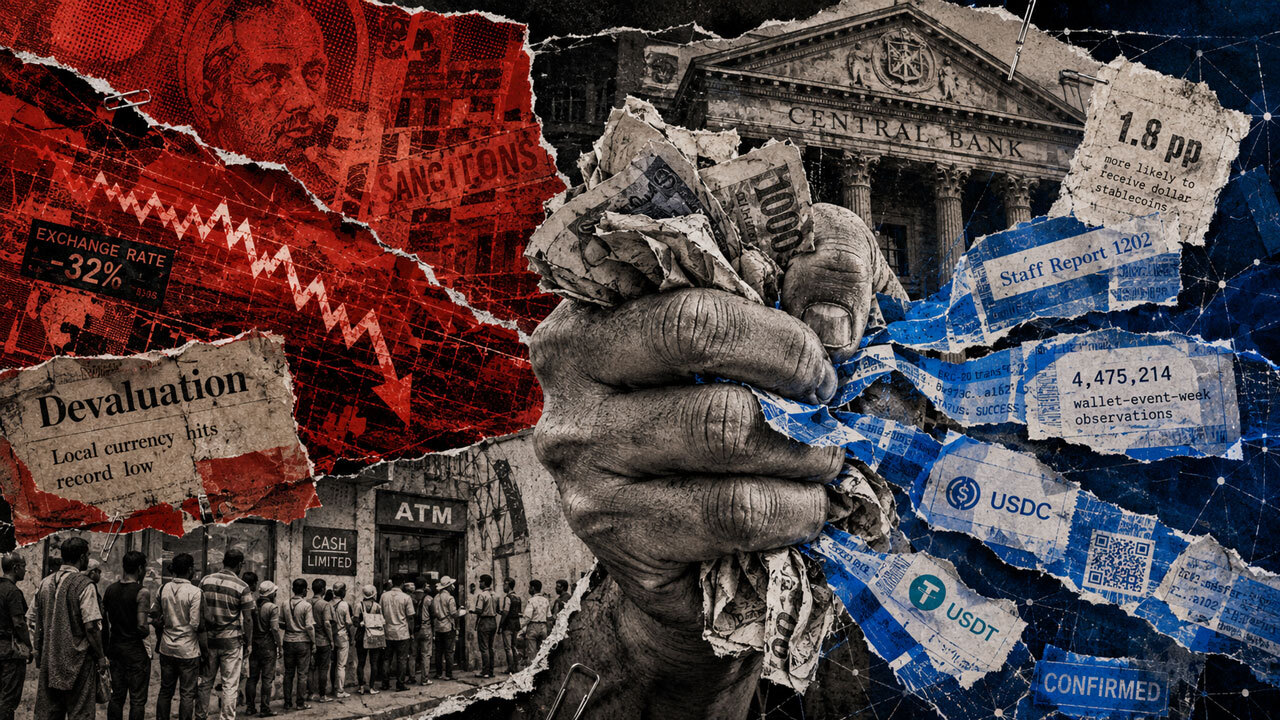
    A New York Federal Reserve study found that dollar stablecoins are more likely to flow into wallets tied to countries experiencing currency or banking crises.

    Wallets linked to countries experiencing some form of financial crisis were 1.8% more likely to receive dollar stablecoins during the week a crisis began, researchers Pablo Azar, Maryam Farboodi and Nish Sinha found in an August staff paper. Receipt volumes of these assets across these wallets also increased significantly during those periods.

    The findings provide evidence for a growing challenge facing central banks in economies under financial stress.

    Governments have traditionally relied on banks and other regulated intermediaries to enforce restrictions on foreign-exchange purchases and cross-border transfers.

    However, the advent of stablecoins has given households and businesses another route to dollar exposure that can operate outside those domestic banking channels.

    The research comes as the stablecoin market has grown beyond $300 billion and is expected to reach the trillions of dollars before the end of the decade. That expansion could make the alternative payment rails identified by the New York Fed increasingly relevant during future currency crises.

    Crisis demand shifts onto blockchain rails

    According to the paper, the researchers studied nine episodes across eight countries between 2021 and 2025, including monetary disruptions, banking restrictions, sanctions and devaluations affecting Argentina, Egypt, Iran, Myanmar, Nigeria, Russia, Turkey and the United Kingdom.

    They linked Ethereum Name Service registrations carrying country signals, such as languages, scripts and national identifiers, with transfer histories for 19 major dollar-pegged stablecoins.

    During crisis weeks, tagged wallets recorded both a higher probability of receiving stablecoins and larger receipt volumes. A separate specification found no significant increase in the two weeks before the shocks, while the probability of receiving stablecoins rose 1.9% during the crisis week.
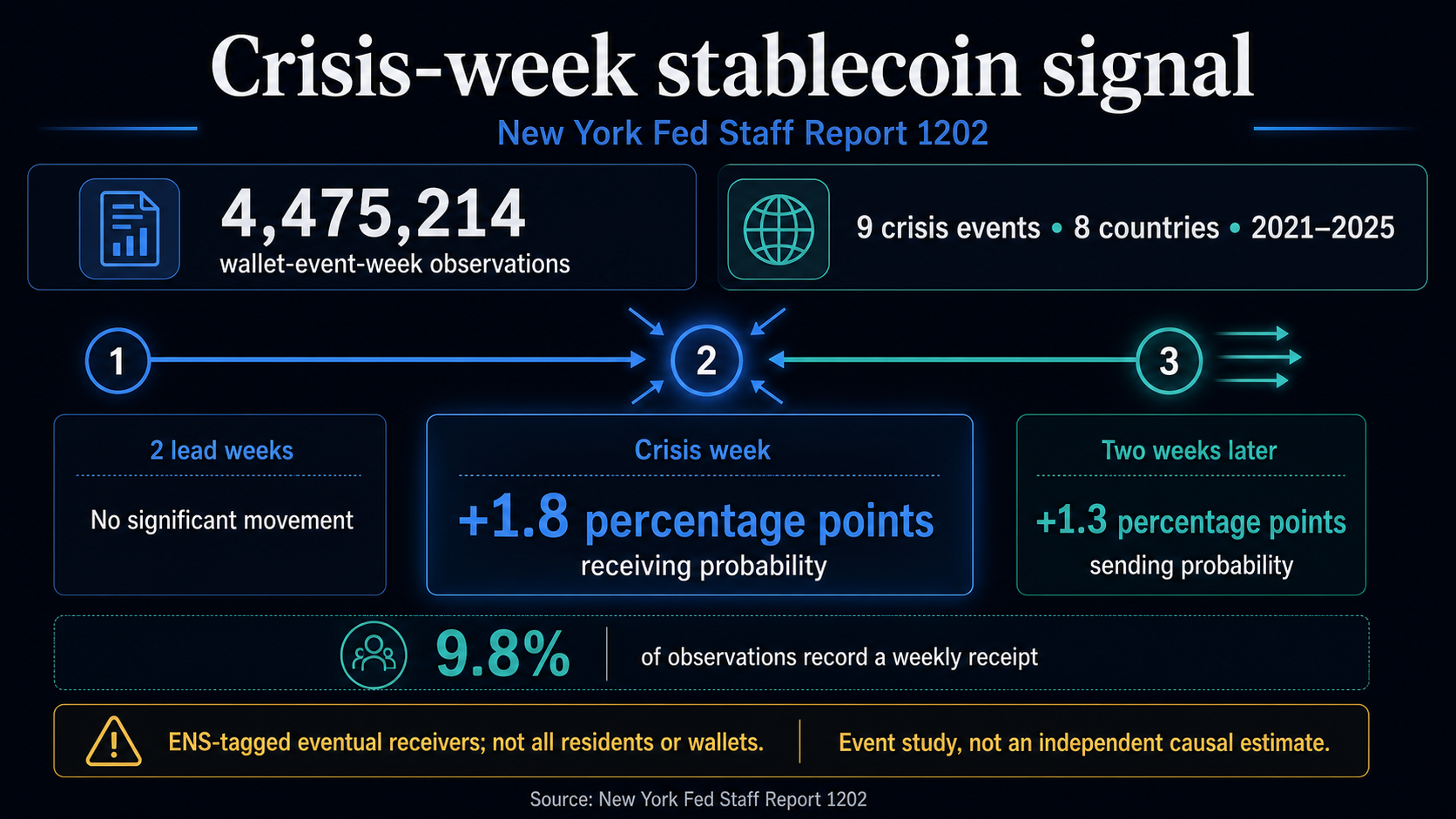
    Infographic showing the New York Fed paper's 4,475,214 wallet-event-week observations and the crisis-week increase in stablecoin receiving probability among ENS-tagged eventual receivers.Infographic showing the New York Fed paper's 4,475,214 wallet-event-week observations and the crisis-week increase in stablecoin receiving probability among ENS-tagged eventual receivers.

    Sending activity increased later, with wallets becoming 1.3% more likely to send stablecoins two weeks after the crisis began.

    The sequence supports the researchers’ argument that demand for blockchain-based dollars rises when confidence in domestic financial arrangements comes under pressure.

    However, these estimates require qualification. The dataset does not represent every resident or crypto wallet in the countries studied. Its roughly 4.5 million observations are wallet-event-week records, and the sample focuses on wallet-country pairs that received stablecoins at some point within a 53-week window around each crisis.

    The result therefore captures a change in behavior among wallets already connected to stablecoin activity rather than showing that stablecoin adoption rose by 1.8% across an entire national population.

    Stablecoins complicate the capital-control playbook

    The behavior feeds directly into a longstanding constraint on monetary policy.

    The Daily Brief

    The signal, before the noise.

    Start your day with the crypto stories moving markets, decoded by CryptoSlate’s editors.

    One email. Everything that matters.

    Free to join. Unsubscribe any time.

    Whoops, looks like there was a problem. Please try again.

    You’re on the list. Your next Daily Brief is on its way.

    Under the Mundell-Fleming framework, countries cannot simultaneously maintain a fixed exchange rate, unrestricted capital mobility, and independent control over domestic interest rates.

    Governments seeking to protect a currency while retaining monetary autonomy can restrict capital movement through banks and other financial institutions.

    The New York Fed researchers model stablecoins as weakening that enforcement channel.

    A household facing restrictions on buying or transferring dollars through its bank may instead receive dollar-denominated tokens into a blockchain wallet. As access to those rails expands, the government must devote more resources to enforcement or allow more of the pressure to emerge through currency depreciation or domestic interest rates.

    The paper does not establish that stablecoins caused particular currencies to weaken during the nine episodes.

    Instead, the observed wallet activity supports the model’s central assumption that financial stress encourages stablecoin adoption. Its broader monetary-policy consequences remain theoretical.

    Governments also retain significant points of control. Major dollar tokens such as USDT and USDC are issued by centralized companies that can freeze addresses, while regulated exchanges can be required to restrict transactions or identify customers.

    Those powers shift enforcement away from a country’s banking system toward a wider network of issuers, exchanges, and blockchain addresses.

    Transfers between self-custodied wallets can leave governments with fewer immediate domestic chokepoints even when issuers retain the ability to intervene at other stages.

    A $300 billion market shifts where governments can’t intervene

    The policy challenge becomes more consequential as stablecoins expand from a niche crypto product into a global dollar-payment network.

    The market has already grown beyond $300 billion and is expected to reach trillions of dollars before the end of the decade.

    Blockchain analysis firm Chainalysis projects an even steeper rise in activity, estimating that adjusted stablecoin transaction volume could reach $719 trillion by 2035 through organic growth alone and approach $1.5 quadrillion if broader macro and adoption trends accelerate usage.

    That growth would increase the number of routes available to households seeking dollar exposure during periods of domestic financial stress, but it would not put stablecoins entirely beyond government reach.

    The largest dollar tokens remain centralized. Issuers such as Circle and Tether can freeze identifiable addresses, while governments can impose requirements on regulated exchanges and other intermediaries even when a transfer initially bypasses the domestic banking system.

    The problem is that enforcement becomes less uniform once tokens move beyond those points.

    Federal Reserve Vice Chair for Supervision Michael Barr warned in June that US stablecoin legislation left an illicit-finance vulnerability around secondary-market transfers involving unhosted wallets.

    The Bank for International Settlements has identified a similar problem for monetary policy, arguing that stablecoin dollarization can threaten monetary sovereignty while restrictions may prove less effective when bearer-like tokens circulate through self-custodied wallets.

    That creates a more fragmented enforcement map. Governments can exert substantial control over banks, stablecoin issuers and regulated trading venues, but may have less visibility or immediate reach when dollar tokens move between private wallets without returning to those intermediaries.

    The distinction becomes particularly important during a currency crisis, when demand for an alternative store of value and payment rail can rise just as authorities try to restrict capital movement.

    The New York Fed paper suggests that this choice of financial infrastructure is becoming part of the macroeconomic constraint itself. As stablecoin networks grow, effective capital mobility increasingly depends on both the controls governments impose and the blockchain rails households can still access.

    At the scale projected for the next decade, that could turn stablecoins from an alternative payment mechanism into a material constraint on how governments defend currencies during periods of financial stress.

    Featured,Macro,Payments,Stablecoins,Technology,Circle,ethereum,ethereum name service,payments,stablecoins,Tether,USDC,USDTCircle,ethereum,ethereum name service,payments,stablecoins,Tether,USDC,USDT#currency #crisis #harder #stablecoins1787868912

    Circle crisis currency Ethereum ethereum name service harder Payments stablecoins Tether USDC USDT
    Share. Facebook Twitter Pinterest LinkedIn Tumblr Email
    行政
    • Website

    Related Posts

    It just got 25 times easier to move self-custody Bitcoin directly onto Wall Street, and $5 billion already has

    August 27, 2026

    Bitcoin and gold ETFs just pulled a record $7 billion inflow in 5 days

    August 27, 2026

    Solana is up 43% and ETF money is suddenly pouring in

    August 27, 2026

    Bitcoin’s bottom signal is flashing, but six months of data shows a trap waiting for early buyers

    August 27, 2026
    Add A Comment

    Leave A Reply Cancel Reply

    Top Posts

    Millennials Are Quitting Job to Become Day Traders

    January 20, 2021

    Jack Dorsey Says Bitcoin Will Unite The World

    January 15, 2021

    Hong Kong Customs Arrest Four in Crypto Laundering Bust

    January 15, 2021

    Subscribe to Updates

    Get the latest sports news from SportsSite about soccer, football and tennis.

    Advertisement
    Demo

    Your source for the serious news. This demo is crafted specifically to exhibit the use of the theme as a news site. Visit our main page for more demos.

    We're social. Connect with us:

    Facebook Twitter Instagram Pinterest YouTube
    Top Insights

    The next currency crisis may be harder to contain because of stablecoins

    August 27, 2026

    It just got 25 times easier to move self-custody Bitcoin directly onto Wall Street, and $5 billion already has

    August 27, 2026

    Bitcoin and gold ETFs just pulled a record $7 billion inflow in 5 days

    August 27, 2026
    Get Informed

    Subscribe to Updates

    Get the latest creative news from FooBar about art, design and business.

    Facebook Twitter Instagram Pinterest
    • Home
    • Business
    • Markets
    • Technology
    • Contact us
    © 2026 ThemeSphere. Designed by WPfastworld.
    • Easterngifts
    • koreanbj
    • korean bj porn​
    • korean bj nude

    Type above and press Enter to search. Press Esc to cancel.