

What's Hot

    Ethereum’s plan to triple network speed could silently break millions of existing smart contracts

    August 28, 2026

    Ethereum and Solana are hosting trillions in dollar volume, yet their native tokens risk losing direct consumer demand

    August 28, 2026

    HashKey Cloud backs Stacks’ Genesis Bond to prove institutional appetite for native Bitcoin yield

    August 28, 2026
    Facebook Twitter Instagram
    • Business
    • Markets
    • Get In Touch
    • Our Authors
    Facebook Twitter Instagram
    Crypto News: Latest Cryptocurrency News and Analysis
    • Home
    • Business

      Fidelity Buys 7.4% Of Bitcoin Mining Company Marathon Digital Holdings

      February 11, 2021

      Twitter Reacts as Auto Driver Begins Accepting Crypto as Payment

      February 11, 2021

      HSBC Becomes Latest Bank to Suspend Payments to Crypto

      February 4, 2021

      Bitcoin Holds Support; Approaching $50K Resistance

      February 4, 2021

      Cryptocurrency Prices Today: Bitcoin Up Over $47,000, Ether Rises 3%

      February 3, 2021
    • Technology
      1. Business
      2. Insights
      3. View All

      Fidelity Buys 7.4% Of Bitcoin Mining Company Marathon Digital Holdings

      February 11, 2021

      Twitter Reacts as Auto Driver Begins Accepting Crypto as Payment

      February 11, 2021

      HSBC Becomes Latest Bank to Suspend Payments to Crypto

      February 4, 2021

      Bitcoin Holds Support; Approaching $50K Resistance

      February 4, 2021

      Ethereum’s plan to triple network speed could silently break millions of existing smart contracts

      August 28, 2026

      Ethereum and Solana are hosting trillions in dollar volume, yet their native tokens risk losing direct consumer demand

      August 28, 2026

      HashKey Cloud backs Stacks’ Genesis Bond to prove institutional appetite for native Bitcoin yield

      August 28, 2026

      This new KuCoin rule could block your crypto transfer

      August 28, 2026

      Bitcoin Climbs as Elon Musk Says Tesla ‘Likely’ to Accept it Again

      March 16, 2021

      Can Cryptocurrency Be Hacked, Stolen Or Scammed? How Can You Be Safe?

      February 11, 2021

      How Investors Can Get In On Crypto Without Actually Buying Any

      February 4, 2021

      Ethereum Just Underwent a Major Change – Hence, The 25% Jump in a Week!

      February 4, 2021
    • Insights
      1. Bitcoin
      2. Ethereum
      3. Eurozone
      4. Monero
      5. View All

      Revolut’s EURR Stablecoin Goes Live in Limited Pilot, Takes Aim at Circle’s EURC

      August 27, 2026

      Most Onchain Activity May Escape Global Reporting Rules

      August 27, 2026

      Bitcoin Eyes $83K Confirmation as Bernstein Bets on $1M by 2033

      August 27, 2026

      Americans Reject Crypto in Retirement Plans as 77% Call It Risky

      August 27, 2026

      Ethereum’s plan to triple network speed could silently break millions of existing smart contracts

      August 28, 2026

      Ethereum and Solana are hosting trillions in dollar volume, yet their native tokens risk losing direct consumer demand

      August 28, 2026

      HashKey Cloud backs Stacks’ Genesis Bond to prove institutional appetite for native Bitcoin yield

      August 28, 2026

      This new KuCoin rule could block your crypto transfer

      August 28, 2026

      Ethereum price outlook turns bullish as ETF inflows support $2,800 target

      August 27, 2026

      Pi holds above $0.085 support as crypto market recovery loses momentum

      August 26, 2026

      Bitcoin hits $80k for the first time since May as rally continues

      August 25, 2026

      BTC consolidates near $77,000 as traders take $1.72B in profits

      August 24, 2026

      1804 Dollar Returns in New U.S. Mint Gold and Silver Set

      August 27, 2026

      Race Medal Leads, Morgan and Peace Gain

      August 26, 2026

      U.S. Mint Offers 1776-2026 Constitution Quarter Rolls and Bags

      August 26, 2026

      US Mint Launches First Enhanced Uncirculated Morgan & Peace Dollars

      August 25, 2026

      Ethereum’s plan to triple network speed could silently break millions of existing smart contracts

      August 28, 2026

      Ethereum and Solana are hosting trillions in dollar volume, yet their native tokens risk losing direct consumer demand

      August 28, 2026

      HashKey Cloud backs Stacks’ Genesis Bond to prove institutional appetite for native Bitcoin yield

      August 28, 2026

      This new KuCoin rule could block your crypto transfer

      August 28, 2026
    • Markets
    • Get In Touch
    Crypto News: Latest Cryptocurrency News and Analysis
    Home » Ethereum’s plan to triple network speed could silently break millions of existing smart contracts
    Ethereum

    Ethereum’s plan to triple network speed could silently break millions of existing smart contracts

    行政By 行政August 28, 2026No Comments6 Mins Read
    Share
    Facebook Twitter LinkedIn Pinterest Email

    Ethereum’s next attempt to expand base-layer throughput includes contracts and transactions that create persistent state, which would cost far more gas for new accounts, storage slots, and deployed bytecode.

    The Ethereum Foundation said the candidate Glamsterdam schedule is designed to support roughly three times more base throughput by aligning gas charges with the network resources each operation consumes.

    The two proposals are scheduled for Glamsterdam, yet EIP-8037 and EIP-8038 both retain formal Review status. Ethereum’s official roadmap plans the upgrade for the fourth quarter of 2026, with fixed Sepolia, Hoodi, and mainnet fork dates still unannounced.

    That leaves builders a testing window before the candidate parameters and deployment schedule harden.

    Higher throughput moves the bill to state creation

    Every new account, storage slot, and byte of contract code expands the persistent state that nodes retain and serve. EIP-8037 says the state portion of a Geth database was about 390 GiB in January 2026.

    After Ethereum’s gas limit rose from 30 million to 60 million, average new state created each day increased from roughly 105 MiB to 326 MiB, an annual pace of about 116 GiB.

    The proposal takes that post-increase rate and scales it proportionally to a deliberately severe 200 million gas-limit scenario. The result is roughly 387 GiB of annual growth, enough to cross a cited 650 GiB performance threshold within a year from the 390 GiB starting point.

    The EIP describes the earlier 30 million-to-60 million response as non-linear, making 387 GiB a motivating extrapolation rather than a measured forecast.

    Its proposed control is a common cost of 1,530 gas for every byte of new state and a separate state-gas dimension. At a reference block limit of 150 million, that parameter targets average growth of 120 GiB a year.

    The proposal lists 160 GiB a year as the worst case at a 200 million limit after repricing.

    State-creation operation Current charge Candidate state-gas charge
    Create a new account 25,000 183,600
    Create a new storage slot 20,000 97,920
    Deploy 24 KiB of code plus a new account 4,947,200 37,784,880

    At the transaction level, users pay for both execution and state gas. The split preserves room for computational work while placing a separate ceiling on permanent additions to network state.

    EIP-8038 tackles access to and writes of existing state, raising selected account and storage costs from client benchmarks conducted against a state snapshot comparable to mainnet in March 2026.

    Together, the proposals use the roughly threefold throughput figure as an engineering support target. Activation would create headroom for higher limits rather than guarantee an immediate tripling of mainnet capacity.

    Related Reading

    Ethereum’s 2026 roadmap includes this validator risk that’s bigger than you think

    A 929.7 million-transaction replay separates higher-limit fixes from code changes

    The public repricing impact dashboard covers 929,731,274 transactions in 4 million blocks from Dec. 3, 2024, through June 15, 2026.

    Each transaction was replayed independently against its canonical pre-transaction state under the existing schedule and one candidate schedule. Researchers first used the transaction’s original gas limit, then allowed a ceiling up to 10 times that limit.

    The comparison covered success, gas consumption, logs, output, and execution traces.

    The Daily Brief

    The signal, before the noise.

    Start your day with the crypto stories moving markets, decoded by CryptoSlate’s editors.

    One email. Everything that matters.

    Free to join. Unsubscribe any time.

    Whoops, looks like there was a problem. Please try again.

    You’re on the list. Your next Daily Brief is on its way.

    Under EIP-8037, 174,473,898 transaction replays failed at their original limit but succeeded with more gas, while 2,687,652 entered the potentially broken group. Under EIP-8038, 84,708,228 were fixable with a higher limit, and 3,036,537 were potentially broken.

    Repeated activity from a busy application can dominate the count, so the figures do not describe millions of separate contracts at risk.
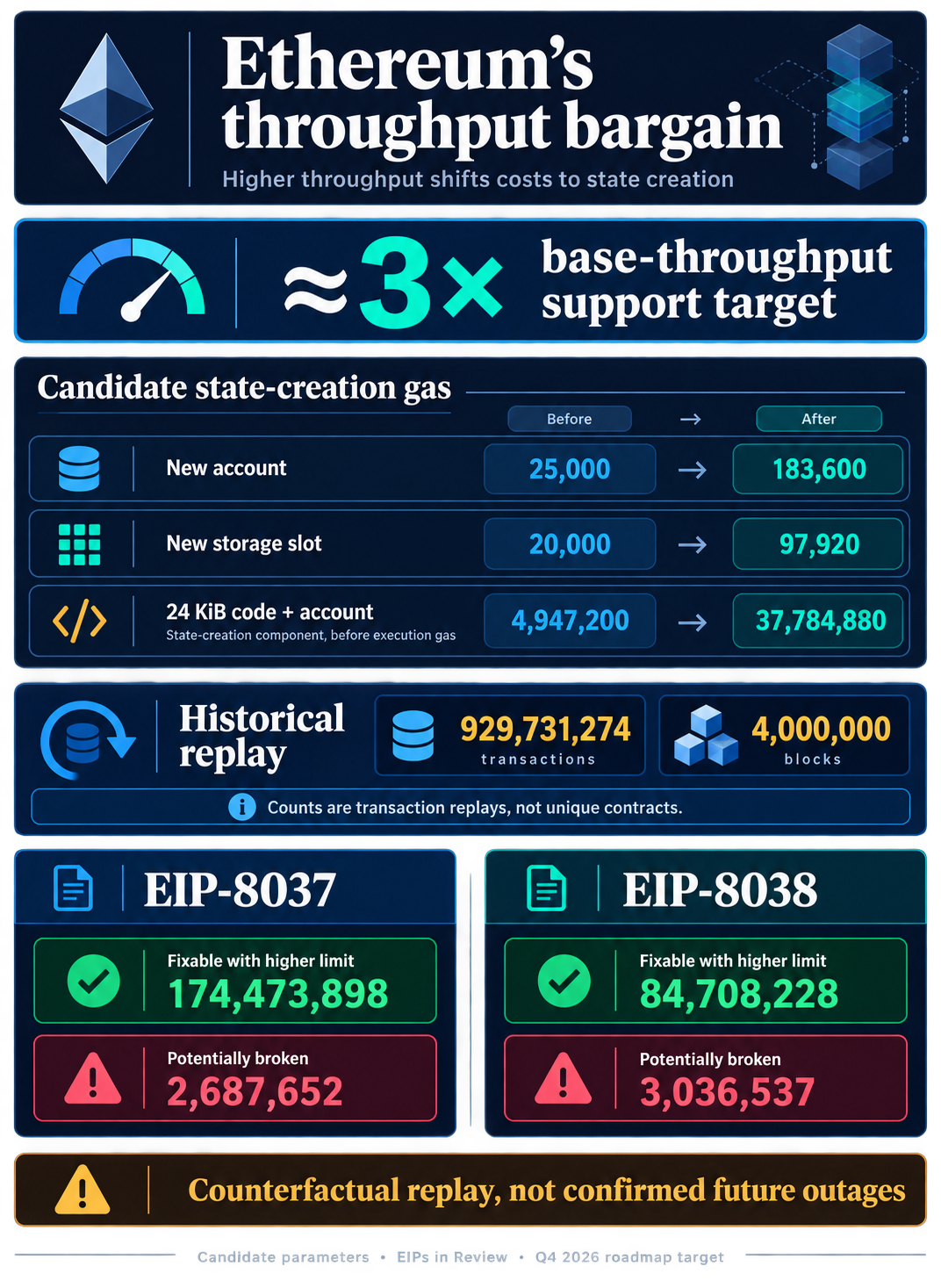
    Infographic comparing Ethereum Glamsterdam candidate state-creation gas charges and EIP-8037 and EIP-8038 historical replay results.Infographic comparing Ethereum Glamsterdam candidate state-creation gas charges and EIP-8037 and EIP-8038 historical replay results.
    Ethereum’s proposed throughput boost raises state-creation gas costs, while EIP-8037 and EIP-8038 remain within higher gas limits under replay testing.

    The dashboard defines potentially broken as a baseline-successful transaction that the candidate schedule failed to rescue at the tested 10-times ceiling.

    That group includes out-of-gas cases and transactions that reverted for another reason after the new costs changed execution behavior. It is a counterfactual risk classification: users, wallets, contracts, builders, and fee markets can adapt before mainnet.

    The much larger fixable cohort chiefly shifts work to frontends, bundlers and infrastructure providers, which must submit limits that reflect the new schedule. The harder cohort exposes assumptions that more top-level gas cannot cure, including fixed 2,300-gas stipends, hardcoded gas forwarded to internal calls, logic that branches on gasleft() and presigned transactions with fixed limits.

    A public outreach report prioritizes versions of the eth-infinitism ERC-4337 EntryPoint and related smart-account stacks, including ZeroDev and Alchemy. It also identifies recurring counterfactual failures involving Across, Socket/Bungee, CoW Protocol, and 0x.

    Immutable contracts make the toughest cases operationally expensive. A durable response can require a new EntryPoint, account, factory, or validator implementation followed by user migration. Other systems may be repaired through routing, batching, or gas-accounting changes.

    ERC-4337 bundlers also need to distinguish the two classes: better simulation and higher submitted limits can resolve fixable failures, while a validation guard or internal gas assumption still reverts when the outer transaction receives more gas.

    Who must update before Glamsterdam

    Wallets, RPC providers, indexers, node tooling, and gas estimators must incorporate the new rules, while frontends and bundlers need to stop relying on cached constants or limits calibrated to the old schedule.

    Both EIPs require eth_estimateGas and related logic to account for the new costs. The Platåberget testnet announcement also warns that tools built around a hardcoded maximum gas limit or a single gas dimension will break.

    A plain ETH transfer to an existing account can still use 21,000 gas. Sending value to an account that does not yet exist adds a state-creation charge at runtime, so software that assumes every transfer fits the old constant needs revision.

    Regular users can keep familiar workflows if wallets and infrastructure update correctly. Meanwhile, developers carry the immediate burden of resimulating transactions, reviewing fixed stipends and internal call limits, and testing affected paths against the candidate schedule.

    The Glamsterdam fork was scheduled for Aug. 20 and was reported live with the repricing schedule by Aug. 24. The published sequence moves from stable devnets to the long-lived Sepolia and Hoodi public testnets, then to mainnet, with the 2026 roadmap target still subject to testing.

    Ethereum can price its way toward more throughput, but builders that encoded yesterday’s gas assumptions now have a limited window to prove their contracts and tools can survive tomorrow’s schedule.

    Featured,Governance,Technology,Wallets,ethereum,Ethereum foundation,regulationethereum,Ethereum foundation,regulation#Ethereums #plan #triple #network #speed #silently #break #millions #existing #smart #contracts1787894532

    break Contracts Ethereum Ethereum foundation Ethereums existing millions network plan regulation silently smart speed Triple
    Share. Facebook Twitter Pinterest LinkedIn Tumblr Email
    行政
    • Website

    Related Posts

    Ethereum and Solana are hosting trillions in dollar volume, yet their native tokens risk losing direct consumer demand

    August 28, 2026

    HashKey Cloud backs Stacks’ Genesis Bond to prove institutional appetite for native Bitcoin yield

    August 28, 2026

    This new KuCoin rule could block your crypto transfer

    August 28, 2026

    How Bitcoin just proved it could survive a quantum attack

    August 27, 2026
    Add A Comment

    Leave A Reply Cancel Reply

    Top Posts

    Millennials Are Quitting Job to Become Day Traders

    January 20, 2021

    Jack Dorsey Says Bitcoin Will Unite The World

    January 15, 2021

    Hong Kong Customs Arrest Four in Crypto Laundering Bust

    January 15, 2021

    Subscribe to Updates

    Get the latest sports news from SportsSite about soccer, football and tennis.

    Advertisement
    Demo

    Your source for the serious news. This demo is crafted specifically to exhibit the use of the theme as a news site. Visit our main page for more demos.

    We're social. Connect with us:

    Facebook Twitter Instagram Pinterest YouTube
    Top Insights

    Ethereum’s plan to triple network speed could silently break millions of existing smart contracts

    August 28, 2026

    Ethereum and Solana are hosting trillions in dollar volume, yet their native tokens risk losing direct consumer demand

    August 28, 2026

    HashKey Cloud backs Stacks’ Genesis Bond to prove institutional appetite for native Bitcoin yield

    August 28, 2026
    Get Informed

    Subscribe to Updates

    Get the latest creative news from FooBar about art, design and business.

    Facebook Twitter Instagram Pinterest
    • Home
    • Business
    • Markets
    • Technology
    • Contact us
    © 2026 ThemeSphere. Designed by WPfastworld.
    • Easterngifts
    • koreanbj
    • korean bj porn​
    • korean bj nude

    Type above and press Enter to search. Press Esc to cancel.