

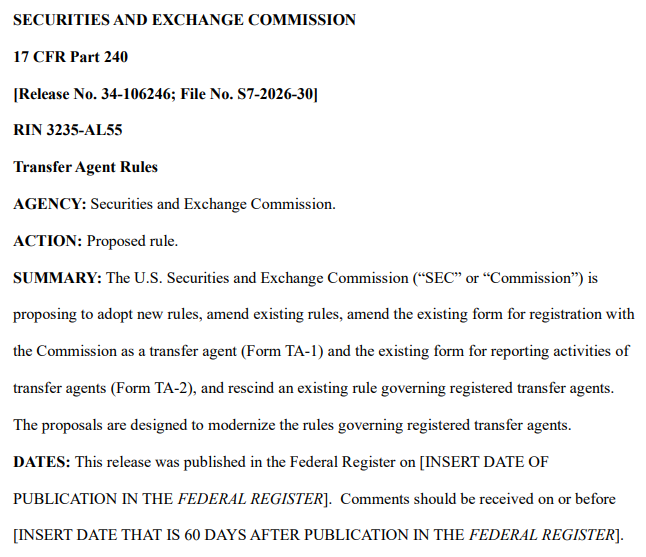
- The SEC has proposed updating transfer agent rules that largely date back to the late 1970s and early 1980s.
- The changes would tighten requirements around registration, recordkeeping, safeguarding assets, reporting and third-party providers.
- The proposal addresses risks and new practices linked to onchain transfer agents, tokenised securities, distributed ledgers and AI.
- The move forms part of a broader SEC modernisation push, with public comments due 60 days after publication in the Federal Register.
Some of the rules governing who legally owns US investors’ shares haven’t been touched since Jimmy Carter was in office. On Tuesday, the US Securities and Exchange Commission (SEC) proposed changing that.
Transfer agents are the unglamorous plumbing of the securities market – they track who owns what, process dividends and mergers, and help clear and settle trades. The rules they operate under date to the late 1970s and early 1980s. The SEC says that framework doesn’t reflect what these firms actually do anymore, and it’s not hard to see why: back then, nobody was thinking about tokenised funds or smart contracts.
The proposal touches registration, recordkeeping, and how agents safeguard securities and investor records. It also rescinds a 1977 exemption that let limited partnership interests and fund shares skirt some of these requirements. Agents will face heavier reporting obligations too, including around restrictive legends and their use of third-party vendors.
SEC Chair Paul Atkins framed it as a catch-up exercise, aligning the rules with electronic communications and blockchain tech that’s already in use for securities offerings and share transfers.
Read more: Hyperliquid Policy Center Calls for Clearer U.S. Rules on Perpetuals
Onchain Agents Are Already a Thing
The SEC flagged growing interest in blockchain-native, or “onchain”, transfer agents. Firms are testing distributed ledgers for ownership records and experimenting with tokenised funds, while cross-chain activity is also emerging.
The agency warned that the current rules don’t adequately cover the risks involved, including data integrity on distributed ledgers, the safeguarding of tokenised assets and whether decentralised infrastructure can withstand operational stress.
AI is also on the SEC’s radar, both as a tool transfer agents may use and as a technology regulators need to scrutinise to ensure firms aren’t overstating their capabilities.
Injective recently became an SEC-registered transfer agent, joining Securitize and tZERO in building regulated infrastructure for tokenised securities. The proposal would bring the rules more closely in line with technology and practices that are already emerging in the market.
Part Of a Bigger Housecleaning
The transfer agent proposal is one piece of a broader modernisation push. The SEC has also proposed changes to public company reporting and sent a separate custody rule overhaul – covering how advisers and funds hold digital assets – to the White House for review.
As Jamie Selway, Director of the SEC’s Division of Trading and Markets, put it: “Good government requires revisiting legacy rules and regulations.”
Public comments are due 60 days after the proposal hits the Federal Register. Commissioner Hester Peirce backed it before her expected exit from the agency and says she’ll keep pushing for it from the outside.
Read also: Ripple Prepares XRP Ledger for a Post-Quantum Future
Blockchain,SEC,Tokenisation#SEC #Moves #Modernise #Transfer #Agent #Rules #Blockchain #Tokenised #Securities1788337633
