
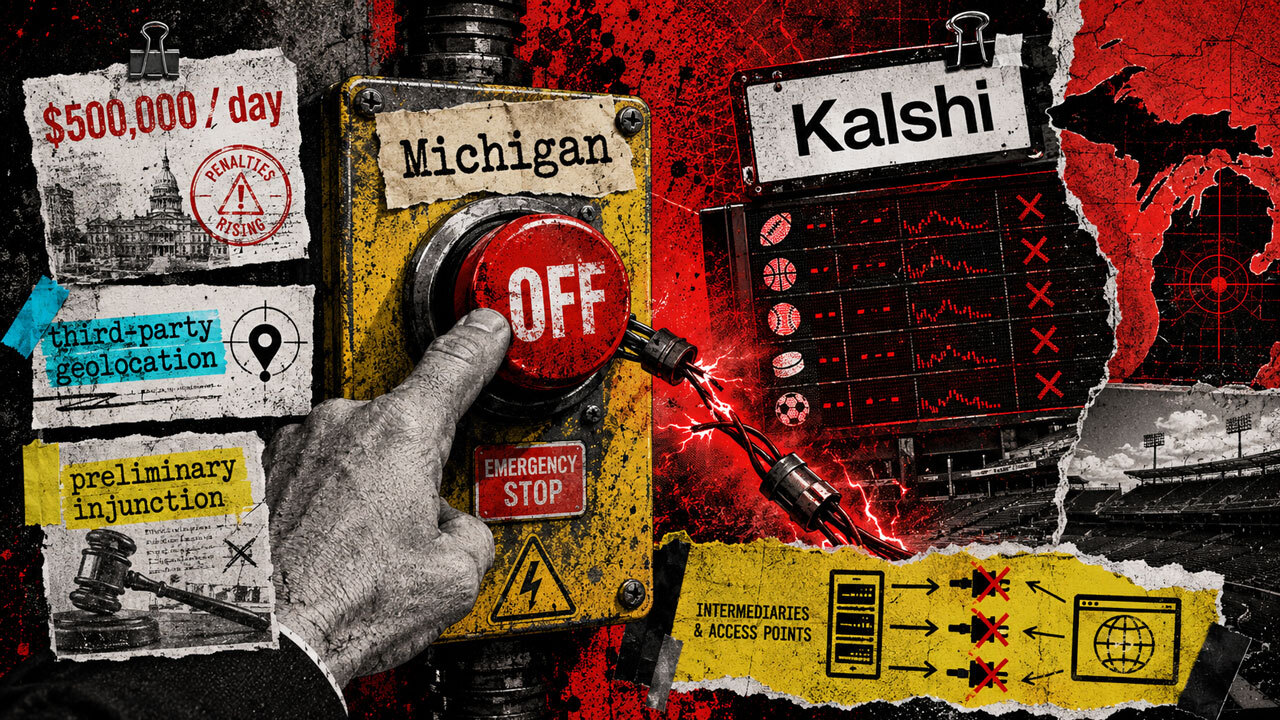

A Michigan judge has placed prediction-market exchange Kalshi under a preliminary injunction that keeps its sports event contracts fenced off from people in the state until the court issues a final order. The ruling moves the dispute beyond a short-term restraint and into an open-ended compliance regime.
Kalshi calls the products federally regulated event contracts, while Michigan treats the covered sports products as internet sports betting subject to state licensing. That classification fight explains why the order is more than routine sportsbook enforcement and why its reach is contested.
What the Kalshi Michigan injunction requires
The Sept. 1 order bars Kalshi and people acting with it from offering or facilitating covered internet sports-betting contracts for anyone located in Michigan. It also reaches deposits, advertising and solicitation, account access, and functionally similar sports-betting products in the state.
Kalshi must use a third-party geolocation provider licensed by the Michigan Gaming Control Board and capable of meeting the regulator’s geofencing specifications. If the court finds Kalshi failed to comply with that requirement, the order directs the company to pay $500,000 for each day of noncompliance.
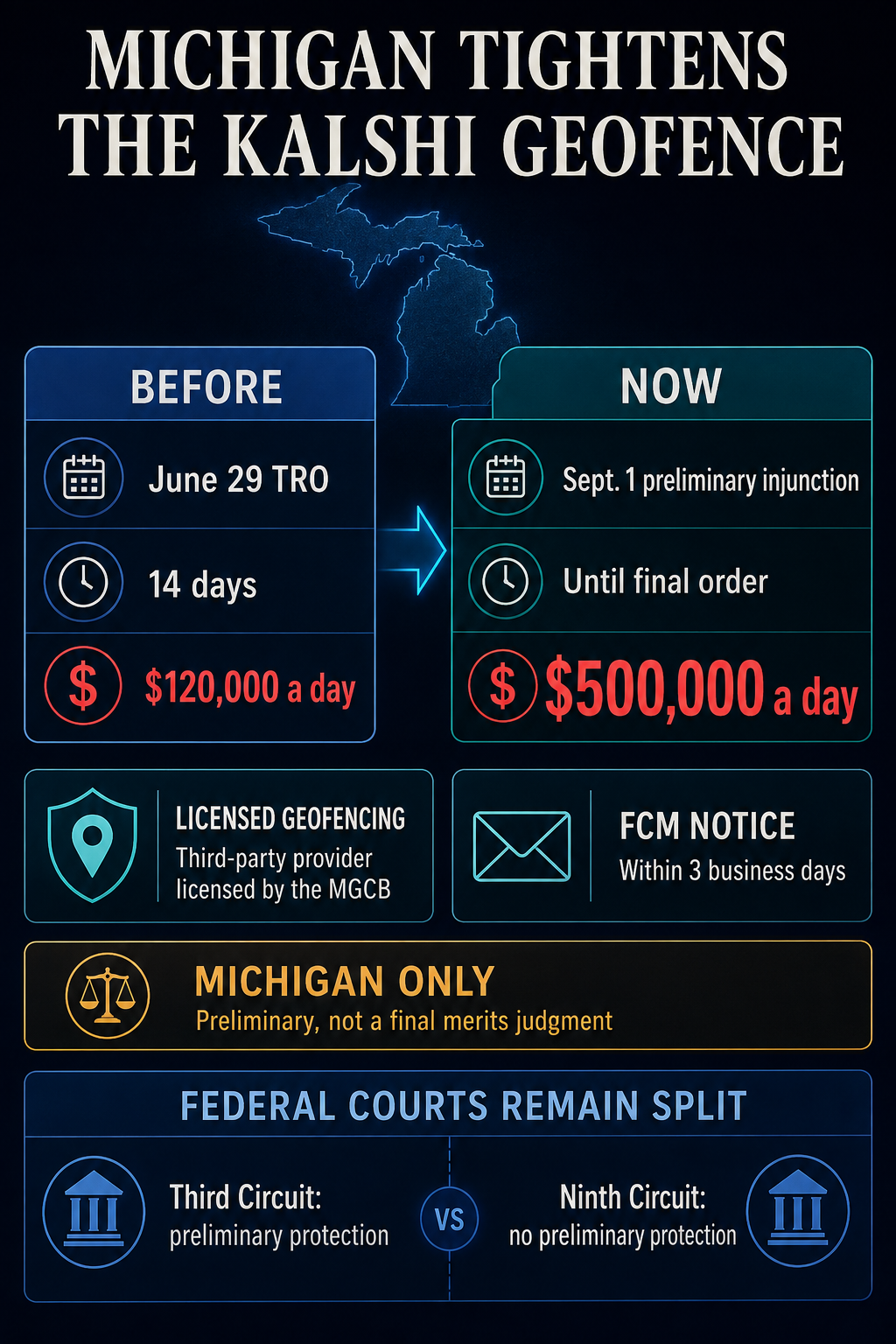
The injunction also reaches intermediaries that can give customers access to Kalshi’s exchange. Within three business days after the order was entered, Kalshi must send a copy and contact details for Michigan’s counsel to every futures commission merchant that makes its sports event contracts available to customers. The order does not hold Kalshi liable for an FCM’s later action or inaction after notice.
The new order is the next procedural stage after a temporary restraining order whose initial stated term was 14 days. The Michigan Gaming Control Board said that the June measure carried a $120,000 daily noncompliance penalty. The preliminary injunction raises the stated geolocation-specific penalty to $500,000 per day and remains effective until a final order in the case.
That duration does not make the ruling a final judgment. The judge found at this stage that Michigan and its residents would face immediate and irreparable harm without relief, based on harms the state alleged were tied to unlicensed sports products. Whether Michigan ultimately proves its allegations remains unresolved. WILX reported on Sept. 2 that Kalshi had not released a statement about that week’s ruling.
A national split, not a national ban
Michigan’s order applies only inside the state. It gives Michigan enforcement control for now without settling Kalshi’s key federal defense: that the Commodity Exchange Act leaves regulation of its federally registered market to the Commodity Futures Trading Commission.
In April, the Third Circuit found Kalshi had a reasonable chance of showing that federal law preempts New Jersey’s enforcement effort and preserved preliminary protection for the exchange. On Aug. 28, the Ninth Circuit reached the other side of the dispute in Nevada, holding that Kalshi had not shown preemption for its sports event contracts.
The CFTC has argued that it has exclusive jurisdiction over prediction markets offered on designated contract markets. Michigan’s injunction does not resolve that national conflict. It instead adds another state-specific restriction while the appellate split leaves operators, regulators and intermediaries facing different rules across jurisdictions.
Derivatives,Featured,Legal,Regulation,Sports,payments,regulationpayments,regulation#Kalshi #Michigan #injunction #sets #500K #daily #geofence #penalty1788546073
