

Compound is a crypto lending protocol governed by holders who delegate their COMP tokens, a setup known as a decentralized autonomous organization, or DAO. It works like an online republic, with token holders debating proposals, voting, and letting software carry out the result.
In July 2024, that republic nearly sent a fortune to a small group of voters. Proposal 289 asked Compound to transfer 499,000 COMP, then worth about $24 million, into a yield-bearing vehicle they controlled. Two earlier versions had failed, and the third seemed headed the same way.
Then, during the final 34 minutes, supporting addresses cast 563,591 votes, equal to 82% of all support for the proposal. The last big block landed eight minutes before the deadline, and the measure passed by 682,191 votes to 633,636.
While this was extremely controversial and remains highly contested, there was no issue with the code, as it worked exactly as intended.
But that was the problem: the wallets had gathered enough COMP and delegated their voting power before the period closed, but Compound lacked an emergency authority that could pause the software. Several reasonable rules had combined into a convenient path for a treasury raid.
Compound reached a settlement that canceled the allocation and later added a veto role, placing a brake in the system built around automatic token-holder rule.
That captures the central DAO dilemma, because most defenses against rushed or hostile votes give somebody more control over participation or the final result.
Two 2026 studies from the Max Planck Institute for Software Systems and Vrije Universiteit Amsterdam traced a similar problem across 48 large Ethereum DAOs. One examined how registration, staking, and delegation concentrate voting power, while the other mapped attacks that use valid governance rules.
The ballot has a velvet rope
Calling a governance token a vote isn’t really correct. Depending on the DAO, a holder may need to register a wallet, lock tokens, delegate them, maintain a minimum balance, or pay for an on-chain transaction before they can actually cast that vote.
Proposals face obstacles of their own, because someone needs enough tokens or delegated support to introduce them in the first place, and the idea may pass through a forum and informal poll before a binding vote on the blockchain or through an off-chain service such as Snapshot.
Once the tally clears the quorum and approval formula, a smart contract, multisignature wallet, or named person carries the result into effect.
While each of these gates solves a real problem, it also favors a particular participant or type of participant.
Proposal thresholds discourage spam and malicious code, but they inadvertently reserve authorship for wealthy holders and established delegates. On-chain voting makes those results enforceable, but transaction fees favor people with enough money and conviction to use it. Free off-chain polls draw a wider crowd, then depend on a smaller group for execution.
The researchers found an even split: 24 DAOs used on-chain voting and 24 used off-chain systems.
Uniswap showed how different electorates can form inside the same organization: more wallets joined its free off-chain polls, while much larger blocks of voting power appeared during the paid on-chain phase that could make a proposal binding.
Turnout is only one small part of this, because a protocol may have thousands of token holders while a few addresses control proposals, votes, and execution. By the time the public tally appears, the rules have already picked the electorate.
The security rules pick the ruling class
DAOs often keep tokens in treasury contracts, and founding teams or investors may hold allocations that have yet to vest, so registration separates circulating tokens from balances that currently carry voting rights.
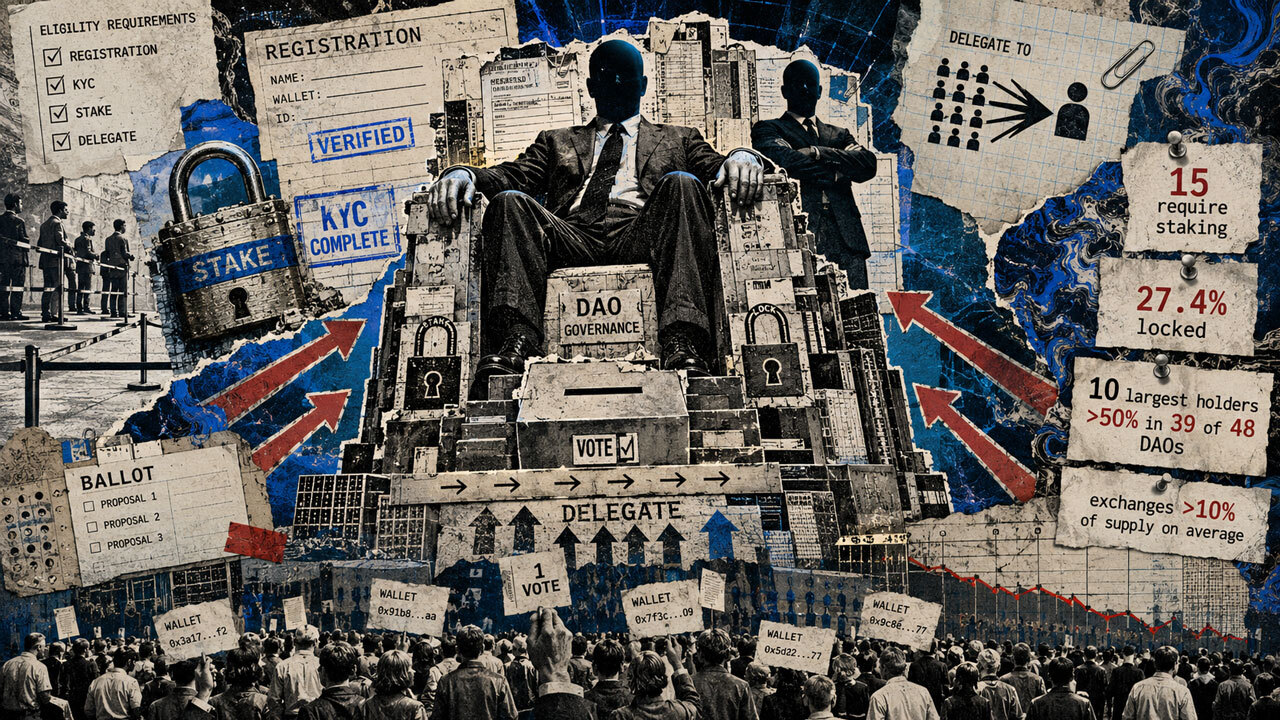
Among the 48 DAOs, 36 required some form of registration, and only four had registered more than half of their outstanding supply. Across those 36 organizations, the average registered share was 21%, meaning the practical electorate usually covered a small fraction of all tokens.
Much of the missing supply belonged to users whose coins were held by exchanges or deposited into DeFi protocols. Centralized exchanges held more than 10% of outstanding tokens on average across the sample, and DeFi contracts held another 3.5%.
In 14 registration-based DAOs, those intermediary wallets controlled more tokens than the entire registered electorate.
That creates a very strange and rather unique custody problem, because an exchange wallet can represent thousands of customers even though the blockchain sees one address with one giant balance.
Letting the exchange vote turns a custodian into a political heavyweight, while excluding it strips customers of governance rights attached to tokens they paid for. Most DAOs also let one wallet send all its power to a single delegate, which makes splitting votes among the underlying owners difficult.
Staking tackles a different vulnerability by making voting power expensive to build and slow to unwind. A would-be attacker can buy or borrow a large position, approve a favorable proposal, and sell once the vote ends, while a lock keeps that voter financially exposed to the result for longer.
Fifteen DAOs required staking, with a median of 27.4% of tokens locked. Some imposed a one- or two-week withdrawal wait, while Curve, Angle, and Frax offered stronger voting power for locks lasting up to four years. The system rewards patience and turns liquid wealth into a prerequisite for political influence.
Crypto soon produced middlemen for people who wanted influence and the freedom to trade. These services maintain long locks, issue tradable substitutes, and keep the original voting rights. The arrangement concentrated enormous voting blocs inside a few services, according to the researchers’ measurements:
| DAO | Service controlling the votes | Share of voting power | Maximum native lock |
|---|---|---|---|
| Curve | Convex | 53% | 4 years |
| Frax | Convex | 46% | 4 years |
| Angle | StakeDAO | 57% | 4 years |
| Balancer | Aura | 65% | 1 year |
Delegation works the same because most holders have limited appetite for forum arguments about collateral ratios. Handing votes to a professional participant makes sense, and repeated delegation builds durable political blocs.
The ten largest holders controlled more than half of voting power in 39 of the 48 DAOs, while delegated voting was usually more concentrated than direct voting.
Registration protects treasury balances, staking makes a quick attack costlier, and delegation gives passive holders a voice through someone who pays attention. Put them together, and the people with the most capital, time, technical fluency, or control over customer assets tend to run the place.
A legal DAO vote can still be a raid
The second paper defines a governance attack as an actor using the authorized process to win an outcome that harms the wider organization.
Among 28 DAO incidents, researchers classified 16 as attacks that a different mechanism could have prevented. Six involved contract bugs, while ten depended on buying or borrowing enough tokens to influence a vote.
Compound is the best example because the wallets associated with Proposal 289 gathered more than 680,000 COMP over four months.
Researchers traced 563,790 tokens through four centralized exchanges and another 118,089 borrowed through Compound itself, even though those addresses had held only 853 COMP before the buildup and had little history in the protocol’s politics.
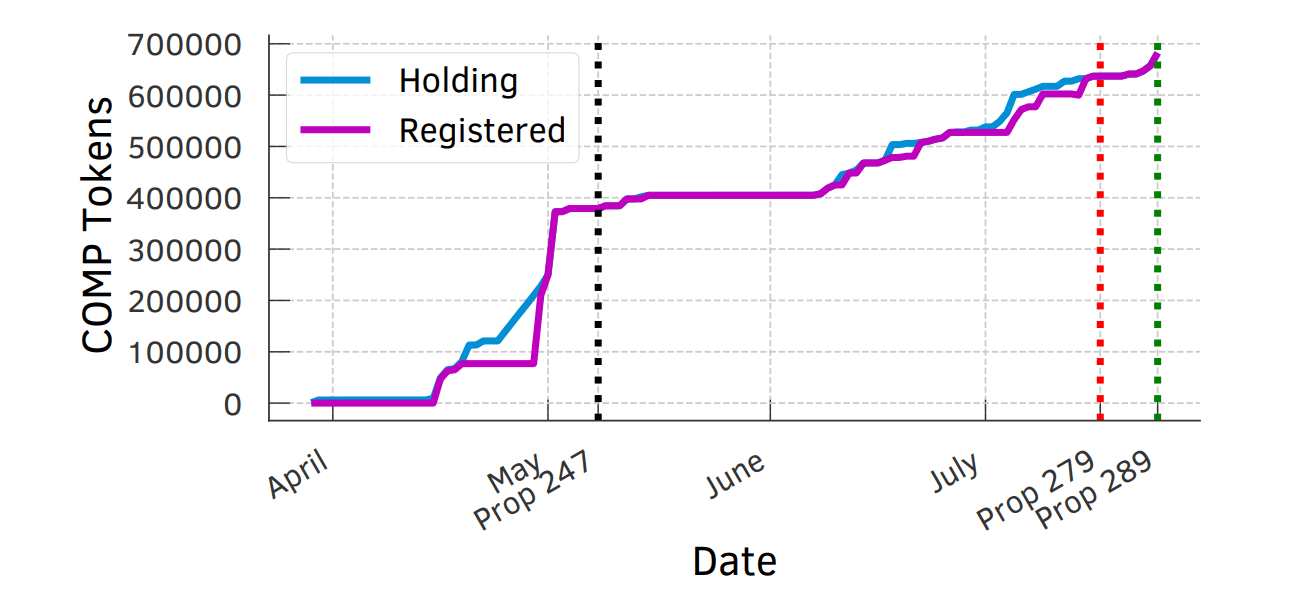
The late burst took advantage of a community that expected the third proposal to fail. Compound could have extended the vote when a large bloc appeared near the deadline, required longer staking, or allowed a trusted council to pause execution.
Every option would have moved power toward reactive voters, committed holders, locking services, or a small emergency body.
But Compound chose the emergency brake, and in the 2024 configurations researchers reviewed, seven other DAOs shared its exposure to readily available voting power and late vote accumulation: Uniswap, Radicle, Gitcoin, Silo, Ampleforth, Hop, and Cryptex.
Those systems can evolve through governance, so the list records a moment in 2024, while a current security rating would require a fresh review.
Decentralization needs a richer accounting than token distribution alone. A good governance report would show how much supply can vote, how much power the largest delegates control, which intermediaries hold staked tokens, and who can introduce, execute, or veto proposals.
Smart contract audits already ask whether governance code follows its specification, while a constitutional audit would ask where that specification sends authority.
DAOs can spread ownership across thousands of wallets and still funnel practical control toward a few dozen professionals, custodians, and large holders, with software that performs flawlessly all the way through.
Analysis,DAOs,DeFi,Featured,Governance#DAOs #forcing #crypto #protocols #choose #code #emergency #brakes1788630253
