

What's Hot

    Ethereum’s Vitalik Buterin puts 60% odds on a cryptography breakthrough

    September 7, 2026

    Bittensor targets $300 as TAO extends five-day rally

    September 7, 2026

    Why state backing cannot ensure an exit

    September 7, 2026
    Facebook Twitter Instagram
    • Business
    • Markets
    • Get In Touch
    • Our Authors
    Facebook Twitter Instagram
    Crypto News: Latest Cryptocurrency News and Analysis
    • Home
    • Business

      Fidelity Buys 7.4% Of Bitcoin Mining Company Marathon Digital Holdings

      February 11, 2021

      Twitter Reacts as Auto Driver Begins Accepting Crypto as Payment

      February 11, 2021

      HSBC Becomes Latest Bank to Suspend Payments to Crypto

      February 4, 2021

      Bitcoin Holds Support; Approaching $50K Resistance

      February 4, 2021

      Cryptocurrency Prices Today: Bitcoin Up Over $47,000, Ether Rises 3%

      February 3, 2021
    • Technology
      1. Business
      2. Insights
      3. View All

      Fidelity Buys 7.4% Of Bitcoin Mining Company Marathon Digital Holdings

      February 11, 2021

      Twitter Reacts as Auto Driver Begins Accepting Crypto as Payment

      February 11, 2021

      HSBC Becomes Latest Bank to Suspend Payments to Crypto

      February 4, 2021

      Bitcoin Holds Support; Approaching $50K Resistance

      February 4, 2021

      Ethereum’s Vitalik Buterin puts 60% odds on a cryptography breakthrough

      September 7, 2026

      Bittensor targets $300 as TAO extends five-day rally

      September 7, 2026

      Why state backing cannot ensure an exit

      September 7, 2026

      A Coinbase-backed crypto bridge is shutting down after its business model stopped working

      September 7, 2026

      Bitcoin Climbs as Elon Musk Says Tesla ‘Likely’ to Accept it Again

      March 16, 2021

      Can Cryptocurrency Be Hacked, Stolen Or Scammed? How Can You Be Safe?

      February 11, 2021

      How Investors Can Get In On Crypto Without Actually Buying Any

      February 4, 2021

      Ethereum Just Underwent a Major Change – Hence, The 25% Jump in a Week!

      February 4, 2021
    • Insights
      1. Bitcoin
      2. Ethereum
      3. Eurozone
      4. Monero
      5. View All

      XRP Ledger Holds More Value as RLUSD Growth Accelerates

      September 7, 2026

      Ripple Brings XRP Branding to Florida Football

      September 7, 2026

      Liquid Network Hit by $320M Bitcoin Withdrawal

      September 7, 2026

      Orionx Shuts Down After $7M Custody Discrepancy

      September 7, 2026

      Ethereum’s Vitalik Buterin puts 60% odds on a cryptography breakthrough

      September 7, 2026

      Why state backing cannot ensure an exit

      September 7, 2026

      A Coinbase-backed crypto bridge is shutting down after its business model stopped working

      September 7, 2026

      A whitehat hacker is holding $320 million in drained Bitcoin until developers prove they patched a fatal network flaw

      September 7, 2026

      Bittensor targets $300 as TAO extends five-day rally

      September 7, 2026

      Can ADA extend its recovery toward $0.245?

      September 7, 2026

      Bitcoin holds above $80,800 as bulls target $85k ahead of NFP

      September 4, 2026

      Flowra, KorDA explore gold-backed Solana validator infrastructure

      September 3, 2026

      Photos Show U.S. Mint’s 1804 Dollar Gold Coin & Silver Medal Set

      September 6, 2026

      Rare 1893-S Morgan Silver Dollar Sells for $1.18 Million

      September 4, 2026

      Michael Fuljenz Wins NLG Award for Metals Market Report

      September 4, 2026

      Hours Left to Order U.S. Mint Freedom 250 Race Medal

      September 4, 2026

      Ethereum’s Vitalik Buterin puts 60% odds on a cryptography breakthrough

      September 7, 2026

      Bittensor targets $300 as TAO extends five-day rally

      September 7, 2026

      Why state backing cannot ensure an exit

      September 7, 2026

      A Coinbase-backed crypto bridge is shutting down after its business model stopped working

      September 7, 2026
    • Markets
    • Get In Touch
    Crypto News: Latest Cryptocurrency News and Analysis
    Home » Ethereum’s Vitalik Buterin puts 60% odds on a cryptography breakthrough
    Ethereum

    Ethereum’s Vitalik Buterin puts 60% odds on a cryptography breakthrough

    行政By 行政September 7, 2026No Comments5 Mins Read
    Share
    Facebook Twitter LinkedIn Pinterest Email

    Vitalik Buterin sees a 60% chance that advanced cryptography becomes cheap enough to reshape Ethereum privacy.

    On Sept. 6, the Ethereum co-founder said there is a 60% probability that SNARKs, fully homomorphic encryption and indistinguishability obfuscation will eventually operate at less than 10 times the cost of ordinary computation. He put the odds at 33% that all three could approach near-zero additional overhead at sufficient scale.

    The forecast reaches well beyond hiding transactions.

    Cheap SNARKs could make private proofs easier to generate. Fully homomorphic encryption (FHE) could let applications compute directly on encrypted data. Indistinguishability obfuscation (iO) aims to let software run without exposing its internal logic.

    Together, the technologies could move privacy from a specialized feature toward a default layer for financial and computational systems.

    Buterin’s timeline is more cautious than the probability headline suggests. He said there is a good chance that at least one of the three, probably SNARKs, reaches single-digit overhead by the end of the decade. He did not assign a probability to that specific deadline.

    Ethereum can improve privacy before the big breakthrough

    Ethereum does not need all three technologies to become cheap before meaningful privacy improvements arrive.

    Its roadmap separates privacy into private reads, private writes, and private proving, allowing progress in one area without waiting for a universal cryptographic cost collapse.

    Anonymous RPC systems, private information retrieval, oblivious RAM, and light clients can improve how users access blockchain data without exposing as much information about who they are or what they are querying.
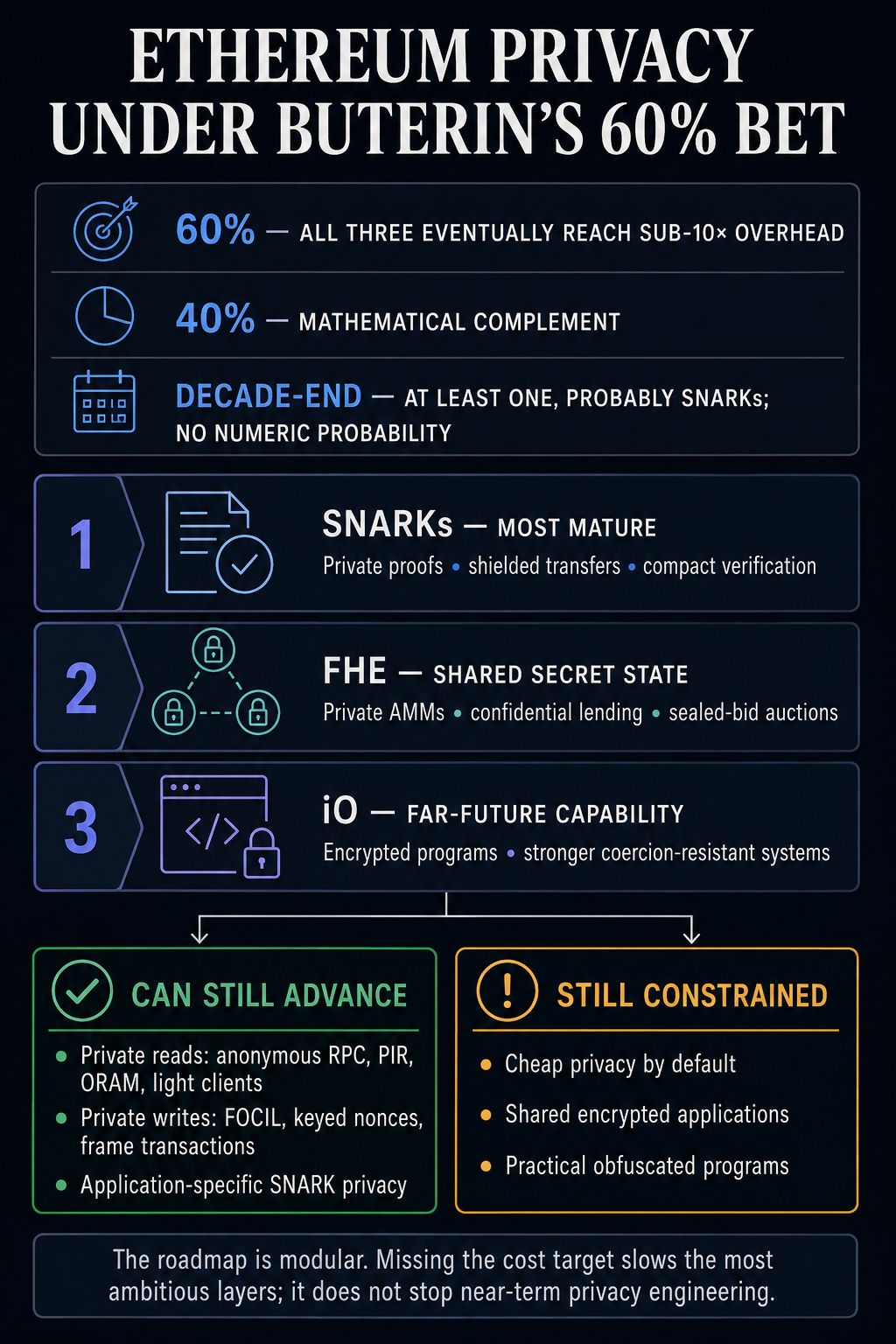
    Infographic mapping Buterin’s 60% cryptography forecast to Ethereum privacy capabilities that can still advance and those constrained by high overheadInfographic mapping Buterin’s 60% cryptography forecast to Ethereum privacy capabilities that can still advance and those constrained by high overhead

    Private transactions have their own constraints. A transfer can still be censored before inclusion, linked through its fee payer or correlated through sequential account nonces.

    Ethereum researchers have proposed frame transactions that separate fee payment from the account performing an action, inclusion lists that force builders to include eligible transactions seen by validator committees, and keyed nonces that make activity harder to correlate. Those mechanisms remain proposals rather than guaranteed upgrades.

    Application-specific zero-knowledge systems are further ahead.

    SNARKs already allow users to prove that a private computation or statement is valid without revealing the underlying information.

    Ethereum’s existing design patterns can support uses such as anonymous voting, private claims, and shielded withdrawals, though privacy can still leak through wallet reuse, RPC providers, public inputs, or weak anonymity sets.

    That makes SNARKs the most mature part of Buterin’s three-way bet.

    The Daily Brief

    The signal, before the noise.

    Start your day with the crypto stories moving markets, decoded by CryptoSlate’s editors.

    One email. Everything that matters.

    Free to join. Unsubscribe any time.

    Whoops, looks like there was a problem. Please try again.

    You’re on the list. Your next Daily Brief is on its way.

    FHE and iO could take privacy beyond transactions

    The more consequential leap for decentralized finance would come from making FHE substantially cheaper.

    Unlike application-specific proofs, FHE allows multiple users to interact with shared data while keeping that state encrypted.

    That capability is essential for applications such as private automated market makers, confidential lending pools, and sealed-bid auctions, where the system must process several users’ inputs without revealing them.

    However, the obstacle is cost.

    One 2026 benchmark required multi-gigabyte cryptographic artifacts and more than six hours of encrypted computation for a small BERT workload. The result reflects a single application rather than a universal performance measure, but it illustrates how far some FHE workloads remain from ordinary computation.

    Developers can work around those constraints with specialized coprocessors, narrower workloads, or threshold-decryption systems. Those approaches can make encrypted applications practical today, but they add infrastructure and, in some cases, new trust assumptions.

    Bringing FHE into single-digit overhead would change that tradeoff. Shared encrypted state could become a routine application primitive rather than something reserved for specialized systems, making confidential financial applications cheaper and easier to deploy.

    The third technology, indistinguishability obfuscation, pushes that idea further.

    FHE seeks to keep data private while it is being processed. iO aims to conceal the program itself, allowing users to execute software and verify its behavior without exposing the underlying logic.

    That capability remains much further away. Buterin has previously described this rigorous approach as carrying “galactic” runtimes, while newer methods remain promising but unproven.

    If practical iO eventually emerges, software could begin performing roles now assigned to trusted intermediaries without revealing how it makes decisions internally. Potential applications include more coercion-resistant voting, tightly controlled encrypted protocols and systems that disclose only authorized outputs.

    Those possibilities extend beyond the private-read, private-write and private-proving tools currently emphasized in Ethereum’s privacy roadmap. They also broaden the implications beyond Ethereum itself.

    Christopher Inks, founder of Texas West Capital, said cheaper cryptography could allow proprietary financial models to run on outside infrastructure without exposing private data, model mechanics or intellectual property.

    He argued that such systems could eventually weaken the role of intermediaries including auditors, custodians, clearinghouses and exchanges, whose businesses partly depend on serving as trusted observers or validators.

    The progression is therefore from hiding user data to hiding shared financial state and, eventually, the logic of the programs operating on it. If the cost of those protections falls far enough, the result could be a new class of financial infrastructure rather than simply more private blockchain transactions.

    The privacy roadmap does not depend on one outcome

    Ethereum’s privacy path is therefore better understood as a progression rather than a single breakthrough.

    Anonymous access, censorship resistance, shielded transfers and specialized proofs can advance with technologies that already exist. Cheaper SNARKs would expand those capabilities. FHE would determine whether confidential shared-state applications can become practical at scale. iO would open a much more distant class of encrypted software.

    Buterin’s 60% scenario would accelerate all three layers, potentially making privacy far cheaper and more composable.

    The remaining 40% does not imply Ethereum privacy fails. It means progress would likely stay uneven, with useful protections arriving through specialized systems while general encrypted computation remains expensive.

    Featured,People,Privacy,Technology,ethereum,Ethereum foundation,paymentsethereum,Ethereum foundation,payments,Privacy#Ethereums #Vitalik #Buterin #puts #odds #cryptography #breakthrough1788783983

    Breakthrough Buterin cryptography Ethereum Ethereum foundation Ethereums Odds Payments privacy puts Vitalik
    Share. Facebook Twitter Pinterest LinkedIn Tumblr Email
    行政
    • Website

    Related Posts

    Why state backing cannot ensure an exit

    September 7, 2026

    A Coinbase-backed crypto bridge is shutting down after its business model stopped working

    September 7, 2026

    A whitehat hacker is holding $320 million in drained Bitcoin until developers prove they patched a fatal network flaw

    September 7, 2026

    Arbitrum watchdog proposes bans for three DeFi projects

    September 6, 2026
    Add A Comment

    Leave A Reply Cancel Reply

    Top Posts

    Millennials Are Quitting Job to Become Day Traders

    January 20, 2021

    Jack Dorsey Says Bitcoin Will Unite The World

    January 15, 2021

    Hong Kong Customs Arrest Four in Crypto Laundering Bust

    January 15, 2021

    Subscribe to Updates

    Get the latest sports news from SportsSite about soccer, football and tennis.

    Advertisement
    Demo

    Your source for the serious news. This demo is crafted specifically to exhibit the use of the theme as a news site. Visit our main page for more demos.

    We're social. Connect with us:

    Facebook Twitter Instagram Pinterest YouTube
    Top Insights

    Ethereum’s Vitalik Buterin puts 60% odds on a cryptography breakthrough

    September 7, 2026

    Bittensor targets $300 as TAO extends five-day rally

    September 7, 2026

    Why state backing cannot ensure an exit

    September 7, 2026
    Get Informed

    Subscribe to Updates

    Get the latest creative news from FooBar about art, design and business.

    Facebook Twitter Instagram Pinterest
    • Home
    • Business
    • Markets
    • Technology
    • Contact us
    © 2026 ThemeSphere. Designed by WPfastworld.
    • Easterngifts
    • koreanbj
    • korean bj porn​
    • korean bj nude

    Type above and press Enter to search. Press Esc to cancel.