
What's Hot

    Builder receipts versus ETH burn

    September 7, 2026

    Moonwell bad-debt plan: USDC recovery questions remain

    September 7, 2026

    Solana decentralization: What ARK’s scorecard measures

    September 7, 2026
    Facebook Twitter Instagram
    • Business
    • Markets
    • Get In Touch
    • Our Authors
    Facebook Twitter Instagram
    Crypto News: Latest Cryptocurrency News and Analysis
    • Home
    • Business

      Fidelity Buys 7.4% Of Bitcoin Mining Company Marathon Digital Holdings

      February 11, 2021

      Twitter Reacts as Auto Driver Begins Accepting Crypto as Payment

      February 11, 2021

      HSBC Becomes Latest Bank to Suspend Payments to Crypto

      February 4, 2021

      Bitcoin Holds Support; Approaching $50K Resistance

      February 4, 2021

      Cryptocurrency Prices Today: Bitcoin Up Over $47,000, Ether Rises 3%

      February 3, 2021
    • Technology
      1. Business
      2. Insights
      3. View All

      Fidelity Buys 7.4% Of Bitcoin Mining Company Marathon Digital Holdings

      February 11, 2021

      Twitter Reacts as Auto Driver Begins Accepting Crypto as Payment

      February 11, 2021

      HSBC Becomes Latest Bank to Suspend Payments to Crypto

      February 4, 2021

      Bitcoin Holds Support; Approaching $50K Resistance

      February 4, 2021

      Builder receipts versus ETH burn

      September 7, 2026

      Moonwell bad-debt plan: USDC recovery questions remain

      September 7, 2026

      Solana decentralization: What ARK’s scorecard measures

      September 7, 2026

      AUSTRAC registration removals: 45 providers affected

      September 7, 2026

      Bitcoin Climbs as Elon Musk Says Tesla ‘Likely’ to Accept it Again

      March 16, 2021

      Can Cryptocurrency Be Hacked, Stolen Or Scammed? How Can You Be Safe?

      February 11, 2021

      How Investors Can Get In On Crypto Without Actually Buying Any

      February 4, 2021

      Ethereum Just Underwent a Major Change – Hence, The 25% Jump in a Week!

      February 4, 2021
    • Insights
      1. Bitcoin
      2. Ethereum
      3. Eurozone
      4. Monero
      5. View All

      XRP Ledger Holds More Value as RLUSD Growth Accelerates

      September 7, 2026

      Ripple Brings XRP Branding to Florida Football

      September 7, 2026

      Liquid Network Hit by $320M Bitcoin Withdrawal

      September 7, 2026

      Orionx Shuts Down After $7M Custody Discrepancy

      September 7, 2026

      Builder receipts versus ETH burn

      September 7, 2026

      Moonwell bad-debt plan: USDC recovery questions remain

      September 7, 2026

      Solana decentralization: What ARK’s scorecard measures

      September 7, 2026

      AUSTRAC registration removals: 45 providers affected

      September 7, 2026

      KuCoin launches KCUSD with up to 4% base APR on Stablecoins

      September 7, 2026

      Bittensor targets $300 as TAO extends five-day rally

      September 7, 2026

      Can ADA extend its recovery toward $0.245?

      September 7, 2026

      Bitcoin holds above $80,800 as bulls target $85k ahead of NFP

      September 4, 2026

      Photos Show U.S. Mint’s 1804 Dollar Gold Coin & Silver Medal Set

      September 6, 2026

      Rare 1893-S Morgan Silver Dollar Sells for $1.18 Million

      September 4, 2026

      Michael Fuljenz Wins NLG Award for Metals Market Report

      September 4, 2026

      Hours Left to Order U.S. Mint Freedom 250 Race Medal

      September 4, 2026

      Builder receipts versus ETH burn

      September 7, 2026

      Moonwell bad-debt plan: USDC recovery questions remain

      September 7, 2026

      Solana decentralization: What ARK’s scorecard measures

      September 7, 2026

      AUSTRAC registration removals: 45 providers affected

      September 7, 2026
    • Markets
    • Get In Touch
    Crypto News: Latest Cryptocurrency News and Analysis
    Home » Builder receipts versus ETH burn
    Ethereum

    Builder receipts versus ETH burn

    行政By 行政September 7, 2026No Comments5 Mins Read
    Share
    Facebook Twitter LinkedIn Pinterest Email

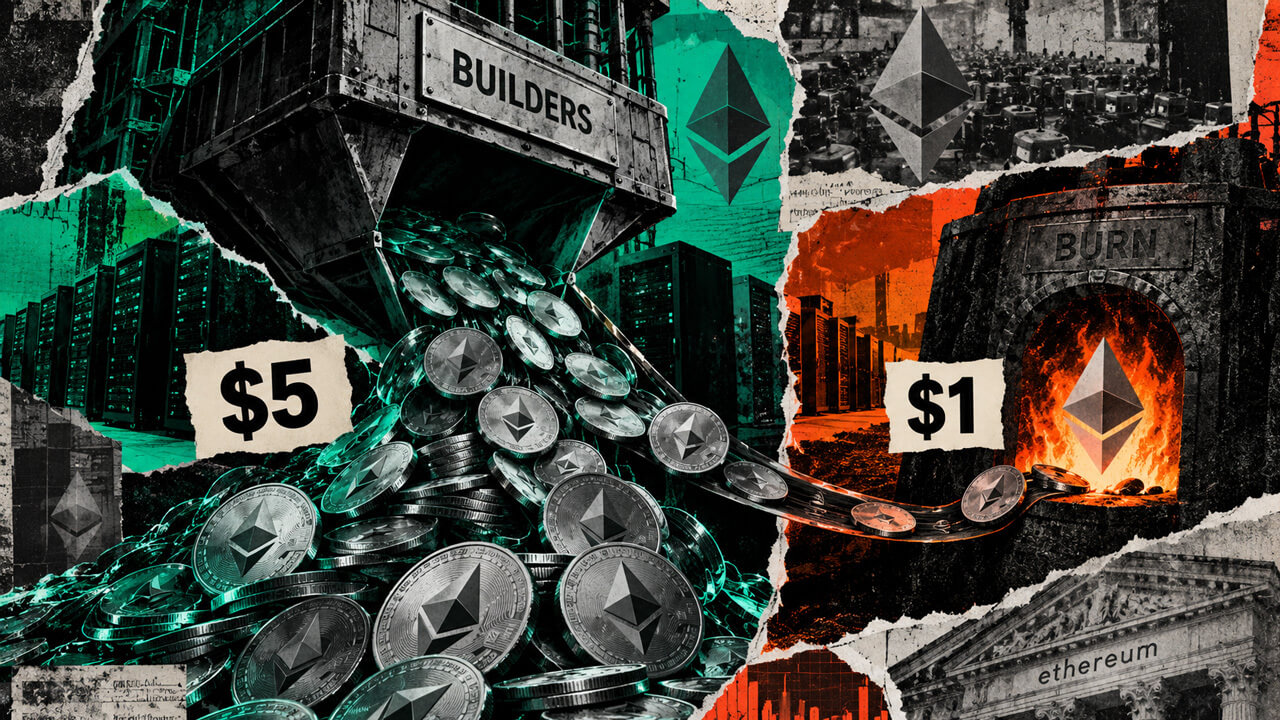
    Ethereum arbitrage generated about $5.24 in builder receipts for every $1 burned in a 30-day sample reported by blockchain data provider Bitquery. Its allocation puts 49.3% of measured surplus toward block assembly, 9.4% toward burned fees and 41.3% with trading operators.

    For ETH holders, the finding shows why trading activity and the investment case for holding the token require different measures. Payments reward participants executing and ordering trades; fee burning changes ETH supply. Builders also pay validators to propose blocks, so the largest receipt bucket does not identify the largest final profit.

    The investigation marks its figures verified Aug. 31, 2026. Its allocation table specifies 30 days without exact endpoints; a separate monthly trade-distribution table ends Aug. 29. The five-to-one comparison is calculated from the rounded shares and describes sampled arbitrage surplus, not Ethereum-wide revenue.
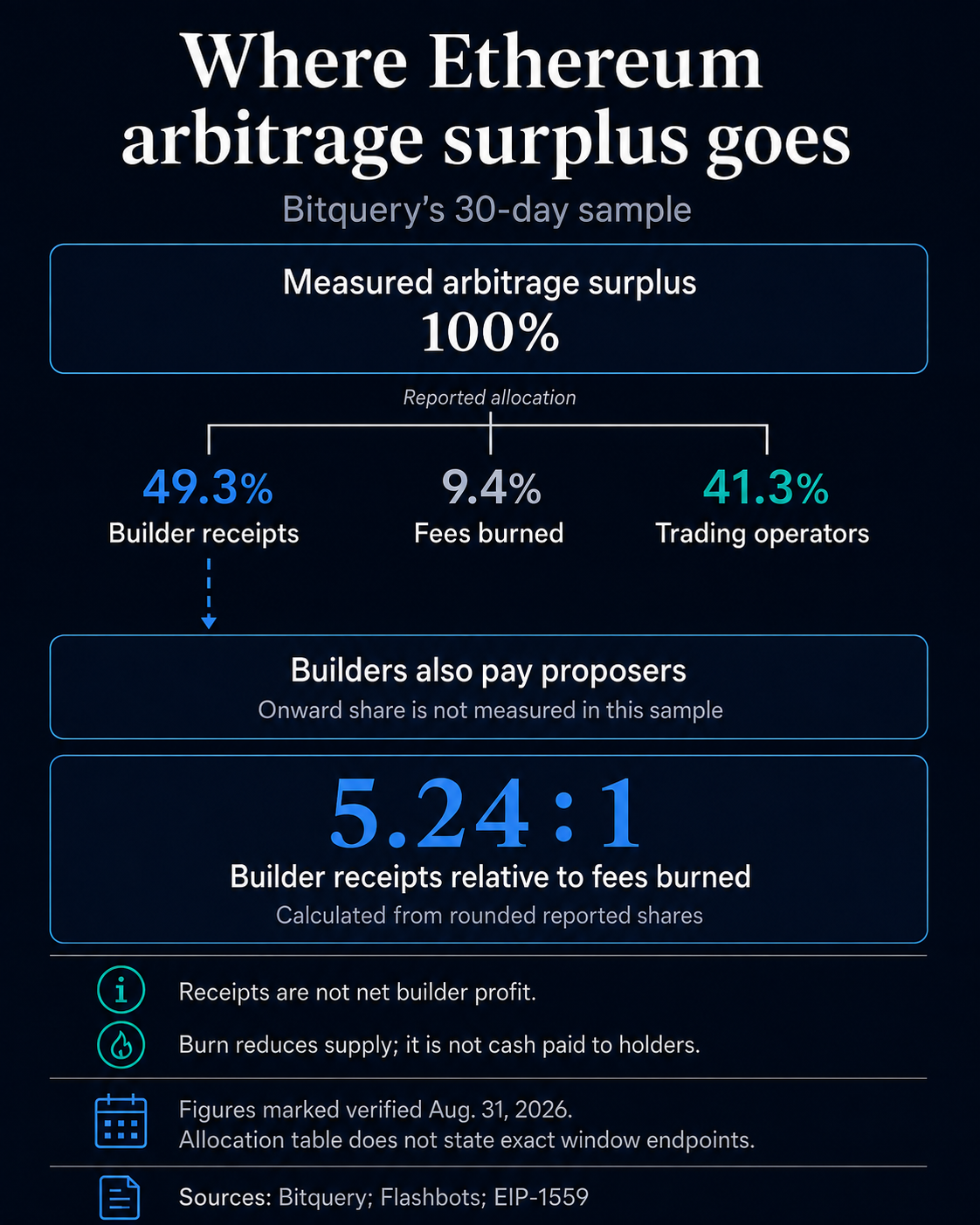
    Bitquery's 30-day Ethereum arbitrage allocation: 49.3% builder receipts, 9.4% fees burned and 41.3% trading operators. Builder receipts are 5.24 times burn; builders also pay proposers, but the onward share is unmeasured.Bitquery's 30-day Ethereum arbitrage allocation: 49.3% builder receipts, 9.4% fees burned and 41.3% trading operators. Builder receipts are 5.24 times burn; builders also pay proposers, but the onward share is unmeasured.

    A payment to builders has another destination

    Arbitrage software looks for a token available at different prices, buys at the cheaper price and sells at the higher one. Ethereum’s MEV documentation describes the specialized participants finding these opportunities as searchers. When several searchers pursue the same trade, getting a transaction included in the right position has economic value.

    An operator must secure execution while the price difference still exists. Competition for that opportunity can turn part of a trading gain into a payment for inclusion, reducing what remains with the operator.

    In the block-building arrangement documented by Flashbots, builders gather transactions and bundles, construct blocks, then bid for validators’ blockspace through relays. The validator acting as proposer is paid to propose the builder’s block.

    The payment design makes the distinction visible. A builder sets its own address as the block’s fee recipient, then includes a transaction at the end of the block paying ETH to the proposer’s designated recipient. Money can reach the builder address and subsequently leave for the validator within that same block.

    Related Reading

    Ethereum’s next upgrade turns a 2-second block bottleneck into a roughly 9-second window

    Counting only the incoming payment stops the accounting too early. To compare participants, the relevant builder figure is what remains after the proposer payment, with business costs a further consideration. The proposer receipt is a separate flow, not an additional arbitrage gain to add on top of the original surplus.

    New York Fed Staff Report 1102 uses this distinction in its historical research: builder profit is direct payments plus priority fees, minus the payment to the proposer. It measures retained block revenue, rather than a complete business profit after operating costs.

    The Daily Brief

    The signal, before the noise.

    Start your day with the crypto stories moving markets, decoded by CryptoSlate’s editors.

    One email. Everything that matters.

    Free to join. Unsubscribe any time.

    Whoops, looks like there was a problem. Please try again.

    You’re on the list. Your next Daily Brief is on its way.

    Bitquery’s allocation does not measure the fraction of its builder receipts passed onward to proposers. Assigning that money between builders and validators would require matching the sampled trading payments to the relevant onward transfers. The protocol describes the route; it does not supply the missing percentage.

    What fee burn means for ETH holders

    Ethereum’s EIP-1559 specification separates the base fee from the priority fee. The base fee is destroyed by the protocol. The priority fee is a payment associated with transaction inclusion.

    Base fee per gas adjusts according to gas used relative to the block target. That is a different mechanism from a searcher’s willingness to pay for a profitable trading position. Both can feature in the same transaction, but they answer different economic questions.

    This is why the comparison cannot be read as though every payment made on Ethereum contributes equally to reducing ETH supply. A larger inclusion payment can change what a participant receives without representing an equivalent increase in burned ETH. Likewise, a transaction count does not disclose either the gas consumed or the base fee paid.

    Related Reading

    Ethereum’s next major upgrade just slipped to late 2026, forcing a two-week scramble to save its 2027 roadmap

    For a holder assessing the supply effect, the useful measurement is ETH destroyed over a defined period, compared with ETH created over that same period. Ethereum’s issuance documentation explains that the balance of issuance and burn determines whether supply expands or contracts.

    Burn consequently reduces supply relative to a world without that destruction, but it does not by itself establish that total supply fell. Nor does it transfer cash to a passive holder. Those distinctions remain relevant even when the underlying activity creates a profitable trade for somebody else.

    The study filters for surplus no greater than the capital committed in each transaction. Wallet reconciliation can reduce apparent earnings further, and incomplete Ethereum venue decoding misses activity. The separate annual comparison covers Ethereum, BNB Chain, Base, Arbitrum and Polygon for 12 months through Aug. 29, 2026; Optimism and Solana are excluded. Its fixed reference prices differ from the monthly prices used in the historical series.

    These boundaries leave a useful allocation finding without establishing a trend in anyone’s profits. A later comparison would need consistent coverage, periods and accounting, including builder payments onward to proposers. Otherwise, a change in the reported share could reflect a change in what was counted.

    The investment-thesis test therefore has distinct parts. Operators need retained trading surplus sufficient to cover their business costs. Builders need receipts considered alongside proposer payments. Validators receive compensation through their own role. Passive holders face a supply outcome that depends on issuance as well as destruction.

    Related Reading

    A 36-day staking bottleneck is costing Ethereum depositors over $350,000 in lost rewards daily

    More transactions cannot answer all four questions. Evidence that activity strengthens ETH’s supply-reduction case would be comparable burn and issuance measurements; evidence of higher retained block revenue would be comparable receipts and onward payments. The distinction determines whether a busy network is producing more income for its participants, reducing its token supply, or doing both.

    Analysis,Featured,Research,Trading,BNB,ethereum,Flashbots,payments,SolanaBNB,ethereum,Flashbots,payments,Solana#Builder #receipts #ETH #burn1788816940

    BNB builder Burn ETH Ethereum Flashbots Payments receipts Solana
    Share. Facebook Twitter Pinterest LinkedIn Tumblr Email
    行政
    • Website

    Related Posts

    Moonwell bad-debt plan: USDC recovery questions remain

    September 7, 2026

    Solana decentralization: What ARK’s scorecard measures

    September 7, 2026

    AUSTRAC registration removals: 45 providers affected

    September 7, 2026

    Ethereum co-founder Vitalik Buterin says AI won’t break Bitcoin

    September 7, 2026
    Add A Comment

    Leave A Reply Cancel Reply

    Top Posts

    Millennials Are Quitting Job to Become Day Traders

    January 20, 2021

    Jack Dorsey Says Bitcoin Will Unite The World

    January 15, 2021

    Hong Kong Customs Arrest Four in Crypto Laundering Bust

    January 15, 2021

    Subscribe to Updates

    Get the latest sports news from SportsSite about soccer, football and tennis.

    Advertisement
    Demo

    Your source for the serious news. This demo is crafted specifically to exhibit the use of the theme as a news site. Visit our main page for more demos.

    We're social. Connect with us:

    Facebook Twitter Instagram Pinterest YouTube
    Top Insights

    Builder receipts versus ETH burn

    September 7, 2026

    Moonwell bad-debt plan: USDC recovery questions remain

    September 7, 2026

    Solana decentralization: What ARK’s scorecard measures

    September 7, 2026
    Get Informed

    Subscribe to Updates

    Get the latest creative news from FooBar about art, design and business.

    Facebook Twitter Instagram Pinterest
    • Home
    • Business
    • Markets
    • Technology
    • Contact us
    © 2026 ThemeSphere. Designed by WPfastworld.
    • Easterngifts
    • koreanbj
    • korean bj porn​
    • korean bj nude

    Type above and press Enter to search. Press Esc to cancel.