
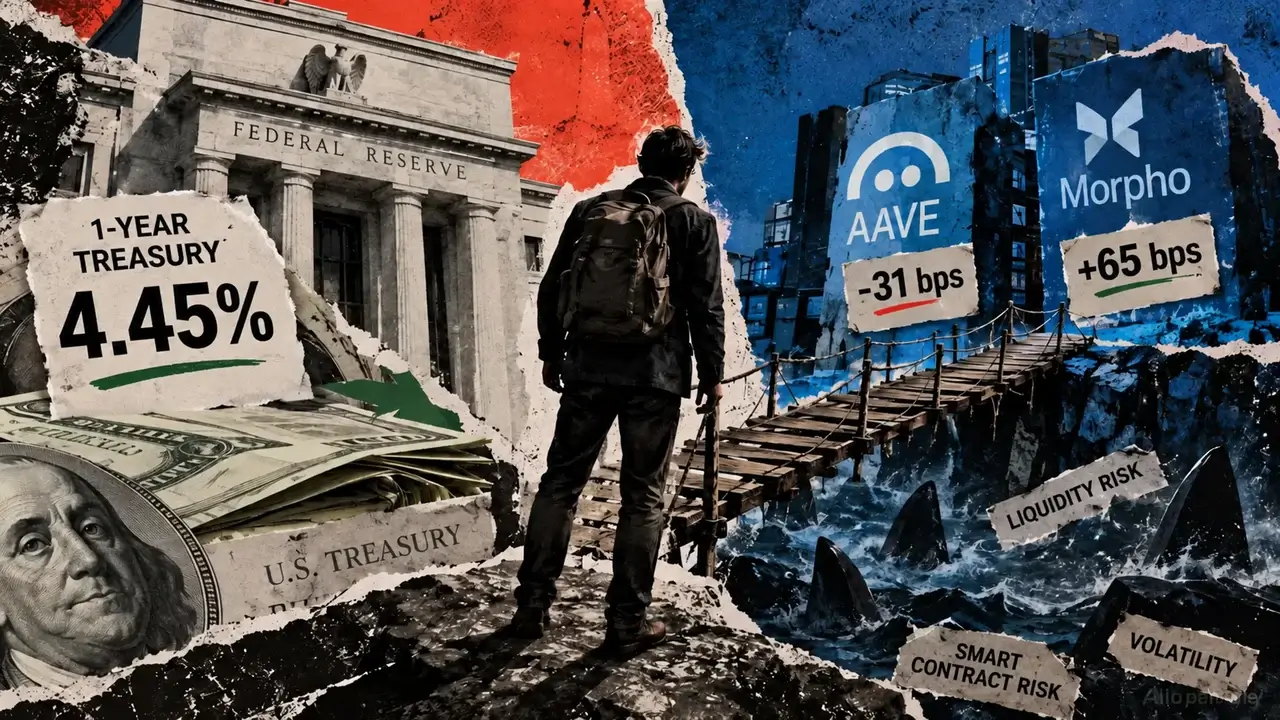

The Federal Reserve raised its target range by 25 basis points to 3.75%-4.00% on Sept. 16, pushing the one-year Treasury yield to 4.45% the same day and pressuring crypto lending yields.
That move lifts the return available to anyone willing to hold nothing riskier than government debt, setting a fresh benchmark for crypto lending yields to measure against.
Coin Metrics found that USDC lenders on Aave earned an average of 31 basis points less than that one-year Treasury throughout the period it studied in 2026. The Aave yield fell short of the Treasury rate in 78% of the intervals measured across that same window.
That gap predates the Fed decision, and the more useful question is what a Fed hike does to the calculation from here.
| Yield / Benchmark | Current or Studied Level | What it Measures | Why it Matters |
|---|---|---|---|
| Fed target range | 3.75%–4.00% | Policy-rate floor | Raises the base return available in dollar markets |
| 1-year Treasury | 4.45% | Low-risk dollar alternative | Main opportunity-cost benchmark for investors |
| Aave USDC vs 1-year Treasury | -31 bps avg. | Stablecoin lending spread | Shows Aave lenders did not consistently earn a premium |
| Aave underperformance frequency | 78% of intervals | Consistency of yield shortfall | Shows the gap was not just a one-off |
| Morpho median USDC vault | +65 bps avg. | Higher-yield vault spread | Clears Treasuries, but with more volatility |
| Morpho volatility | 3.3x Aave | Yield variability | Shows extra return came with a rougher ride |
Treasuries and on-chain rates measure two different things
Anthony DeMartino, co-founder and CEO of Sentora, points to CDOR as the better lever for judging on-chain credit.
Sentora helped build that benchmark, which tracks overnight borrowing rates on USDC and USDT inside Aave V3, the largest decentralized credit market.
DeMartino told CryptoSlate:
“Correlation between SOFR and CDOR has been very low, so a Fed hike should not be expected to pull onchain rates materially higher, and SOFR is the wrong anchor for pricing onchain exposure.”
That argument works alongside the Treasury comparison, adding a second lens without replacing it.
The one-year Treasury measures what an investor gives up by choosing crypto lending over the safest available alternative, while CDOR measures what borrowing dollars inside Aave costs on any given day.
A useful accounting of crypto yield needs both figures, since a return that clears CDOR but misses the Treasury rate has still failed the more basic opportunity-cost test.
| Benchmark | What It Captures | Best Use in the Article | Limitation |
|---|---|---|---|
| 1-year Treasury | Return on low-risk government debt | Measures investor opportunity cost | Does not reflect on-chain borrowing demand |
| SOFR | Secured overnight dollar funding rate | Useful for traditional dollar markets | DeMartino argues it is the wrong anchor for on-chain credit |
| CDOR | Overnight USDC/USDT borrowing in Aave V3 | Measures native on-chain credit conditions | Does not by itself prove investors are paid enough |
| Vault net APY | Investor-facing return after fees | Shows what users actually receive | Can hide volatility, leverage, liquidity, and tail risk |
| Required premium | Extra yield above the benchmark | Measures compensation for added crypto risk | No market-wide standard exists |
What the numbers show about the crypto premium
A European Central Bank working paper published Sept. 14 found that monetary-policy transmission into DeFi stablecoin deposit rates is weak and unstable in the short term.
Rates can even move in the opposite direction from Fed policy entirely before converging over a longer horizon, and deleveraging in crypto markets often drives that short-run divergence more directly.
Borrowers unwind positions and reduce the organic demand that sets on-chain borrowing costs.
Coin Metrics data shows where that premium currently stands. Aave’s USDC yield trailed the one-year Treasury by 31 basis points on average, while Morpho’s median USDC vault beat the same Treasury benchmark by 65 basis points, but carried roughly 3.3 times the annualized volatility of the Aave figure.
DeMartino noted:
“The premium over CDOR is where smart contract, liquidity, and credit risk are compensated, but there is no standard rate that can be applied here.”
In his account, the fair premium depends entirely on the specific protocols, curators, and assets an investor is exposed to.
As a purely analytical exercise, a plain stablecoin vault might reasonably need to clear the higher of the Treasury rate or CDOR plus another 100 to 300 basis points. Curated or leveraged strategies would need 300 to 600 basis points above that same floor.
That range mainly shows why a 4.1% yield can look inadequate against 4.45% Treasuries, while even a 5.1% crypto yield can remain debatable once volatility and tail risk enter the picture.
Turning abstraction into real numbers
Kraken’s newly launched xStocks Vaults let investors keep exposure to tokenized equities like SPYx, QQQx or NVDAx while the vault borrows stablecoins against that collateral and deploys the proceeds into DeFi reward strategies.
Returns convert back into the same token and compound automatically. Kraken currently advertises a 2% net annualized yield for SPYx and QQQx and 1.8% for NVDAx, already net of a 25% performance fee, with withdrawals taking three days and potentially longer under stress.
On a $10,000 SPYx position, that 2% yield works out to roughly $200 of additional annual reward, entirely separate from whatever the underlying stock itself does.
DeMartino explained that if the stock sells off, the smart contract automatically repays debt to keep the position from being liquidated. If the market rallies, it takes on more debt to preserve the yield.
A 2% loss specific to the crypto vault’s strategy would erase that entire year’s incremental return. A decline in SPYx’s price is a separate risk any equity token holder would face regardless of the vault, and keeping those two loss sources distinct is key.
| Scenario | What Happens to Crypto Borrowing Demand | What Happens to Yield | What Investors Need to Watch |
|---|---|---|---|
| Bull case | BTC-driven borrowing demand stays strong | CDOR rises from on-chain utilization, independent of Fed policy | Whether DeFi yields clear Treasuries by a meaningful margin |
| Base case | Borrowing demand holds but does not surge | Yields fluctuate around Treasury/CDOR benchmarks | Whether net APY compensates for smart-contract and liquidity risk |
| Bear case | Risk appetite weakens and borrowers deleverage | Stablecoin deposit rates fall even as Treasuries stay elevated | Whether vaults pay less just as safe alternatives pay more |
| Stress case | Equity collateral falls, liquidity tightens, or execution delays emerge | Automated deleveraging protects positions but can compress returns | Whether a small yield premium is enough for tail risk |
Whether crypto’s rate cycle pays off or gets caught by the Fed’s
The bull case has organic borrowing demand, still concentrated almost entirely in BTC by DeMartino’s account, staying strong enough that CDOR climbs on its own utilization independent of anything the Fed does.
Under that path, crypto lending yields can clear Treasuries through genuine on-chain demand, giving DeMartino’s argument that crypto runs its own rate cycle real support in the data itself, beyond just commentary.
The bear case has higher-for-longer Fed policy eventually cooling risk appetite broadly, weakening crypto activity and pushing borrowers to deleverage.
In that scenario, the ECB’s mechanism becomes the dominant force, with stablecoin deposit rates falling even as Treasuries stay elevated. Automated tools like Kraken’s margin management prevent liquidations but compress the yield investors collect, and crypto lending ends up paying less when the safe alternative sitting right next to it pays more.
Crypto yield products are already easy to access, though the harder question is whether that yield compensates for the risk sitting underneath it. No single benchmark, CDOR or Treasury alike, fully answers that.
DeFi,Featured,Lending,Market#risk #smart #contract #exploit #safe #Treasuries #pay #crypto #yields1789728460
