
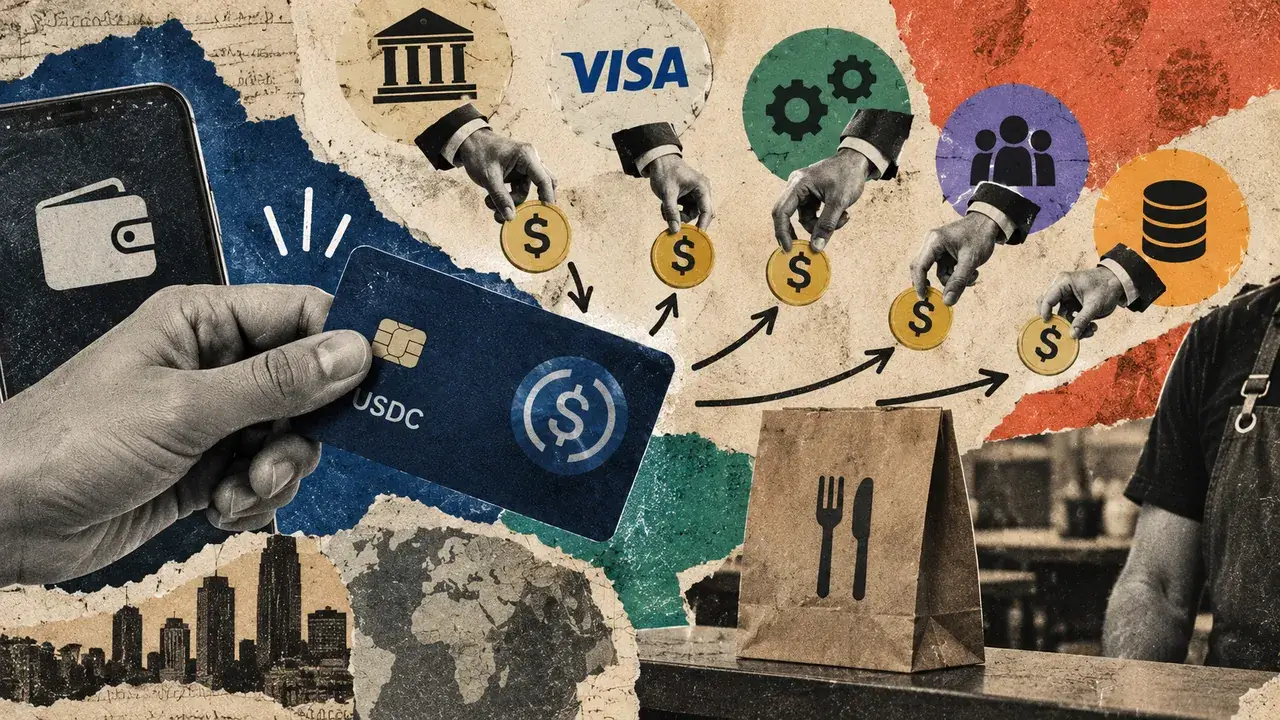

Someone paying for lunch with a stablecoin card doesn’t need the restaurant to know what USDC is. The card works like any other at the terminal, with the customer’s digital dollar balance funding the purchase while the merchant receives regular dollars through its usual payment provider.
That leaves several companies to collect fees for connecting the two.
Visa enables this arrangement through its partnership with Bridge, which allows customers in Colombia to spend stablecoins while merchants receive Colombian pesos.
Bridge handles the conversion, so neither the restaurant nor its payment provider needs to accept cryptocurrency, letting customers spend stablecoins without first withdrawing them to a bank account.
On Oct. 1, Visa reported more than 160 stablecoin-linked card programs, with payment volume up nearly 200% from the previous year, creating a growing business for companies such as Bridge, Wirex, and Rain that provide the infrastructure behind those cards.
Much of their revenue comes from payment fees, with additional opportunities in currency conversion, settlement financing, and customer subscriptions. The new funding source hasn’t removed the traditional costs of running a card program, which still need to be covered every time someone makes a purchase.
The card still runs on familiar fees
The name printed on a stablecoin card rarely identifies every company involved in processing the payment.
The consumer app manages the customer relationship, the regulated issuer provides the card, the payment network connects participating institutions, and the merchant’s provider handles acceptance, with conversion or settlement services sometimes supplied by another business.
Those responsibilities can overlap, but funding the purchase with USDC doesn’t eliminate them, and each participant needs enough revenue to cover its part of the transaction.
| Participant | Role in the payment | Potential revenue |
|---|---|---|
| Card issuer | Issues the card and manages issuing responsibilities | Interchange |
| Wallet or card brand | Provides the app and customer relationship | Interchange share, subscriptions, transaction fees |
| Card network | Connects financial institutions and processes payments | Network and processing fees |
| Merchant’s payment provider | Enables the merchant to accept cards | Merchant service charges |
| Settlement lender, where used | Advances money for payment obligations | Interest |
Companies can perform more than one role, and these aren’t separate fees necessarily charged on every transaction.
Interchange matters because the merchant’s bank or payment provider pays it to the card issuer, usually as part of the broader fees merchants pay to accept cards.
Visa earns money from its network and related services, while the issuer’s agreements determine how much revenue it can share with the company operating the customer-facing card.
Bridge, which Stripe acquired in 2025, advertises a card product that allows program operators to retain 100% of interchange and charge additional transaction fees.
That gives crypto wallets and financial apps a way to earn money when customers spend their balances, although the amount retained after processing costs, fraud prevention, compliance, and other expenses depends on each program’s arrangements.
Those expenses don’t end when a payment is approved. Disputed purchases can produce chargebacks weeks later, fraudulent transactions require investigation, and customer support costs continue regardless of whether the provider earns enough from an individual purchase to cover them.
Pavel Matveev, Wirex co-founder and CEO, told CryptoSlate that programs using the company’s infrastructure process more than $200 million in monthly spending, including partner activity.
The company hasn’t provided the requested breakdown of transaction fees and revenue sharing, so its reported processing volume can’t establish how much of it Wirex retains.
Someone has to fund the stablecoin payment
Card payments also create obligations that aren’t always settled when a customer taps the terminal. Authorization lets the merchant accept the purchase, while the financial institutions involved must later settle what they owe one another, sometimes before the customer’s funds have completed their journey through the system.
Stablecoins can move around the clock, but card programs still need access to money when settlement obligations come due, which creates demand for short-term financing even when the underlying transaction begins with digital dollars.
Rain, a provider of stablecoin-linked card infrastructure, uses a revolving credit facility from Credit Coop to meet its Visa settlement obligations. Under the arrangement, Rain draws on the facility to fund payments, then directs incoming cardholder proceeds through smart contracts that help repay the borrowing and interest.
Credit Coop earns income for supplying money during the interval between payment and repayment, allowing Rain to support transactions without keeping enough idle cash to cover every settlement obligation entirely from its own resources.
Borrowing $1 million at an annual rate of 10% would cost approximately $274 for one day, compared with about $68 for six hours. Those aren’t Rain’s disclosed borrowing terms, but they show why faster settlement can reduce financing costs without changing how much customers spend.
Revolving credit also lets the same capital fund successive batches of payments as earlier advances are repaid, so cumulative processing volume can far exceed the amount borrowed at any given moment.
Credit Coop’s financing model allows card operators to cover Visa settlement obligations with borrowed stablecoins rather than tying up their own cash. Visa claims the arrangement has reduced borrowing costs by as much as 30% for some participants, although the underlying terms and allocation of credit risk remain undisclosed.
The potential benefit is lower funding costs for card operators, but no evidence yet shows those savings are being passed on to customers through lower fees.
Visa also supports USDC settlement between participating financial institutions, allowing stablecoins to move further through the payment system without requiring the merchant to receive them.
The currency a customer spends, the currency institutions use to settle, and the money ultimately deposited into the merchant’s account can all be different.
Stablecoin cashback has to survive the math
Rewards introduce another cost, and the fee income available to cover them can be much smaller than the advertised cashback rate.
Britain’s Payment Systems Regulator sets interchange caps of 0.2% for covered domestic consumer debit transactions and 0.3% for covered consumer credit transactions. On a qualifying £100 debit purchase, that leaves at most 20 pence in interchange before the issuer’s operating expenses or any share paid to a card partner.
Offering 2% cashback on the same purchase would cost £2, leaving a £1.80 gap that would need to come from another revenue source or a promotional budget.
The UK caps don’t apply to every stablecoin card or international transaction, but they show why generous rewards can’t always be funded from ordinary payment fees. Providers can cover the difference through subscriptions, conversion charges, income from other services, or subsidies designed to attract new customers.
Those arrangements become more important when the advertised cashback depends on maintaining a qualifying token balance, joining a paid plan, or meeting minimum spending requirements.
With the Wirex card, higher cryptoback rates are tied to subscription tiers and token lockups, and rewards vary by market and customer plan.
The customer’s return depends on the entire arrangement. Cashback loses much of its appeal when a monthly subscription, conversion spread, or foreign-transaction charge eats into the benefit, especially for customers who don’t spend enough to justify an upgraded plan.
For the operator, a customer who makes one purchase to collect an introductory bonus has different economics than someone who uses the card for groceries, travel, and bills every month.
Revenue from repeat spending can help cover the cost of acquiring and supporting customers, but that depends on how much the program earns after rewards and its partners’ fees.
The customer may save money, but not always
Stablecoin cards offer their best advantage to people who already receive or hold digital dollars.
For example, freelancers paid in stablecoins can spend their earnings without repeatedly transferring money through a crypto exchange and a local bank, avoiding some of the steps and charges involved in accessing those funds.
Whether that convenience translates into savings depends on the customer’s alternatives and the transaction’s total cost.
Someone earning and spending euros faces a different calculation because converting euros into dollar stablecoins and then back into euros at checkout can introduce currency costs that wouldn’t arise with an ordinary euro-denominated bank card.
Even someone paid directly in stablecoins needs to consider conversion spreads, card fees, and the exchange rate applied when spending in local currency.
Dollar-linked tokens aim to maintain a stable value against the dollar. Their purchasing power in euros, pesos, or pounds can change with foreign-exchange rates, regardless of whether the token maintains its dollar peg.
Those differences make it hard to estimate typical customer savings from card-spending totals alone. Wirex hasn’t supplied transaction-level fee figures or retention data that would let its reported payment activity connect to individual customer economics, while public spending dashboards don’t show how much of each purchase stays with the companies operating the cards.
Despite the rapid growth in stablecoin-card spending, the volume moving through these products doesn’t establish whether customers keep using them after introductory incentives end or whether providers consistently earn more than they spend serving those customers.
Stablecoin cards made digital dollars easier to use at ordinary businesses without asking merchants to change how they accept payments. The companies making that possible now earn money from the same services that have supported card payments for decades, with blockchain-based settlement potentially reducing some costs.
For people paying with stablecoins, the benefit comes down to the money left after every fee, conversion, and reward is counted. For the companies behind the cards, it comes down to whether enough customers find that benefit worth returning for.
Analysis,Featured,Payments,Research,Stablecoins#Stablecoin #cards #booming #money #swipe1792250568
