
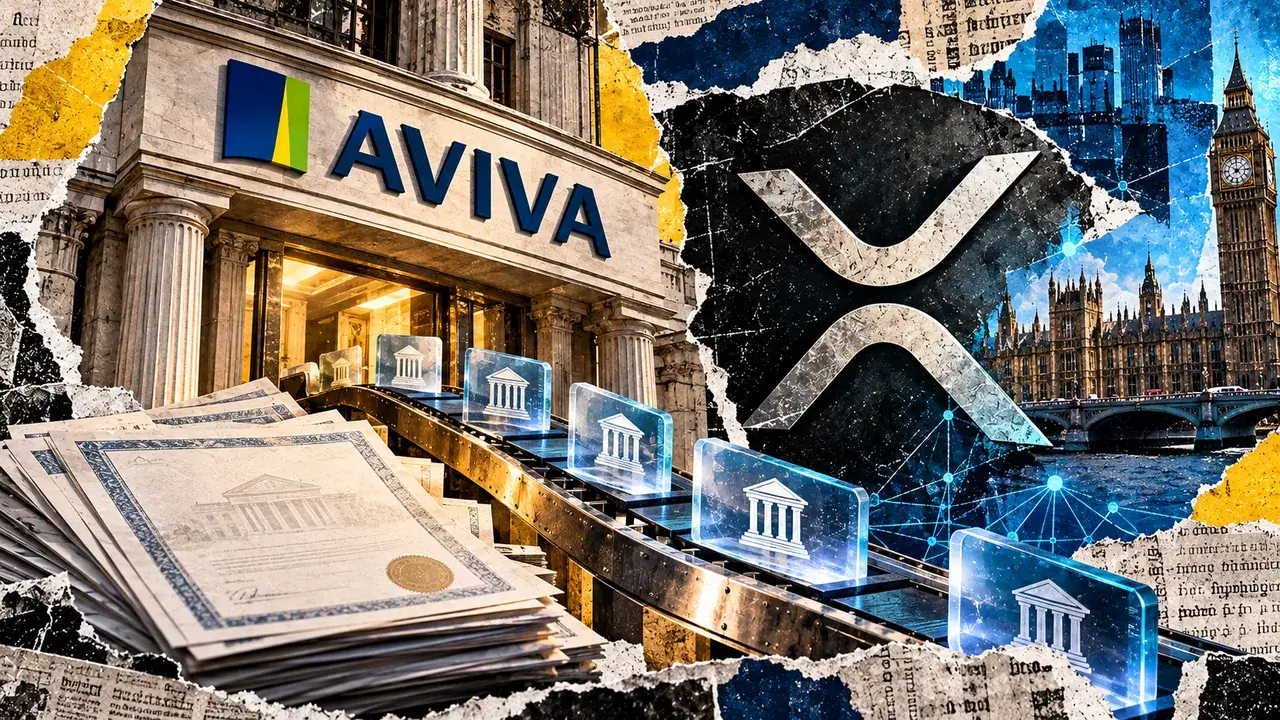

Ripple expanded its institutional reach Monday as Aviva added another tokenized fund share class to the XRP Ledger (XRPL).
The British asset manager invested £50 million ($66 million) in a blockchain-based share class of its Sterling Liquidity Fund, bringing its combined investments across two XRP Ledger offerings to more than £86 million ($116 million).
The announcement coincided with Ripple’s expansion into round-the-clock corporate cash management, extending its presence across two areas of institutional finance that could increase activity within its digital asset ecosystem.
The developments also raise a question about XRP’s role in Ripple’s growing financial infrastructure business, particularly how increased institutional adoption of the Ledger translates into demand for its native cryptocurrency.
Aviva deepens XRPL commitment with £22 billion fund
Aviva’s latest offering introduces a tokenized share class to its largest investment fund, which manages approximately £22 billion ($29 billion).
The £50 million investment represents roughly 0.23% of the existing fund’s assets, while the broader portfolio continues to operate through conventional financial infrastructure.
The Ireland-domiciled fund invests in high-grade sterling-denominated short-term debt instruments and offers daily liquidity. Its tokenized version uses a digital twin structure, representing ownership on the XRP Ledger while preserving the underlying fund’s existing investment arrangements.
The launch follows Aviva’s first tokenized money market fund offering in July, when the asset manager introduced an XRP Ledger-based share class for its US Dollar Liquidity Fund.
Mark Versey, CEO of Aviva Investors, said the second launch lays the groundwork for further expansion. Versey said:
“We believe tokenised funds can increase efficiency and ultimately lead to improved client outcomes.”
He added that the company intends to explore additional opportunities with Ripple.
The latest issuance uses the XRP Ledger’s Multi-Purpose Token (MPT) standard, which allows financial institutions to define how digital assets can be held, transferred, and recovered.
XRPL Foundation contributor Vet pointed out three restrictions on the Aviva token: holders must be authorized, the issuer can claw back tokens under specified circumstances, and transfers between investors are disabled.
These controls allow Aviva to maintain oversight of ownership and compliance while using blockchain infrastructure for issuance and redemption.
BNY Mellon remains custodian of the underlying fund assets, while Komainu provides digital asset custody support and Licuido supplies tokenization infrastructure.
The structure also establishes the limits of the development’s immediate impact on XRP.
Transactions on the XRP Ledger require XRP-denominated fees, while accounts and certain ledger objects must maintain XRP reserves. Increased network use could therefore generate additional transactional demand for the cryptocurrency.
However, standard transaction fees are extremely small, and Aviva’s investments in tokenized fund shares do not represent equivalent purchases of XRP.
The network’s ability to attract further institutional issuances, increase settlement activity and develop additional liquidity applications will determine whether these deployments create more substantial demand for the token.
Ripple targets corporate cash with 24/7 returns
Separately, Ripple introduced new capabilities for its corporate treasury platform at its Swell 2026 conference, targeting businesses seeking to manage liquidity and payments beyond traditional banking hours.
The expansion includes a product called 24/7 Returns, which allows eligible corporate clients to generate returns on qualifying digital assets, including Ripple’s RLUSD stablecoin, held in Ripple wallets.
The service helps companies earn returns on operating cash that would otherwise sit idle overnight, on weekends, and on public holidays, without independently managing the underlying digital asset transactions.
Ripple also introduced an orchestration layer that integrates its GSmart artificial intelligence capabilities with cash forecasting, reconciliation, liquidity management, and payment execution.
The rollout builds on Ripple’s $1 billion acquisition of treasury management provider GTreasury in October 2025, which brought an established enterprise software business into its digital asset operations.
Ripple identified American Airlines, Subway, Adecco, Kingfisher, Christian Louboutin, and Trax among the businesses served by its treasury platform. However, the announcement did not establish that these companies are participating in the new returns program or using XRP and RLUSD.
The commercial opportunity is substantial, although existing adoption data suggests corporate treasury departments remain cautious about digital assets.
The Association for Financial Professionals’ 2026 Liquidity Survey found that 46% of organizations increased their US cash balances, while 86% of respondents would consider real-time money market funds if they complied with their investment policies.
Yet just 1% of surveyed organizations were already using or piloting stablecoins or tokenized products, with another 9% actively exploring them.
Ripple’s expanded offering could give corporate clients another route into digital assets, but the implications for XRP depend partly on which settlement networks and assets those businesses ultimately use.
RLUSD operates across multiple blockchains, and Ripple’s payment infrastructure can settle transactions in stablecoins or conventional currencies without necessarily using XRP as an intermediary.
Ripple has also not yet disclosed the returns available through its new treasury product, the mechanisms generating those returns, or whether participating companies will route transactions through the XRP Ledger.
Adoption,Stablecoins,Technology,Tokenization#Ripple #connects #XRP #Ledger #billion #investment #giant #chasing #wave #corporate #money1793044850
