
What's Hot

    Bitcoin returns to the price that capped 2021, defined 2024, and now tests the rally again

    June 3, 2026

    Bank of England stablecoin caps may choke the UK’s pound-token market before launch

    June 3, 2026

    Ethena soars 20%: Here’s why ENA is rising and how high it can go

    June 3, 2026
    Facebook Twitter Instagram
    • Business
    • Markets
    • Get In Touch
    • Our Authors
    Facebook Twitter Instagram
    Crypto News: Latest Cryptocurrency News and Analysis
    • Home
    • Business

      Fidelity Buys 7.4% Of Bitcoin Mining Company Marathon Digital Holdings

      February 11, 2021

      Twitter Reacts as Auto Driver Begins Accepting Crypto as Payment

      February 11, 2021

      HSBC Becomes Latest Bank to Suspend Payments to Crypto

      February 4, 2021

      Bitcoin Holds Support; Approaching $50K Resistance

      February 4, 2021

      Cryptocurrency Prices Today: Bitcoin Up Over $47,000, Ether Rises 3%

      February 3, 2021
    • Technology
      1. Business
      2. Insights
      3. View All

      Fidelity Buys 7.4% Of Bitcoin Mining Company Marathon Digital Holdings

      February 11, 2021

      Twitter Reacts as Auto Driver Begins Accepting Crypto as Payment

      February 11, 2021

      HSBC Becomes Latest Bank to Suspend Payments to Crypto

      February 4, 2021

      Bitcoin Holds Support; Approaching $50K Resistance

      February 4, 2021

      Bitcoin returns to the price that capped 2021, defined 2024, and now tests the rally again

      June 3, 2026

      Bank of England stablecoin caps may choke the UK’s pound-token market before launch

      June 3, 2026

      Ethena soars 20%: Here’s why ENA is rising and how high it can go

      June 3, 2026

      Warren, Sanders Urge Labor Department to Reject Crypto-Friendly 401(k) Rule

      June 3, 2026

      Bitcoin Climbs as Elon Musk Says Tesla ‘Likely’ to Accept it Again

      March 16, 2021

      Can Cryptocurrency Be Hacked, Stolen Or Scammed? How Can You Be Safe?

      February 11, 2021

      How Investors Can Get In On Crypto Without Actually Buying Any

      February 4, 2021

      Ethereum Just Underwent a Major Change – Hence, The 25% Jump in a Week!

      February 4, 2021
    • Insights
      1. Bitcoin
      2. Ethereum
      3. Eurozone
      4. Monero
      5. View All

      Warren, Sanders Urge Labor Department to Reject Crypto-Friendly 401(k) Rule

      June 3, 2026

      Ripple Expands RLUSD Into Turkey Through Three Local Crypto Platforms

      June 3, 2026

      Strategy’s Bitcoin Sale Could Signal Start of Ether Outperformance

      June 3, 2026

      Bitcoin Slide Sparks Biggest Short-Term Holder Losses Since February

      June 3, 2026

      Bitcoin returns to the price that capped 2021, defined 2024, and now tests the rally again

      June 3, 2026

      Bank of England stablecoin caps may choke the UK’s pound-token market before launch

      June 3, 2026

      Bitcoin’s plunge to $65,000 has traders paying to protect against a fall to $50,000

      June 3, 2026

      Ripple is bringing its regulated RLUSD stablecoin to MENA’s biggest crypto market

      June 2, 2026

      Ethena soars 20%: Here’s why ENA is rising and how high it can go

      June 3, 2026

      HYPE hits new ATH as ETF momentum and institutional demand fuel rally

      June 2, 2026

      XRP drops below $1.25 amid crypto market selloff

      June 2, 2026

      Bitcoin crashes below $70K as ETF exodus and Mt. Gox fears intensify

      June 2, 2026

      Photos Show Fast-Moving Enhanced Uncirculated Gold Eagle

      June 2, 2026

      1776-2026 Declaration of Independence Quarter Enters Circulation

      June 1, 2026

      1776-2026 Cent, Quarter, and Gold Lead June US Mint Releases

      May 29, 2026

      US Mint Launches 1776-2026 Enhanced Uncirculated Gold Eagle

      May 28, 2026

      Bitcoin returns to the price that capped 2021, defined 2024, and now tests the rally again

      June 3, 2026

      Bank of England stablecoin caps may choke the UK’s pound-token market before launch

      June 3, 2026

      Ethena soars 20%: Here’s why ENA is rising and how high it can go

      June 3, 2026

      Warren, Sanders Urge Labor Department to Reject Crypto-Friendly 401(k) Rule

      June 3, 2026
    • Markets
    • Get In Touch
    Crypto News: Latest Cryptocurrency News and Analysis
    Home » Bank of England stablecoin caps may choke the UK’s pound-token market before launch
    Ethereum

    Bank of England stablecoin caps may choke the UK’s pound-token market before launch

    行政By 行政June 3, 2026No Comments8 Mins Read
    Share
    Facebook Twitter LinkedIn Pinterest Email

    A House of Lords committee has told the Bank of England to rethink stablecoin caps before the UK’s regime is finalized.

    The Financial Services Regulation Committee published its report, Stablecoins: waiting for regulation, on June 3, turning a technical debate over reserve design into a test of whether the UK can build a pound-denominated stablecoin market without making it uneconomic from the start.

    The pressure point is the design of the safeguards. The committee supports 1:1 backing and accepts that stablecoins can create risks around financial stability, consumer protection, and illicit finance.

    Its challenge is more specific: the Bank’s proposed safeguards may be calibrated for a market that does not yet exist in the UK.

    Two measures sit at the center of that critique. The Bank has proposed temporary per-coin holding limits of £20,000 for individuals and £10 million for businesses.

    It has also proposed requiring systemic sterling stablecoin issuers to keep at least 40% of backing assets as deposits at the Bank of England that do not earn interest.

    The Lords report says those choices could shape whether a GBP stablecoin market develops at all. If a pound stablecoin cannot be held in useful amounts or generate enough reserve income to support the issuer’s business, the UK could end up with clear rules, but few firms willing to build the products those rules are meant to govern.
    Revolut’s digital pound trial shifts the UK payments debate from crypto hype to consumer protections and clarityRevolut’s digital pound trial shifts the UK payments debate from crypto hype to consumer protections and clarity
    Related Reading

    Revolut’s digital pound trial shifts the UK payments debate from crypto hype to consumer protections and clarity

    Revolut is about to test a pound stablecoin in the UK’s regulatory sandbox, and the scale of the trial matters less than where it sits.

    Mar 2, 2026 · Andjela Radmilac

    The Rules Under Pressure

    The Bank of England’s November 2025 consultation proposed a split backing model for systemic sterling stablecoins.

    At least 40% of backing assets would sit as deposits at the Bank, while up to 60% could be held in short-term sterling-denominated UK government debt.

    The Bank’s case is that central-bank deposits provide immediate liquidity if holders seek large redemptions in a short period. In its consultation, it said the threshold aligned with estimates of possible short-term redemption requests drawn from stress events in traditional and crypto markets.

    The 60% government-debt allowance was meant to improve issuer viability compared with an earlier model that would have placed all backing assets in unremunerated central-bank deposits.

    That compromise is now under pressure. The Lords committee concluded that remuneration and liquidity requirements for backing assets could have a significant effect on issuer viability and UK competitiveness.

    It urged the Bank to consider the impact of requiring a proportion of unremunerated assets and to reconsider whether deposits held at the Bank should be remunerated at Bank Rate.

    The committee also pushed the Bank toward a more flexible approach to backing-asset composition. It said the Bank should be open to a principles-based and less prescriptive model, with requirements adjusted as market behavior and risks become clearer.

    The same logic applies to holding limits. The Bank’s proposal would cap each individual’s holdings of a systemic stablecoin at £20,000 per coin and each business’s holdings at £10 million, with possible exemptions for businesses that need higher balances in normal operations.
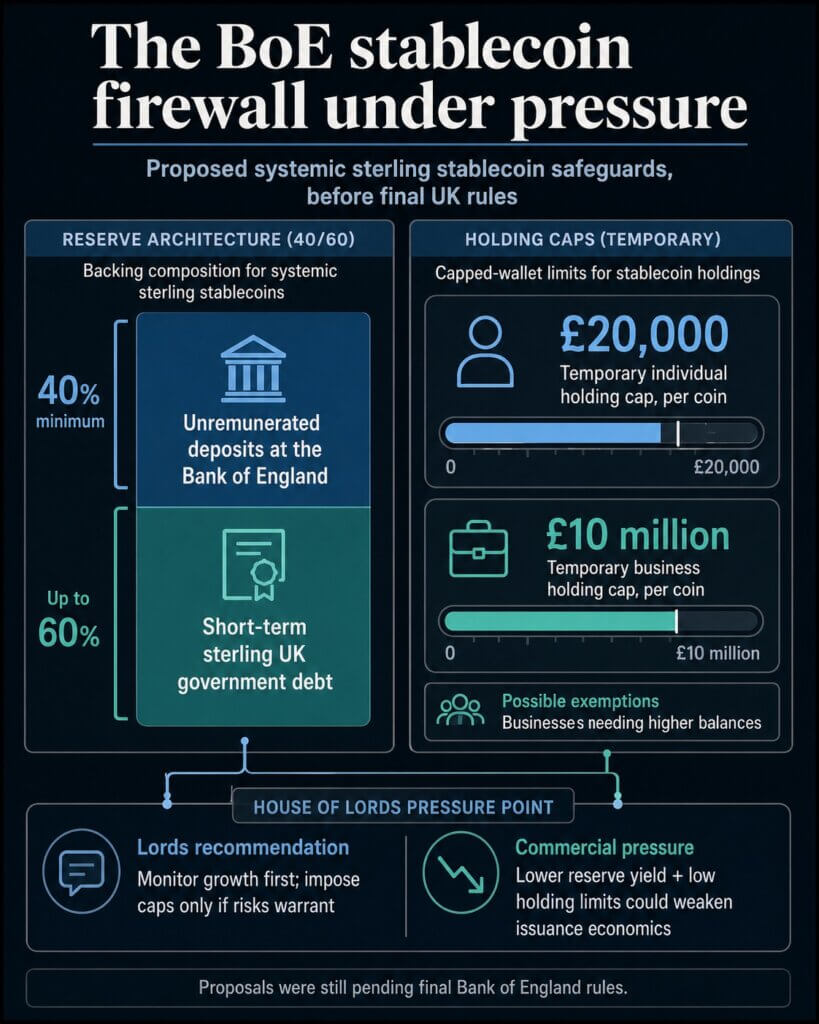
    Infographic showing proposed Bank of England stablecoin reserve split, temporary holding caps, and House of Lords recommendations.Infographic showing proposed Bank of England stablecoin reserve split, temporary holding caps, and House of Lords recommendations.

    In a November news release, the Bank framed those limits as temporary tools to protect access to credit while the financial system adapts to new forms of money.

    The committee’s recommendation was sharper. Given the early stage of the GBP stablecoin market, it said the Bank should monitor growth and impose holding limits only if financial stability risks clearly warrant them.

    If limits become necessary, the committee said the Bank should consult to ensure they can be implemented in a practical way that still meets the Bank’s objectives.

    Why The Bank Is Cautious

    The Bank’s concern goes beyond competition with banks. In the UK, bank deposits do more work inside the credit system than they do in some other major markets.

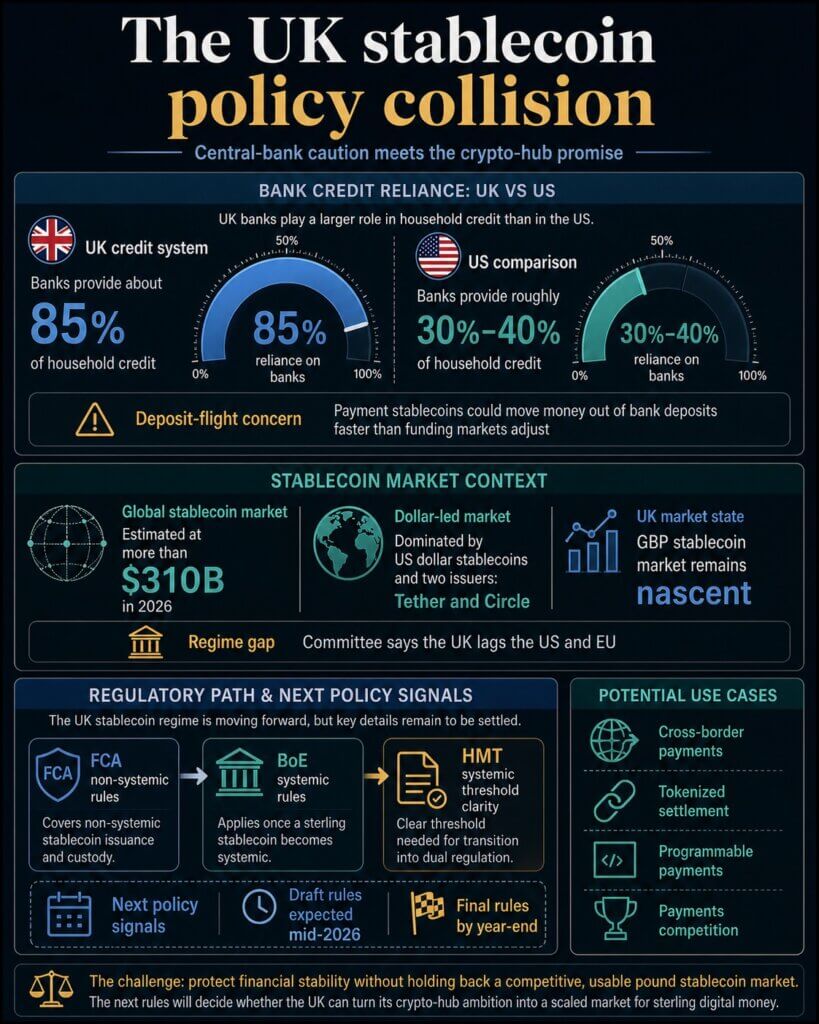
    In oral evidence to the committee in March, Sarah Breeden, the Bank’s deputy governor for financial stability, said banks provide about 85% of household credit in the UK, compared with roughly 30% to 40% in the US.

    Her argument was that if deposits moved rapidly into payment stablecoins and that funding was not replaced, the result could be a drop in credit for households and businesses.

    That is the financial-stability case for a circuit breaker. The Bank is designing for a future in which stablecoins are widely used as money for everyday payments, beyond their current use in crypto trading.

    If adoption moved quickly through social media platforms, e-commerce networks, wallets, or automated payment tools, the Bank worries that money could leave deposits faster than banks and funding markets could adjust.
    The world’s central banks finally see crypto as a real monetary threat to TradFiThe world’s central banks finally see crypto as a real monetary threat to TradFi
    Related Reading

    The world’s central banks finally see crypto as a real monetary threat to TradFi

    The stablecoin debate has left crypto regulation behind and entered the territory of monetary sovereignty.

    Apr 25, 2026 · Andjela Radmilac

    The committee accepts that risk. Its report says stablecoins can pose challenges around financial stability, illicit finance, and consumer protection.

    It also welcomes 1:1 backing, audited reserves, disclosure, statutory trust protections, and the proposed Bank backstop lending facility for systemic issuers.

    The disagreement is about timing and prescription. Lawmakers are asking whether the Bank should impose caps and reserve economics before there is enough evidence about how a pound stablecoin market would behave.

    A protective rulebook could reduce the chance of a disorderly shift out of bank deposits. It could also make the regulated version of the product less attractive than offshore, dollar-denominated, or non-systemic alternatives.

    The stakes are higher because the report describes the UK stablecoin market as nascent while the global market is already large and dollar-led.

    CryptoSlate Daily Brief

    Daily signals, zero noise.

    Market-moving headlines and context delivered every morning in one tight read.

    5-minute digest 100k+ readers

    Free. No spam. Unsubscribe any time.

    Whoops, looks like there was a problem. Please try again.

    You’re subscribed. Welcome aboard.

    It says the global stablecoin market was estimated at more than $310 billion in 2026, overwhelmingly dominated by US dollar stablecoins and two issuers, Tether and Circle.

    For the UK, that creates a strategic problem. A sterling stablecoin market could support cross-border payments, tokenized settlement, programmable payments, and competition in payments.

    It could also reduce the risk that UK users and businesses default to dollar stablecoins because pound alternatives never get enough regulatory clarity or commercial scale.

    The committee says the UK is already lagging the US and EU in developing a stablecoin regime, though it says the country is now moving in the right direction.

    The FCA’s stablecoin issuance and crypto custody consultation covers the non-systemic side of the regime, while the Bank’s rules apply once a sterling stablecoin becomes systemic.

    The transition between those regimes remains one of the areas issuers need to understand before they can build durable business plans.


    Bank of England’s 24/7 settlement plan shows where tokenized finance can enter core marketsBank of England’s 24/7 settlement plan shows where tokenized finance can enter core markets
    Related Reading

    Bank of England’s 24/7 settlement plan shows where tokenized finance can enter core markets

    The Bank of England is laying the groundwork for tokenized finance by fixing the old settlement clock that still governs trillions in payments.

    May 23, 2026 · Andjela Radmilac

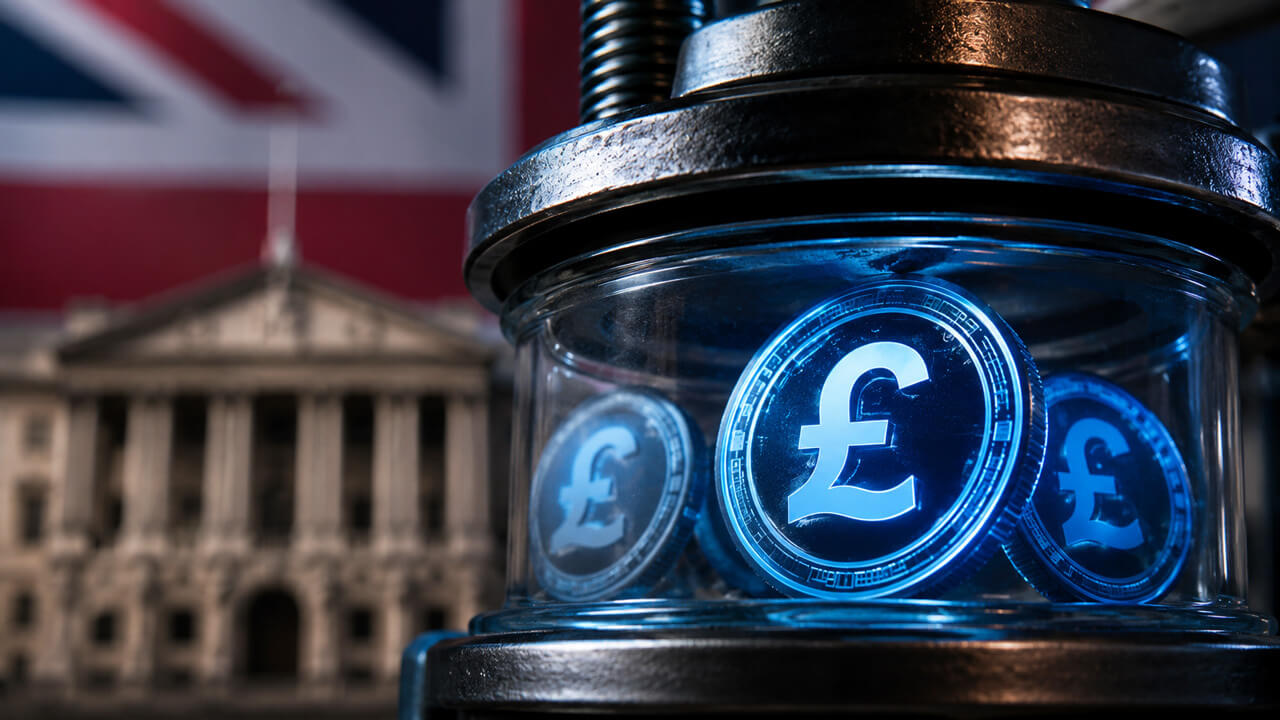
    Cartoon pound token restrained outside the Bank of England as officials debate stablecoin caps.Cartoon pound token restrained outside the Bank of England as officials debate stablecoin caps.

    The Next Signal Is The Draft Rulebook

    The timing makes the Lords report more than a retrospective critique. Breeden told the committee in March that the Bank expected draft rules in the middle of 2026, final rules by year-end, and applications from stablecoin issuers by the end of the year.

    That means the next policy document will show whether the Bank treats the report as a reason to change the design or as a challenge to explain the existing model more clearly.

    The signals to watch are specific: whether per-holder caps remain, whether the Bank shifts toward aggregate issuance guardrails or monitoring triggers, whether the 40% deposit share is adjusted, and whether any Bank deposits receive remuneration.

    Rewards will count, too. The committee noted relatively little demand for issuers to pay interest on stablecoins, but said the treatment of rewards, rebates, or other incentives could affect the creation of a GBP stablecoin market and the UK’s international competitiveness.

    That question connects stablecoin rules to the broader payments market, where card networks and financial apps already compete through reward structures.

    The report also asks for more clarity from HM Treasury on when a stablecoin becomes systemic. That threshold is central for issuers because it determines when a firm moves from the FCA-only track into dual regulation by the Bank and FCA.

    If the transition is too uncertain, scaling may become a risk in itself.
    <p>A House of Lords committee has told the Bank of England to rethink stablecoin caps before the UK's regime is finalized.</p> <p>The Financial Services Regulation Committee published its report, <a href="https://publications.parliament.uk/pa/ld5902/ldselect/ldfsrc/6/603.htm">Stablecoins: waiting for regulation</a>, on June 3, turning a technical debate over reserve design into a test of whether the UK can build a pound-denominated stablecoin market without making it uneconomic from the start.</p> <p>The pressure point is the design of the safeguards. The committee supports 1:1 backing and accepts that stablecoins can create risks around financial stability, consumer protection, and illicit finance.</p> <p>Its challenge is more specific: the Bank's proposed safeguards may be calibrated for a market that does not yet exist in the UK.</p> <p>Two measures sit at the center of that critique. The Bank has proposed temporary per-coin holding limits of £20,000 for individuals and £10 million for businesses.</p> <p>It has also proposed requiring systemic sterling stablecoin issuers to keep at least 40% of backing assets as deposits at the Bank of England that do not earn interest.</p> <p>The Lords report says those choices could shape whether a GBP stablecoin market develops at all. If a pound stablecoin cannot be held in useful amounts or generate enough reserve income to support the issuer's business, the UK could end up with clear rules, but few firms willing to build the products those rules are meant to govern.</p>  <h2>The Rules Under Pressure</h2> <p>The <a href="https://www.bankofengland.co.uk/paper/2025/cp/proposed-regulatory-regime-for-sterling-denominated-systemic-stablecoins">Bank of England's November 2025 consultation</a> proposed a split backing model for systemic sterling stablecoins.</p> <p>At least 40% of backing assets would sit as deposits at the Bank, while up to 60% could be held in short-term sterling-denominated UK government debt.</p> <p>The Bank's case is that central-bank deposits provide immediate liquidity if holders seek large redemptions in a short period. In its consultation, it said the threshold aligned with estimates of possible short-term redemption requests drawn from stress events in traditional and crypto markets.</p> <p>The 60% government-debt allowance was meant to improve issuer viability compared with an earlier model that would have placed all backing assets in unremunerated central-bank deposits.</p> <p>That compromise is now under pressure. The Lords committee concluded that remuneration and liquidity requirements for backing assets could have a significant effect on issuer viability and UK competitiveness.</p> <p>It urged the Bank to consider the impact of requiring a proportion of unremunerated assets and to reconsider whether deposits held at the Bank should be remunerated at Bank Rate.</p> <p>The committee also pushed the Bank toward a more flexible approach to backing-asset composition. It said the Bank should be open to a principles-based and less prescriptive model, with requirements adjusted as market behavior and risks become clearer.</p> <p>The same logic applies to holding limits. The Bank's proposal would cap each individual's holdings of a systemic stablecoin at £20,000 per coin and each business's holdings at £10 million, with possible exemptions for businesses that need higher balances in normal operations.</p> <a href="/Users/akiba/.codex/generated_images/019e8cb1-59a7-7521-9a5b-5530473dc94f/ig_00979bc5d4b7cc9f016a1fef5361748191971068fec11770fa.png" target="_blank" rel="noopener"><img class="aligncenter wp-image-532220 size-full" src="/Users/akiba/.codex/generated_images/019e8cb1-59a7-7521-9a5b-5530473dc94f/ig_00979bc5d4b7cc9f016a1fef5361748191971068fec11770fa.png" alt="Infographic showing proposed Bank of England stablecoin reserve split, temporary holding caps, and House of Lords recommendations." width="1122" height="1402" /></a> <p>In a <a href="https://www.bankofengland.co.uk/news/2025/november/boe-launches-consultation-on-regulating-systemic-stablecoins">November news release</a>, the Bank framed those limits as temporary tools to protect access to credit while the financial system adapts to new forms of money.</p> <p>The committee's recommendation was sharper. Given the early stage of the GBP stablecoin market, it said the Bank should monitor growth and impose holding limits only if financial stability risks clearly warrant them.</p> <p>If limits become necessary, the committee said the Bank should consult to ensure they can be implemented in a practical way that still meets the Bank's objectives.</p> <h2>Why The Bank Is Cautious</h2> <p>The Bank's concern goes beyond competition with banks. In the UK, bank deposits do more work inside the credit system than they do in some other major markets.</p> <p>In <a href="https://committees.parliament.uk/oralevidence/17316/html/">oral evidence to the committee</a> in March, Sarah Breeden, the Bank's deputy governor for financial stability, said banks provide about 85% of household credit in the UK, compared with roughly 30% to 40% in the US.</p> <p>Her argument was that if deposits moved rapidly into payment stablecoins and that funding was not replaced, the result could be a drop in credit for households and businesses.</p> <p>That is the financial-stability case for a circuit breaker. The Bank is designing for a future in which stablecoins are widely used as money for everyday payments, beyond their current use in crypto trading.</p> <p>If adoption moved quickly through social media platforms, e-commerce networks, wallets, or automated payment tools, the Bank worries that money could leave deposits faster than banks and funding markets could adjust.</p>  <p>The committee accepts that risk. Its report says stablecoins can pose challenges around financial stability, illicit finance, and consumer protection.</p> <p>It also welcomes 1:1 backing, audited reserves, disclosure, statutory trust protections, and the proposed Bank backstop lending facility for systemic issuers.</p> <p>The disagreement is about timing and prescription. Lawmakers are asking whether the Bank should impose caps and reserve economics before there is enough evidence about how a pound stablecoin market would behave.</p> <p>A protective rulebook could reduce the chance of a disorderly shift out of bank deposits. It could also make the regulated version of the product less attractive than offshore, dollar-denominated, or non-systemic alternatives.</p> <p>The stakes are higher because the report describes the UK stablecoin market as nascent while the global market is already large and dollar-led.</p> <p>It says the global stablecoin market was estimated at more than $310 billion in 2026, overwhelmingly dominated by US dollar stablecoins and two issuers, <a href="https://cryptoslate.com/coins/tether/">Tether</a> and Circle.</p> <p>For the UK, that creates a strategic problem. A sterling stablecoin market could support cross-border payments, tokenized settlement, programmable payments, and competition in payments.</p> <p>It could also reduce the risk that UK users and businesses default to dollar stablecoins because pound alternatives never get enough regulatory clarity or commercial scale.</p> <p>The committee says the UK is already lagging the US and EU in developing a stablecoin regime, though it says the country is now moving in the right direction.</p> <p>The FCA's <a href="https://www.fca.org.uk/publications/consultation-papers/cp25-14-stablecoin-issuance-cryptoasset-custody">stablecoin issuance and crypto custody consultation</a> covers the non-systemic side of the regime, while the Bank's rules apply once a sterling stablecoin becomes systemic.</p> <p>The transition between those regimes remains one of the areas issuers need to understand before they can build durable business plans.</p>  <h2>The Next Signal Is The Draft Rulebook</h2> <p>The timing makes the Lords report more than a retrospective critique. Breeden told the committee in March that the Bank expected draft rules in the middle of 2026, final rules by year-end, and applications from stablecoin issuers by the end of the year.</p> <p>That means the next policy document will show whether the Bank treats the report as a reason to change the design or as a challenge to explain the existing model more clearly.</p> <p>The signals to watch are specific: whether per-holder caps remain, whether the Bank shifts toward aggregate issuance guardrails or monitoring triggers, whether the 40% deposit share is adjusted, and whether any Bank deposits receive remuneration.</p> <p>Rewards will count, too. The committee noted relatively little demand for issuers to pay interest on stablecoins, but said the treatment of rewards, rebates, or other incentives could affect the creation of a GBP stablecoin market and the UK's international competitiveness.</p> <p>That question connects stablecoin rules to the broader payments market, where card networks and financial apps already compete through reward structures.</p> <p>The report also asks for more clarity from HM Treasury on when a stablecoin becomes systemic. That threshold is central for issuers because it determines when a firm moves from the FCA-only track into dual regulation by the Bank and FCA.</p> <p>If the transition is too uncertain, scaling may become a risk in itself.</p> <a href="/Users/akiba/.codex/generated_images/019e8cb1-59a7-7521-9a5b-5530473dc94f/ig_00979bc5d4b7cc9f016a1fefdcf1b88191817712db7a8bb4c5.png" target="_blank" rel="noopener"><img class="aligncenter wp-image-532220 size-full" src="/Users/akiba/.codex/generated_images/019e8cb1-59a7-7521-9a5b-5530473dc94f/ig_00979bc5d4b7cc9f016a1fefdcf1b88191817712db7a8bb4c5.png" alt="Infographic comparing UK and US household credit reliance, global stablecoin market context, and the UK regulatory path." width="1122" height="1402" /></a> <p>CryptoSlate has already covered adjacent UK payment infrastructure moves, including <a href="https://cryptoslate.com/revolut-pound-stablecoin-uk-sandbox-trial/">Revolut's pound stablecoin sandbox trial</a> and the Bank's <a href="https://cryptoslate.com/bank-of-englands-24-7-settlement-plan-shows-where-tokenized-finance-can-enter-core-markets/">24/7 settlement plans</a>.</p> <p>The Lords report moves the debate to a different point: whether the UK's stablecoin rulebook will let a sterling market become commercially meaningful once tokenized payments enter the system.</p> <p>The Bank is still finalizing the regime, and the committee is still asking for financial-stability protections. The new pressure is for the Bank to show that its safeguards will not stop a pound stablecoin market before it has a chance to form.</p> <p>That is the live test for the UK's crypto-hub promise. The next draft rules will show whether the Bank's stablecoin firewall is a temporary guardrail, a redesign in progress, or a cost issuers decide the pound market cannot absorb.</p><p>A House of Lords committee has told the Bank of England to rethink stablecoin caps before the UK's regime is finalized.</p> <p>The Financial Services Regulation Committee published its report, <a href="https://publications.parliament.uk/pa/ld5902/ldselect/ldfsrc/6/603.htm">Stablecoins: waiting for regulation</a>, on June 3, turning a technical debate over reserve design into a test of whether the UK can build a pound-denominated stablecoin market without making it uneconomic from the start.</p> <p>The pressure point is the design of the safeguards. The committee supports 1:1 backing and accepts that stablecoins can create risks around financial stability, consumer protection, and illicit finance.</p> <p>Its challenge is more specific: the Bank's proposed safeguards may be calibrated for a market that does not yet exist in the UK.</p> <p>Two measures sit at the center of that critique. The Bank has proposed temporary per-coin holding limits of £20,000 for individuals and £10 million for businesses.</p> <p>It has also proposed requiring systemic sterling stablecoin issuers to keep at least 40% of backing assets as deposits at the Bank of England that do not earn interest.</p> <p>The Lords report says those choices could shape whether a GBP stablecoin market develops at all. If a pound stablecoin cannot be held in useful amounts or generate enough reserve income to support the issuer's business, the UK could end up with clear rules, but few firms willing to build the products those rules are meant to govern.</p>  <h2>The Rules Under Pressure</h2> <p>The <a href="https://www.bankofengland.co.uk/paper/2025/cp/proposed-regulatory-regime-for-sterling-denominated-systemic-stablecoins">Bank of England's November 2025 consultation</a> proposed a split backing model for systemic sterling stablecoins.</p> <p>At least 40% of backing assets would sit as deposits at the Bank, while up to 60% could be held in short-term sterling-denominated UK government debt.</p> <p>The Bank's case is that central-bank deposits provide immediate liquidity if holders seek large redemptions in a short period. In its consultation, it said the threshold aligned with estimates of possible short-term redemption requests drawn from stress events in traditional and crypto markets.</p> <p>The 60% government-debt allowance was meant to improve issuer viability compared with an earlier model that would have placed all backing assets in unremunerated central-bank deposits.</p> <p>That compromise is now under pressure. The Lords committee concluded that remuneration and liquidity requirements for backing assets could have a significant effect on issuer viability and UK competitiveness.</p> <p>It urged the Bank to consider the impact of requiring a proportion of unremunerated assets and to reconsider whether deposits held at the Bank should be remunerated at Bank Rate.</p> <p>The committee also pushed the Bank toward a more flexible approach to backing-asset composition. It said the Bank should be open to a principles-based and less prescriptive model, with requirements adjusted as market behavior and risks become clearer.</p> <p>The same logic applies to holding limits. The Bank's proposal would cap each individual's holdings of a systemic stablecoin at £20,000 per coin and each business's holdings at £10 million, with possible exemptions for businesses that need higher balances in normal operations.</p> <a href="/Users/akiba/.codex/generated_images/019e8cb1-59a7-7521-9a5b-5530473dc94f/ig_00979bc5d4b7cc9f016a1fef5361748191971068fec11770fa.png" target="_blank" rel="noopener"><img class="aligncenter wp-image-532220 size-full" src="/Users/akiba/.codex/generated_images/019e8cb1-59a7-7521-9a5b-5530473dc94f/ig_00979bc5d4b7cc9f016a1fef5361748191971068fec11770fa.png" alt="Infographic showing proposed Bank of England stablecoin reserve split, temporary holding caps, and House of Lords recommendations." width="1122" height="1402" /></a> <p>In a <a href="https://www.bankofengland.co.uk/news/2025/november/boe-launches-consultation-on-regulating-systemic-stablecoins">November news release</a>, the Bank framed those limits as temporary tools to protect access to credit while the financial system adapts to new forms of money.</p> <p>The committee's recommendation was sharper. Given the early stage of the GBP stablecoin market, it said the Bank should monitor growth and impose holding limits only if financial stability risks clearly warrant them.</p> <p>If limits become necessary, the committee said the Bank should consult to ensure they can be implemented in a practical way that still meets the Bank's objectives.</p> <h2>Why The Bank Is Cautious</h2> <p>The Bank's concern goes beyond competition with banks. In the UK, bank deposits do more work inside the credit system than they do in some other major markets.</p> <p>In <a href="https://committees.parliament.uk/oralevidence/17316/html/">oral evidence to the committee</a> in March, Sarah Breeden, the Bank's deputy governor for financial stability, said banks provide about 85% of household credit in the UK, compared with roughly 30% to 40% in the US.</p> <p>Her argument was that if deposits moved rapidly into payment stablecoins and that funding was not replaced, the result could be a drop in credit for households and businesses.</p> <p>That is the financial-stability case for a circuit breaker. The Bank is designing for a future in which stablecoins are widely used as money for everyday payments, beyond their current use in crypto trading.</p> <p>If adoption moved quickly through social media platforms, e-commerce networks, wallets, or automated payment tools, the Bank worries that money could leave deposits faster than banks and funding markets could adjust.</p>  <p>The committee accepts that risk. Its report says stablecoins can pose challenges around financial stability, illicit finance, and consumer protection.</p> <p>It also welcomes 1:1 backing, audited reserves, disclosure, statutory trust protections, and the proposed Bank backstop lending facility for systemic issuers.</p> <p>The disagreement is about timing and prescription. Lawmakers are asking whether the Bank should impose caps and reserve economics before there is enough evidence about how a pound stablecoin market would behave.</p> <p>A protective rulebook could reduce the chance of a disorderly shift out of bank deposits. It could also make the regulated version of the product less attractive than offshore, dollar-denominated, or non-systemic alternatives.</p> <p>The stakes are higher because the report describes the UK stablecoin market as nascent while the global market is already large and dollar-led.</p> <p>It says the global stablecoin market was estimated at more than $310 billion in 2026, overwhelmingly dominated by US dollar stablecoins and two issuers, <a href="https://cryptoslate.com/coins/tether/">Tether</a> and Circle.</p> <p>For the UK, that creates a strategic problem. A sterling stablecoin market could support cross-border payments, tokenized settlement, programmable payments, and competition in payments.</p> <p>It could also reduce the risk that UK users and businesses default to dollar stablecoins because pound alternatives never get enough regulatory clarity or commercial scale.</p> <p>The committee says the UK is already lagging the US and EU in developing a stablecoin regime, though it says the country is now moving in the right direction.</p> <p>The FCA's <a href="https://www.fca.org.uk/publications/consultation-papers/cp25-14-stablecoin-issuance-cryptoasset-custody">stablecoin issuance and crypto custody consultation</a> covers the non-systemic side of the regime, while the Bank's rules apply once a sterling stablecoin becomes systemic.</p> <p>The transition between those regimes remains one of the areas issuers need to understand before they can build durable business plans.</p>  <h2>The Next Signal Is The Draft Rulebook</h2> <p>The timing makes the Lords report more than a retrospective critique. Breeden told the committee in March that the Bank expected draft rules in the middle of 2026, final rules by year-end, and applications from stablecoin issuers by the end of the year.</p> <p>That means the next policy document will show whether the Bank treats the report as a reason to change the design or as a challenge to explain the existing model more clearly.</p> <p>The signals to watch are specific: whether per-holder caps remain, whether the Bank shifts toward aggregate issuance guardrails or monitoring triggers, whether the 40% deposit share is adjusted, and whether any Bank deposits receive remuneration.</p> <p>Rewards will count, too. The committee noted relatively little demand for issuers to pay interest on stablecoins, but said the treatment of rewards, rebates, or other incentives could affect the creation of a GBP stablecoin market and the UK's international competitiveness.</p> <p>That question connects stablecoin rules to the broader payments market, where card networks and financial apps already compete through reward structures.</p> <p>The report also asks for more clarity from HM Treasury on when a stablecoin becomes systemic. That threshold is central for issuers because it determines when a firm moves from the FCA-only track into dual regulation by the Bank and FCA.</p> <p>If the transition is too uncertain, scaling may become a risk in itself.</p> <a href="/Users/akiba/.codex/generated_images/019e8cb1-59a7-7521-9a5b-5530473dc94f/ig_00979bc5d4b7cc9f016a1fefdcf1b88191817712db7a8bb4c5.png" target="_blank" rel="noopener"><img class="aligncenter wp-image-532220 size-full" src="/Users/akiba/.codex/generated_images/019e8cb1-59a7-7521-9a5b-5530473dc94f/ig_00979bc5d4b7cc9f016a1fefdcf1b88191817712db7a8bb4c5.png" alt="Infographic comparing UK and US household credit reliance, global stablecoin market context, and the UK regulatory path." width="1122" height="1402" /></a> <p>CryptoSlate has already covered adjacent UK payment infrastructure moves, including <a href="https://cryptoslate.com/revolut-pound-stablecoin-uk-sandbox-trial/">Revolut's pound stablecoin sandbox trial</a> and the Bank's <a href="https://cryptoslate.com/bank-of-englands-24-7-settlement-plan-shows-where-tokenized-finance-can-enter-core-markets/">24/7 settlement plans</a>.</p> <p>The Lords report moves the debate to a different point: whether the UK's stablecoin rulebook will let a sterling market become commercially meaningful once tokenized payments enter the system.</p> <p>The Bank is still finalizing the regime, and the committee is still asking for financial-stability protections. The new pressure is for the Bank to show that its safeguards will not stop a pound stablecoin market before it has a chance to form.</p> <p>That is the live test for the UK's crypto-hub promise. The next draft rules will show whether the Bank's stablecoin firewall is a temporary guardrail, a redesign in progress, or a cost issuers decide the pound market cannot absorb.</p>

    CryptoSlate has already covered adjacent UK payment infrastructure moves, including Revolut’s pound stablecoin sandbox trial and the Bank’s 24/7 settlement plans.

    The Lords report moves the debate to a different point: whether the UK’s stablecoin rulebook will let a sterling market become commercially meaningful once tokenized payments enter the system.

    The Bank is still finalizing the regime, and the committee is still asking for financial-stability protections. The new pressure is for the Bank to show that its safeguards will not stop a pound stablecoin market before it has a chance to form.

    That is the live test for the UK’s crypto-hub promise. The next draft rules will show whether the Bank’s stablecoin firewall is a temporary guardrail, a redesign in progress, or a cost issuers decide the pound market cannot absorb.

    Adoption,Banking,Featured,Politics,Regulation#Bank #England #stablecoin #caps #choke #UKs #poundtoken #market #launch1780493035

    Bank Caps choke England Launch market poundtoken Stablecoin UKs
    Share. Facebook Twitter Pinterest LinkedIn Tumblr Email
    行政
    • Website

    Related Posts

    Bitcoin returns to the price that capped 2021, defined 2024, and now tests the rally again

    June 3, 2026

    Bitcoin’s plunge to $65,000 has traders paying to protect against a fall to $50,000

    June 3, 2026

    Ripple is bringing its regulated RLUSD stablecoin to MENA’s biggest crypto market

    June 2, 2026

    Bitcoin flash crash below $68,000 triggers around $400 million in liquidation in under an hour

    June 2, 2026
    Add A Comment

    Leave A Reply Cancel Reply

    Top Posts

    Millennials Are Quitting Job to Become Day Traders

    January 20, 2021

    Jack Dorsey Says Bitcoin Will Unite The World

    January 15, 2021

    Hong Kong Customs Arrest Four in Crypto Laundering Bust

    January 15, 2021

    Subscribe to Updates

    Get the latest sports news from SportsSite about soccer, football and tennis.

    Advertisement
    Demo

    Your source for the serious news. This demo is crafted specifically to exhibit the use of the theme as a news site. Visit our main page for more demos.

    We're social. Connect with us:

    Facebook Twitter Instagram Pinterest YouTube
    Top Insights

    Bitcoin returns to the price that capped 2021, defined 2024, and now tests the rally again

    June 3, 2026

    Bank of England stablecoin caps may choke the UK’s pound-token market before launch

    June 3, 2026

    Ethena soars 20%: Here’s why ENA is rising and how high it can go

    June 3, 2026
    Get Informed

    Subscribe to Updates

    Get the latest creative news from FooBar about art, design and business.

    Facebook Twitter Instagram Pinterest
    • Home
    • Business
    • Markets
    • Technology
    • Contact us
    © 2026 ThemeSphere. Designed by WPfastworld.
    • Easterngifts
    • koreanbj
    • korean bj porn​
    • korean bj nude

    Type above and press Enter to search. Press Esc to cancel.