


The Clearing House, the bank-owned operator of core U.S. payment infrastructure, is preparing a system that lets banks settle deposits on-chain.
Its June 5 announcement puts the largest U.S. banks behind a shared response to the stablecoin challenge: dollar payments can now move around the clock, across blockchain rails, with programmable settlement.
Banks want those features while retaining the customer balances, compliance controls, and deposit economics that sit inside the regulated banking system.
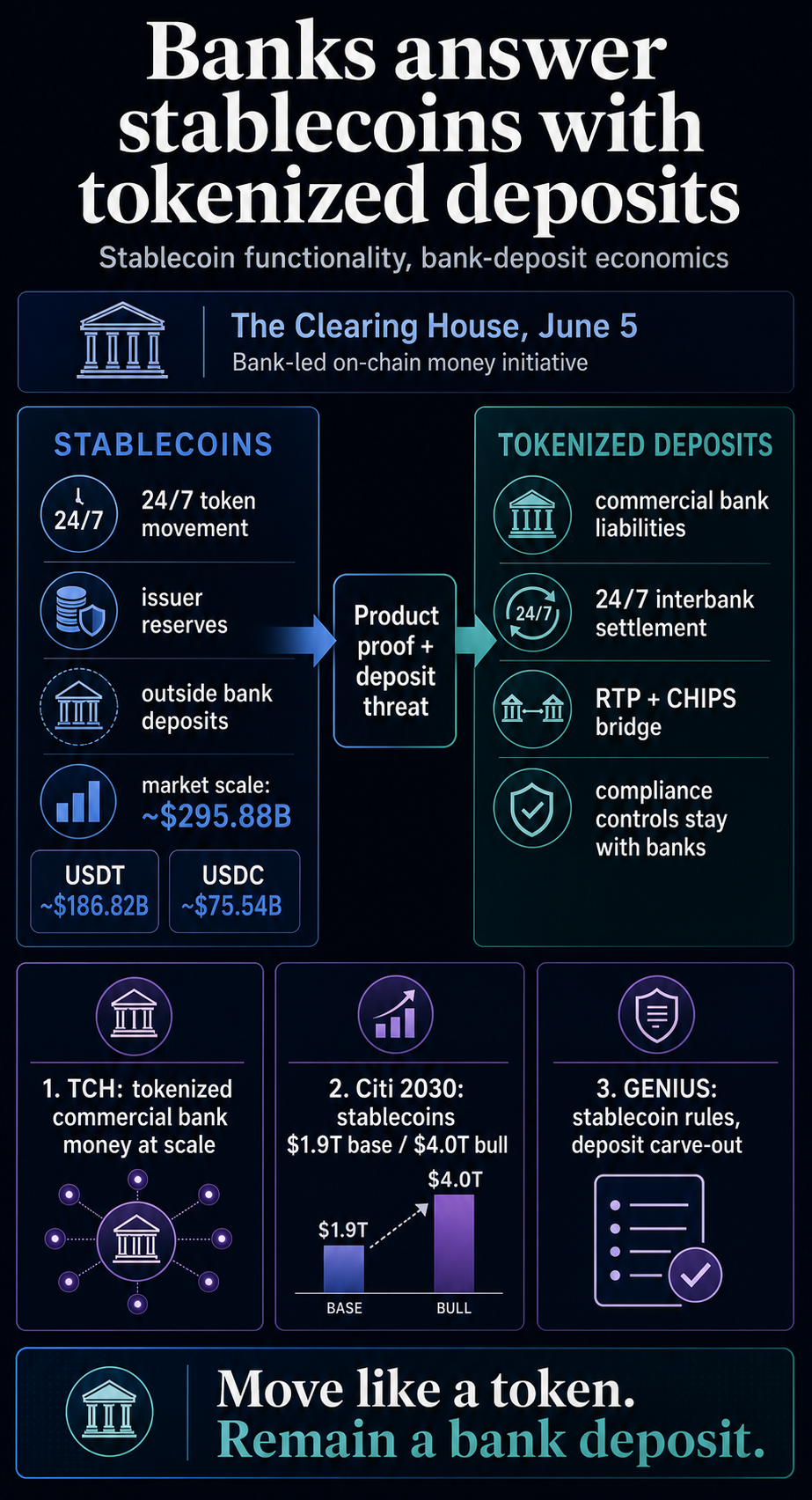
The initiative would enable clearing and settlement of tokenized commercial bank money at scale. TCH said it would support 24/7 on-chain clearing and settlement of tokenized deposits between banks while linking blockchain-based activity with established fiat rails such as RTP and CHIPS, according to The Clearing House announcement.
That structure gives banks a different instrument from a bank stablecoin. Stablecoins move dollar claims outside the deposit system. Tokenized deposits try to move bank deposits with some of the same digital features while keeping the money as commercial bank liabilities.
The strategy is defensive and opportunistic at the same time. Banks are embracing crypto rails because stablecoins proved demand for tokenized dollars, and because stablecoins threaten the deposit base that makes banking economics work.

Bank money moves onto crypto rails
The Clearing House enters this fight as bank-owned payments infrastructure. Its owner-bank page says it is owned by the world’s largest commercial banks, and the new announcement says it is owned by 25 of the nation’s largest financial institutions.
That ownership is central because the proposed network keeps bank money inside bank rails while giving deposits a digital-asset-style settlement layer.
The announcement describes tokenized deposits that can settle between banks, carry richer transaction data, and support automated workflows. The connectivity layer to RTP and CHIPS is equally important. It points to a controlled bridge between on-chain activity and bank payment systems.
The Clearing House already has a tokenization precedent inside bank-controlled payment flows. Its DDA Token Service replaces customer account numbers with tokens and manages translation back to account numbers in a secure environment, including for compliance purposes.
That service is a separate Open Banking payment-token product. It shows the operating principle banks are trying to carry forward: expose less sensitive bank information, preserve compliance visibility, and keep the bank as the trusted control point.
Citi’s research shows why banks care. In its Stablecoins 2030 report, Citi raised its 2030 stablecoin issuance forecast to $1.9 trillion in its base case and $4.0 trillion in its bull case.
The same report argues that stablecoins will coexist with bank tokens such as tokenized deposits and deposit tokens, and that bank-token transaction volumes may exceed stablecoin volumes by 2030.
Citi’s separate Tokenization 2030 research points to the institutional reason. Current stablecoins can create pre-funding and fragmentation issues for institutional settlement.
Tokenized deposits issued by regulated banks are one of the alternatives market participants are exploring for on-chain liquidity.
| Question | Tokenized deposits | Payment stablecoins |
|---|---|---|
| Who stands behind the money? | A regulated bank deposit liability. | A permitted or foreign stablecoin issuer backed by reserves. |
| What feature is banks’ answer to stablecoins? | 24/7 settlement, programmability, interoperability, and richer data inside bank rails. | On-chain transferability, global availability, and token-based settlement. |
| How does yield fit? | Deposit economics remain with banks and their account relationships. | GENIUS bars issuer-paid interest or yield solely for holding, using, or retaining the payment stablecoin. |
| What is the strategic incentive? | Keep customer money and compliance inside the bank system. | Expand digital-dollar usage through non-deposit tokens and reserve-backed payment assets. |
The legal split banks are trying to preserve
The policy backdrop helps explain why banks have chosen tokenized deposits instead of issuing stablecoins and moving on.
The GENIUS Act creates a framework for payment stablecoins, requires permitted issuers to maintain at least one-to-one reserves, and prohibits issuer-paid interest or yield solely for holding, using, or retaining a payment stablecoin.
The text also excludes deposits recorded using distributed ledger technology from the payment stablecoin definition.
That exclusion is central to the banks’ opening. A deposit can be recorded in a new way without becoming a payment stablecoin. The legal wrapper is decisive because it decides whether the money is treated as a bank deposit or as a tokenized claim on a stablecoin issuer’s reserves.
The FDIC has drawn a related distinction. Its April 2026 proposed-rule summary says deposits held as reserves backing a payment stablecoin would not be pass-through insured to stablecoin holders.
It also says deposit insurance treatment for deposits does not depend on whether an insured depository institution records those deposit liabilities using distributed ledger technology.
The rule is still proposed rather than final. Still, the direction is clear enough for the current fight. Tokenized deposits let banks argue that customers can get blockchain-style settlement without stepping outside deposit law.
Stablecoins give users a dollar token, but the holder’s claim and insurance profile are different from an ordinary bank deposit.
The OCC is also implementing GENIUS Act rules for permitted payment stablecoin issuers, foreign issuers, and related custody activities under its supervision, according to its February notice of proposed rulemaking.
That means the banks’ tokenized-deposit push is arriving as the regulatory perimeter around stablecoins is being built.
That distinction puts the TCH network in the tokenized-deposit category rather than the stablecoin launch category. The product copies the settlement experience that made stablecoins useful, but the legal claim, balance-sheet treatment, and compliance perimeter are meant to remain inside banking.
The question is whether that controlled version can match the speed and reach users now expect from dollar tokens.

The fight is really about deposit economics
The cleanest way to understand the TCH initiative is as banks responding to a market signal from stablecoins.
Stablecoin scale already makes the issue bank-relevant. On June 8, CryptoSlate market data showed roughly $296 billion in stablecoin sector market cap, with USDT at about $187 billion and USDC at about $76 billion.
The broader crypto market stood near $2.2 trillion. Those numbers move, but the direction is obvious: stablecoins are too large to treat as a side product of trading venues.
That growth has already become a policy fight. The same tension runs through bank-run warnings and tokenized-deposit defenses, bank pressure over stablecoin rewards, and the question of who captures digital-dollar economics.
The CLARITY Act adds another layer because it moved digital-asset market-structure rules through the House while the fight over payment rails, wallets, reserves, and yield continued in parallel.

Banking groups have been explicit about their fear. The American Bankers Association and 52 state bankers associations warned Congress that yield-like stablecoin incentives risk disintermediating deposit taking and lending, according to the ABA’s December statement.
The concern is direct: if customers can hold dollar tokens that move faster and offer rewards, some balances may leave bank accounts.

But the size of that risk is contested. The Council of Economic Advisers modeled the baseline lending impact of eliminating stablecoin yield at $2.1 billion, while a stacked worst-case scenario reached $531 billion in additional aggregate lending, according to its April analysis.
Those are model outputs, not measured deposit flight.
The Federal Reserve’s December note is also more conditional than the bank-lobby framing. It says stablecoin effects on bank deposits depend on where demand comes from, how issuers invest reserves, and whether issuers gain access to central-bank accounts.
Stablecoins can reduce deposits, recycle deposits into different forms, or change the structure of bank funding even when the total volume of deposits does not fall, according to the Fed analysis.
That is why the TCH move is defensive and offensive at the same time: it protects the deposit relationship while trying to absorb the part of the stablecoin product that customers and institutions have validated.
Faster settlement, programmable money movement, and better connectivity to digital asset markets have become part of the bank product race.
The unresolved question is whether a bank-led network can match the open-network advantages that made stablecoins useful in the first place. The TCH announcement leaves launch timing, ledger design, operating rules, and public-chain interoperability unresolved.
For now, the record supports a sharper conclusion than either side’s talking points. Stablecoins forced banks to move. Tokenized deposits are the bank answer: move the money like a token, but keep the money inside the bank.
Analysis,Banking,Featured,Legal,Legislation,Lending,Market,CLARITY Act,payments,regulation,stablecoins,Tether,usd coin,USDCCLARITY Act,payments,regulation,stablecoins,Tether,usd coin,USDC#Big #banks #answer #CLARITY #Acts #stablecoin #challenge1780921255
