


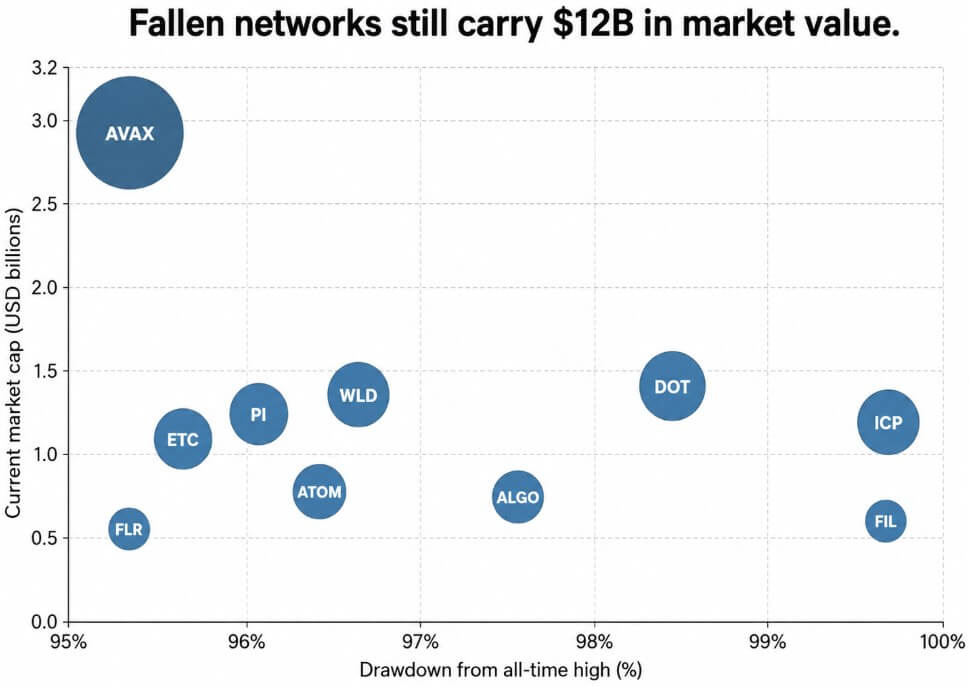
Ten once-prominent cryptocurrency networks now carry a combined market value of $12.06 billion, trading an average of 97.13% below their all-time highs.
A recent report by Taurex noted that recovery needs across the group range from roughly 21.5x for Avalanche, the largest of the ten at $2.91 billion, to roughly 323x for Internet Computer, which sits furthest from its peak at 99.7% below.
Blockchains fund security, developer grants and network growth through token issuance, validator rewards and treasury spending, models that work best when prices climb, and newly minted tokens still carry real dollar value.
At this scale of drawdown, the same issuance produces far less funding, dilutes holders further and adds recurring token supply with little demand behind it.
The sharper test asks whether these ten networks can still fund security, grants and engineering if their tokens never return to their highs.
CryptoSlate defines the subsidy coverage ratio as user-paid fees divided by token rewards and incentives. The ratio shows how much of a network’s measured incentive burden is covered by direct user demand, treasury spending, or other subsidies.
A ratio of 1.0 means user-paid fees match measured incentives, and anything below that shows a funding gap. A very low reading points to a network that stays heavily subsidy-dependent.
The metric shows how much economic activity must grow, or how much spending must fall, for the network to become self-sustaining.
Some networks burn collected fees, and that value never reaches validators or miners, so a climbing fee count can show real demand without paying the people who secure the chain.
A second variant, routed security coverage, divides the fees validators and miners actually receive by consensus rewards, giving a cleaner read on whether infrastructure operators actually collect payment for their costs.
Where the evidence already shows up
Algorand validators earned 6.93 million ALGO in staking rewards in May 2026, and the network collected just 50,000 ALGO in fees that same month, implying roughly 0.7 cents of fees for every ALGO of validator rewards, before accounting for fee-sink and Foundation subsidies.
June brought 6.57 million ALGO in validator rewards against the 40.15 million ALGO the network distributed across the first half of the year.
Internet Computer sets node-provider rewards in XDR and converts them into ICP using a 30-day average, so a weaker ICP price forces it to hand out more tokens to cover the same dollar-denominated cost.
Users burn ICP to mint the cycles that pay for computation, which makes the real test whether that burn and transaction fees can offset governance and node-provider rewards over time.
Filecoin is trying to close the gap outright, as its 2026 strategy pushes rewards toward paid usage and useful work, with final vesting periods ending later this year. Filecoin filed a Solstice proposal on July 17 that would reshape storage-provider rewards and fund services to attract paying customers and data to the network.
Polkadot issuance began stepping down in March 2026 and continues doing so every two years until it hits a hard cap. Parity’s Dynamic Allocation Pool now lets fees, coretime sales and slashes route dynamically across validators, nominators, the treasury and reserves as that issuance shrinks.
That leaves the network deciding in real time who receives funding first.
A July 2026 research update found the Cosmos Hub releasing 0.153% of its supply in claimed rewards every week, roughly 3.6 times Near’s rate and 5.7 times Ethereum’s.
It proposed adjusting future issuance based on observed demand and how much selling the market can absorb. A separate proposal put the Hub’s Nakamoto coefficient at six, with the largest validator alone controlling more than 17% of staked supply.
Avalanche carries the largest market value in the group at $2.91 billion, which makes it the hardest of the ten to dismiss as a dead asset.
The network burns its transaction fees, and validator rewards mint fresh AVAX from a fixed cap of 720 million tokens at the end of each staking period, so fee burns do not directly pay the people securing the chain.
Flare’s FIP.16, approved in April 2026, restructured fee burning, infrastructure-provider economics and reward mechanics once the network completed a 300 million FLR burn, leaving net inflation near 2.66%.
Ethereum Classic’s monetary policy cuts block rewards by 20% every 5 million blocks on a preset schedule. The next reduction, Era 6, lands around block 25 million this July and automatically tightens miner economics.
Worldcoin runs on a different model and needs separate treatment, as its strain comes from unlocks. The daily community token release fell 50%, from 3.2 million WLD to 1.6 million WLD, cutting the total WLD unlock rate 43% in July.
Pi Network also sits outside the classic validator-subsidy model. It allocates 65% of its supply to mining rewards and just 5% to liquidity, so its test is whether apps and payments inside Pi generate enough use to justify continued distribution.
| Network | Main funding model to test | Evidence already visible | Primary pressure |
|---|---|---|---|
| Algorand | Fees vs validator rewards | May fees were tiny versus staking rewards | Fee coverage / Foundation subsidy |
| ICP | Cycles burned vs node and governance rewards | Node rewards are XDR-linked and paid in ICP | Token price vs fixed operating cost |
| Filecoin | Paid storage demand vs provider rewards | Solstice redirects rewards toward paid usage | Subsidized capacity becoming real demand |
| Polkadot | Issuance, coretime sales and treasury routing | Issuance step-down and Dynamic Allocation Pool | Who gets funded as issuance shrinks |
| Cosmos Hub | Fees and demand vs staking emissions | High weekly claimed rewards and validator concentration | Inflation and sell-pressure management |
| Avalanche | Burned fees vs minted validator rewards | Fees burn, but validators are paid through issuance | Demand signal not directly funding validators |
| Flare | Fee burn and infrastructure-provider rewards | FIP.16 lowered net inflation and changed rewards | Long-term incentive sustainability |
| Ethereum Classic | Fees and price vs miner subsidy | Era 6 cuts block rewards by 20% | Miner profitability |
| Worldcoin | Unlocks vs demand absorption | Daily unlock rate falls 43% in July | Supply release into weak demand |
| Pi Network | App/payment utility vs distribution | 65% supply allocated to mining rewards | Utility must justify ongoing distribution |
The next two years
The strain concentrates unevenly across each network, and foundations decide whether to preserve grants, cut issuance, or protect treasury runway.
Validators and miners pay their costs in fiat and collect rewards in tokens that have lost most of their value, and smaller operators are the first to leave when that math stops working. Developers lose funding when treasuries hold mostly depreciated tokens, and holders absorb continued dilution well past a 95% decline.
In the bull case, paid demand catches up to token issuance. Storage demand lifts Filecoin’s provider revenue, and coretime sales and treasury reform give Polkadot more paid activity to work with.
App usage or fee capture could push Avalanche and Cosmos Hub’s subsidy coverage ratios toward the point where fees genuinely offset rewards. Networks that reach that point can operate below their all-time highs on usage that no longer depends on continuous token issuance.
In the bear case, the subsidy gap holds. Fees stay thin against rewards the way they did for Algorand in May, foundations trim grants to protect runway, and smaller validators exit as fiat costs stay fixed and token rewards keep losing value.
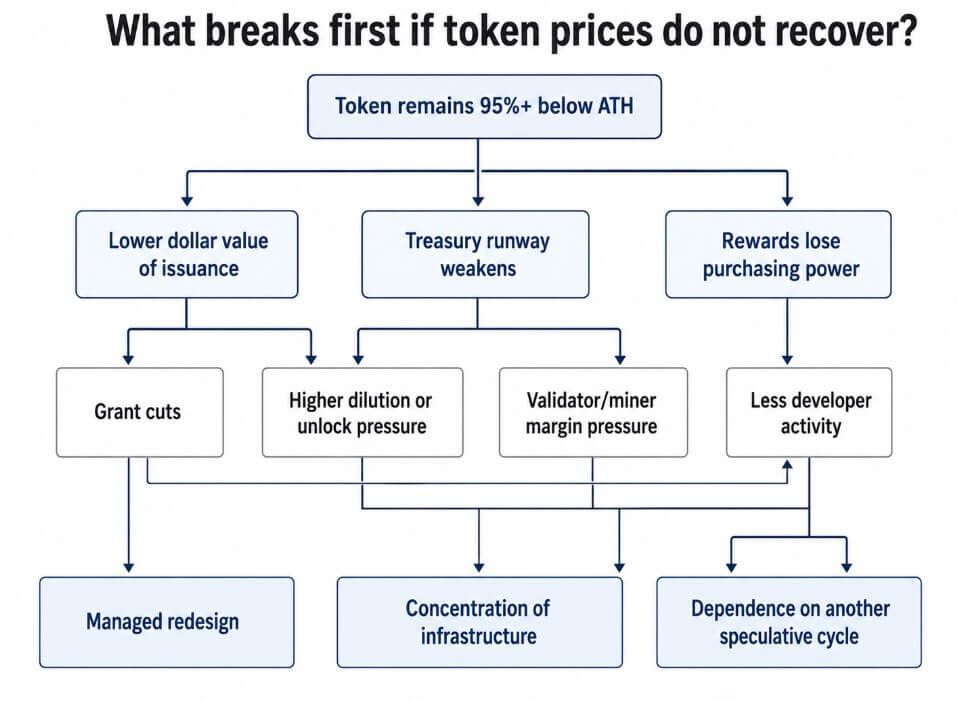
Unlocks like Worldcoin’s daily WLD release add supply faster than demand expands to absorb it, and governance ends up cutting issuance faster than usage can replace it.
Filecoin’s Solstice proposal, Polkadot’s issuance step-down, Cosmos Hub’s demand-linked emissions framework, and Flare’s FIP.16 all show governance already redesigning who pays for security and growth before prices force the issue further.
The real test for these ten networks over the next two years is usage, since it asks whether user fees alone can cover the bills these networks have always had to pay.
Analysis,DeFi,Featured,Staking#altcoins #worth #12B #collapse1784980987
