

Investors who put $1,000 into a GS Finance note linked to Strategy’s MSTR shares are on track to get about $217 back at its July 29 maturity.
MSTR’s July 24 close pushes the note deep into the downside formula in Goldman’s filing, pointing to a loss of roughly $783, or 78.3%, of the principal. Goldman Sachs & Co. LLC still controls the final calculation and can postpone the date or adjust the terms.
GS Finance issued the note, with The Goldman Sachs Group, Inc. backing the payout. Strategy’s share price decides what investors receive, but payment responsibility rests with GS Finance and Goldman. Wells Fargo Securities handled distribution, and Wells Fargo Advisors was named as a possible resale channel.

The SEC-filed pricing supplement set MSTR’s starting price at $421.74 and its threshold at 80% of that figure, or $337.392. A closing price at or above the barrier would have returned $1,417, including a 41.7% contingent gain. A finish below it instead subjects the investment to MSTR’s full decline from the starting price.
The payoff creates a steep cliff. A close exactly at the threshold would still qualify for $1,417. A close even slightly below it would switch the holder to the downside formula, calculated from $421.74 rather than from the barrier. The barrier, set 20% below the starting price, determines which formula applies and offers no loss cap after a breach.

How the payout works
Historical data from Investing.com and Twelve Data place MSTR’s July 24 close at $91.67, after the shares traded between $89.76 and $93.68. The closing price was far below both the $421.74 starting level and the $337.392 threshold.
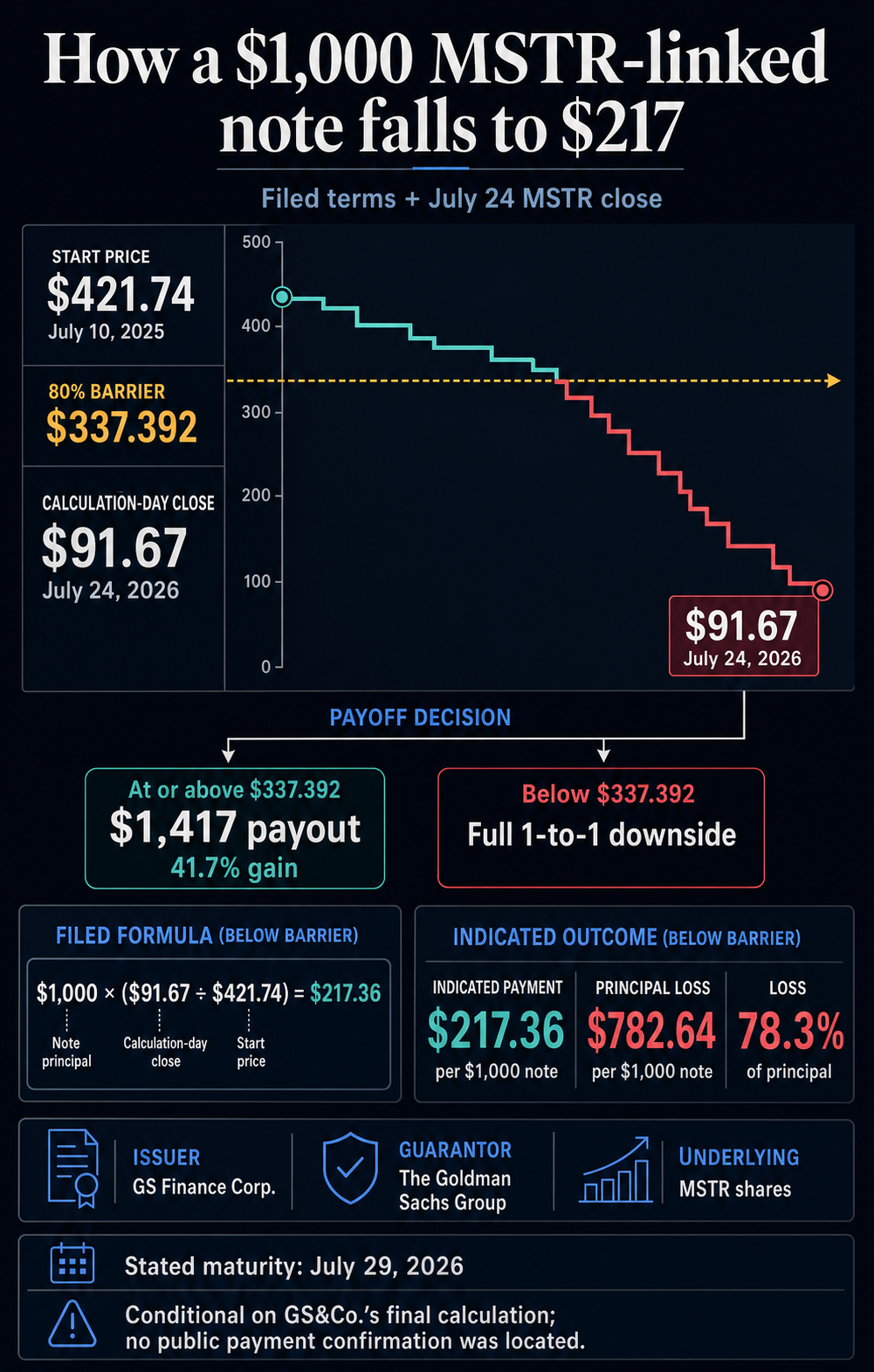
Under the filed downside formula, the maturity payment equals $1,000 plus $1,000 multiplied by MSTR’s return from its starting price. Using the $91.67 close produces an indicated payment of $217.36. The same calculation can be expressed as $1,000 multiplied by $91.67 and divided by $421.74.
The final supplement recorded $660,000 in original aggregate face amount. It does not state how much principal remained outstanding at maturity. Without that figure, the filing supports only the holder-level result per $1,000 note and no defensible estimate of investors’ total losses across the offering.

MSTR is absent from Nasdaq Trader’s July 24 halt log. No CUSIP-specific postponement, corporate-action adjustment, or final payment notice was located in the reviewed public sources. Goldman Sachs & Co. LLC’s contractual determination therefore remains unresolved, and $217.36 is an evidence-backed estimate. If the scheduled dates and filed terms were unchanged, each $1,000 note would return about 22 cents on the dollar.
Debt,Featured,Investments,TradFi,payments,regulationpayments,regulation#Goldman #Sachs #notes #tied #Strategy #set #pay #cents #dollar #maturity1785354371
