
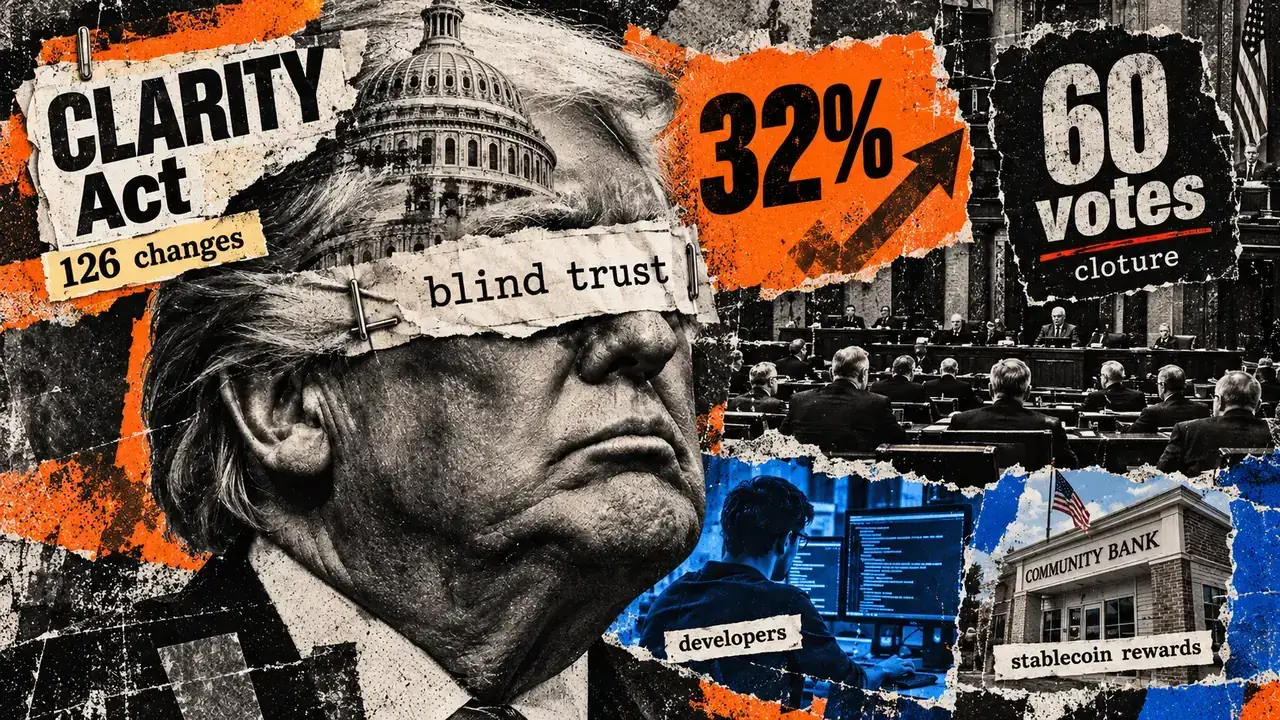

The CLARITY Act’s chances of becoming law climbed above 32% as Senate Republicans unveiled their final compromise before Tuesday’s cloture vote.
Polymarket traders pushed the probability of the landmark crypto market-structure legislation being enacted in 2026 to its highest level since Aug. 2 after Republicans released a 635-page final draft designed to resolve several disputes that have held up the bill.
The move marks a turnaround from weeks of skepticism surrounding the legislation, though prediction-market pricing remains well below levels seen earlier this year. The contract reached about 82% in February before political disputes over ethics, stablecoin rewards and decentralized-finance protections complicated its path through the Senate.
Tuesday provides the next test. Senators are scheduled to vote on cloture on the motion to proceed with H.R. 3633, a procedural step that would require 60 votes and allow the chamber to begin considering the legislation. If cloture is invoked, the final text would then be offered as a substitute amendment.
Republicans said the latest version incorporates 126 substantive changes Democrats requested after more than a year of negotiations. The revisions touch some of the bill’s most contentious parts, including financial ethics rules for elected officials, stablecoin rewards, protections for blockchain developers, and conflicts involving digital-asset trading platforms.
White House digital-assets adviser Patrick Witt cast the revisions as evidence that Republicans had exhausted the room for compromise.
“At every step of the way during the Clarity Act negotiations, the White House and Senate Republicans have been responsive to Democrats’ stated policy objectives,” Witt said. “After more than a year’s worth of negotiations, it’s time to pass this bipartisan bill.”
Trump ethics concession removes a major sticking point
The most politically significant change concerns President Donald Trump and other federal officials with substantial crypto-related financial interests.
Trump agreed to substantially all of an ethics proposal developed by Republican Sen. Thom Tillis and Democratic Sen. Ruben Gallego. The framework would require covered officials with significant crypto interests to divest them or place them in a qualified blind trust, while giving state attorneys general a role in enforcing the restrictions.
That concession addresses one of the most persistent Democratic objections to the legislation. Republican negotiators said Trump voluntarily accepted restrictions covering federally elected officials, judges and their spouses. The White House had previously resisted giving state attorneys general a larger enforcement role.
Republicans also added a stablecoin “circuit breaker” intended to address concerns from community banks that crypto-based rewards could accelerate deposit flight. The measure would give the Treasury secretary authority to intervene if payment stablecoins were found to be causing substantial withdrawals from community banks.
The Blockchain Regulatory Certainty Act provisions were narrowed as well. The final version protects software developers from money-transmission registration requirements and creates a civil safe harbor, while pulling back protections that could have extended more broadly into criminal cases.
Agriculture Committee provisions add restrictions around affiliate trading and conflicts of interest involving digital commodity exchanges, brokers and dealers. The legislation also preserves state consumer-protection laws and clarifies that protections for software developers do not override derivatives regulation or the Commodity Futures Trading Commission’s (CFTC) existing authority.
Republicans are now presenting those concessions as their final offer.
Sen. Cynthia Lummis said Democrats had received more than 120 of the changes they sought and argued that Tuesday’s vote would determine whether senators were willing to proceed with legislation after those demands were addressed. Banking Committee Chairman Tim Scott similarly said the negotiations had produced more than 100 Democratic-requested changes.
The increase in Polymarket odds suggests traders see the revised package as improving the bill’s prospects, but Tuesday’s hurdle remains political rather than probabilistic. Republicans need enough Democrats to join them to reach the 60-vote cloture threshold.
The critical signal before the vote will therefore come from the senators whose objections drove the latest concessions. If enough of them publicly shift toward supporting cloture, the prediction market’s rebound could have room to run further. If they remain uncommitted despite the final offer, Republicans could enter Tuesday with many of Democrats’ requested provisions in the bill but still without the votes needed to debate it.
Featured,Legislation,Politics,Regulation,CLARITY,CLARITY Act,Stablecoin,trumpCLARITY,CLARITY Act,Stablecoin,trump#CLARITY #Act #odds #surge #Republicans #rewrite #bill1789377086
