


Bitcoin held above $80,000 this weekend while three institutional indicators pointed in different directions.
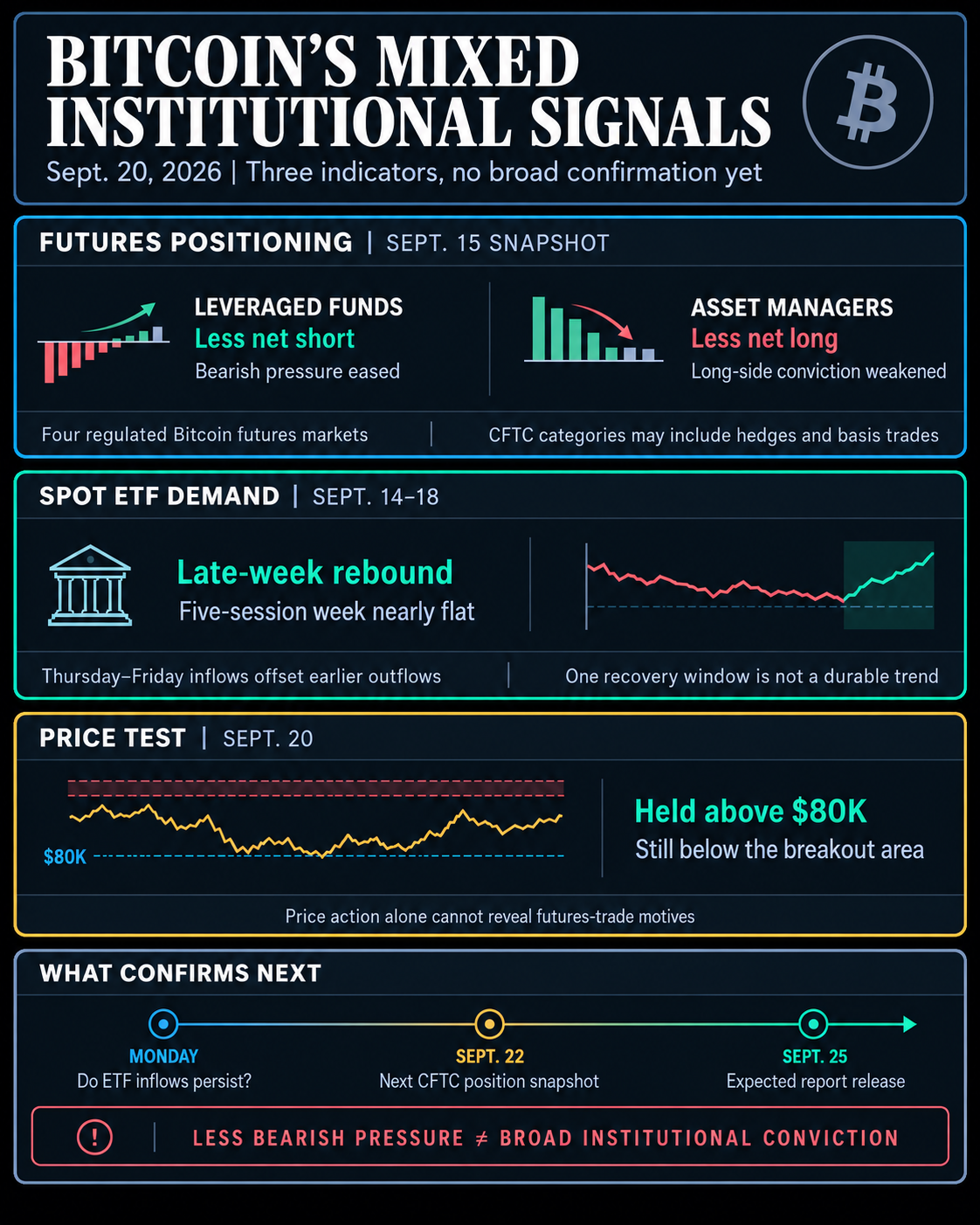
The Sept. 15 snapshot from the Commodity Futures Trading Commission showed leveraged funds becoming less net short across four regulated Bitcoin futures products. Their aggregate net-short exposure fell by the equivalent of 7,275 BTC from the prior week. Asset managers, meanwhile, reduced their aggregate net long by 4,733 BTC-equivalent.
A separate spot-demand measure was also mixed. Farside Investors’ ETF table recorded $592.5 million of US spot Bitcoin ETF inflows over Sept. 17 and Sept. 18, but the full Sept. 14-18 week finished with only $6.1 million of net inflows.
Those observations cover different instruments and windows. The CFTC data measure Tuesday futures positions, the ETF data cover five daily sessions, and the market reading is a later snapshot. They show less net-short positioning without establishing that the futures change caused Bitcoin’s subsequent move or that broad institutional demand has returned.
At the Sept. 20 refresh, CryptoSlate’s Bitcoin market page showed BTC at $80,338.71 with $22.38 billion in 24-hour volume. The price remained below the $82,000 to $82,200 resistance area identified in recent CryptoSlate coverage.
Leveraged funds became less net short as asset-manager longs fell
The CFTC’s futures-only data cover CME standard and micro Bitcoin futures plus Coinbase Derivatives’ nano and nano-perpetual contracts. Because those contracts represent different amounts of Bitcoin, their positions must be normalized into BTC-equivalent units before they can be combined. The totals describe futures exposure, not holdings or transfers of physical bitcoin.
After that conversion, leveraged funds held an aggregate net short of approximately 32,602 BTC-equivalent on Sept. 15. The comparable Sept. 8 figure was roughly 39,877 BTC-equivalent.
The 7,275 BTC-equivalent narrowing reflects two changes: aggregate long exposure increased while aggregate short exposure declined. Leveraged funds still held a material net short at the end of the period.
Asset managers remained net long across the same four products. Their aggregate position fell to approximately 14,133 BTC-equivalent from 18,866 BTC-equivalent, a decline of about 4,733 BTC.
| Signal | Sept. 8 | Sept. 15 | Change |
|---|---|---|---|
| Leveraged funds’ aggregate net position | -39,877 BTC-equivalent | -32,602 BTC-equivalent | 7,275 BTC-equivalent less net short |
| Asset managers’ aggregate net position | +18,866 BTC-equivalent | +14,133 BTC-equivalent | 4,733 BTC-equivalent less net long |
| US spot Bitcoin ETF flows | Sept. 14-16 included two large outflow sessions | +$592.5 million on Sept. 17-18 | +$6.1 million for the five-session week |
The weekly futures change reversed the direction in CryptoSlate’s analysis of the Sept. 8 snapshot, when leveraged funds had added net-short exposure. The latest data show a change in reported positioning, but they do not reveal the trades or motives that produced it.
That limitation applies to both groups. The CFTC’s explanatory notes classify traders by their predominant business activity rather than the purpose of every position. A position may reflect speculation, hedging, risk management or cross-market arbitrage. The labels “leveraged funds” and “asset managers” therefore identify reporting categories, not uniform investment strategies.
Taken together, the figures show two groups moving closer to neutral from opposite sides. They do not show a coordinated bullish turn. Less net-short leveraged positioning reduces one bearish signal, while the decline in aggregate asset-manager longs weakens the case that traditional institutional exposure was expanding across these products.
ETF inflows recovered late but the week was nearly flat
The ETF data provide a separate view of demand for spot Bitcoin investment products.
Farside recorded $159.5 million of net inflows on Sept. 17. It then recorded $433.0 million of net inflows on Sept. 18. The two sessions combined for $592.5 million.
Despite that finish, the five sessions from Sept. 14 through Sept. 18 produced just $6.1 million of net inflows. The result was nearly flat because the strong final two sessions offset substantial outflows earlier in the week.
This is evidence of a late-week rebound in ETF demand, not yet a sustained allocation trend. The weekly total was positive, but almost all of that outcome depended on Thursday and Friday. The next US session will show whether demand continued after Bitcoin returned above $80,000.
ETF flows should not be treated as another version of the CFTC positioning data. ETF creations and redemptions measure net fund flows, while the CFTC report classifies long and short futures exposure. The datasets can be compared as distinct indicators of institutional activity, but they cannot identify matching investors or prove that one position hedges another.
The timing also limits the conclusions. The CFTC snapshot is dated Sept. 15 and predates the post-Fed market move. It cannot establish that the reported change in futures positioning caused later spot buying or the move above $80,000.
The strongest current reading is therefore conditional. Leveraged funds were less net short before the move, but asset managers were also less net long and the ETF week ended close to zero. A durable-demand case would strengthen if ETF inflows persist and future CFTC reports show asset-manager exposure rebuilding. It would weaken if ETF flows reverse or if leveraged funds add net-short exposure again.
The CFTC says its Commitments of Traders reports normally measure positions as of Tuesday and are released Friday at 3:30 p.m. Eastern time, according to its report methodology. The agency’s historical report calendar distinguishes the position date from the later release date.
The next regular snapshot will cover positions as of Sept. 22 and is expected on Sept. 25, absent a schedule disruption. It will be the first CFTC report able to show how these trader groups were positioned after the late-week ETF inflows and Bitcoin’s move back above $80,000.
Several outcomes would sharpen the signal. A further reduction in leveraged net shorts alongside renewed asset-manager net longs would provide broader futures confirmation. Continued short reduction without an asset-manager rebound would still look more like reduced bearish pressure than expanding conviction. A renewed increase in net shorts would reverse the latest weekly shift.
Price remains the immediate market test. Bitcoin was still below the $82,000 to $82,200 resistance area at the Sept. 20 refresh. A break above that zone would carry more weight if it coincides with continued ETF inflows, but price action alone cannot resolve the motives behind reported futures positions.
For now, the evidence is narrower than the headline price move. Bitcoin held $80,000 with leveraged funds less net short, yet weaker aggregate asset-manager longs and an almost flat ETF week left institutional conviction unconfirmed. The Sept. 22 positioning snapshot and the next round of ETF flows will show whether that balance is beginning to change.
Analysis,ETF,Featured,Bitcoin,BTC,CME group,regulationBitcoin,BTC,CME group,ETF,regulation#Bitcoin #futures #shorts #ease #ETF #demand #stays #mixed1789904161
