

What's Hot

    Ethereum’s next scaling leap may come from making everyone stop doing the same work

    September 28, 2026

    Redemptions could shrink buying power

    September 28, 2026

    Michael Saylor Calls for a “Bill of Digital Rights” to Protect Crypto Freedoms

    September 28, 2026
    Facebook Twitter Instagram
    • Business
    • Markets
    • Get In Touch
    • Our Authors
    Facebook Twitter Instagram
    Crypto News: Latest Cryptocurrency News and Analysis
    • Home
    • Business

      Fidelity Buys 7.4% Of Bitcoin Mining Company Marathon Digital Holdings

      February 11, 2021

      Twitter Reacts as Auto Driver Begins Accepting Crypto as Payment

      February 11, 2021

      HSBC Becomes Latest Bank to Suspend Payments to Crypto

      February 4, 2021

      Bitcoin Holds Support; Approaching $50K Resistance

      February 4, 2021

      Cryptocurrency Prices Today: Bitcoin Up Over $47,000, Ether Rises 3%

      February 3, 2021
    • Technology
      1. Business
      2. Insights
      3. View All

      Fidelity Buys 7.4% Of Bitcoin Mining Company Marathon Digital Holdings

      February 11, 2021

      Twitter Reacts as Auto Driver Begins Accepting Crypto as Payment

      February 11, 2021

      HSBC Becomes Latest Bank to Suspend Payments to Crypto

      February 4, 2021

      Bitcoin Holds Support; Approaching $50K Resistance

      February 4, 2021

      Ethereum’s next scaling leap may come from making everyone stop doing the same work

      September 28, 2026

      Redemptions could shrink buying power

      September 28, 2026

      Michael Saylor Calls for a “Bill of Digital Rights” to Protect Crypto Freedoms

      September 28, 2026

      Crypto scammers built an entire fake blockchain to steal over $2 million

      September 28, 2026

      Bitcoin Climbs as Elon Musk Says Tesla ‘Likely’ to Accept it Again

      March 16, 2021

      Can Cryptocurrency Be Hacked, Stolen Or Scammed? How Can You Be Safe?

      February 11, 2021

      How Investors Can Get In On Crypto Without Actually Buying Any

      February 4, 2021

      Ethereum Just Underwent a Major Change – Hence, The 25% Jump in a Week!

      February 4, 2021
    • Insights
      1. Bitcoin
      2. Ethereum
      3. Eurozone
      4. Monero
      5. View All

      Michael Saylor Calls for a “Bill of Digital Rights” to Protect Crypto Freedoms

      September 28, 2026

      Researchers Propose “Shielded Bitcoin” to Bring Zcash-Style Privacy to BTC

      September 28, 2026

      Altman and Amodei Asked to Face Australian Senate After OpenAI Agent Breaches Government Sites

      September 28, 2026

      SEC Says Token Buybacks and Network Upgrades Don’t Automatically Make Crypto Securities

      September 28, 2026

      Ethereum’s next scaling leap may come from making everyone stop doing the same work

      September 28, 2026

      Redemptions could shrink buying power

      September 28, 2026

      Crypto scammers built an entire fake blockchain to steal over $2 million

      September 28, 2026

      Big institutional money is split on Bitcoin’s next move as massive market bets shift

      September 28, 2026

      Bitcoin eases into the week as traders watch BTC’s $85k resistance

      September 28, 2026

      Uniswap price forecast: UNI risks 15% drop as long liquidations build

      September 25, 2026

      Hyperliquid (HYPE) targets $115 as tokenized asset trading gains momentum

      September 24, 2026

      Nexo says 67% of affluent investors own crypto but few make it central to wealth plans

      September 23, 2026

      $3 Million Saint-Gaudens Bronze Highlights New Beverly Hills Coin Gallery

      September 25, 2026

      Only Hours Remain to Preorder U.S. Mint 9/11 Half Dollars

      September 25, 2026

      Saint-Gaudens Set Closes U.S. Mint’s Best of the Mint Series

      September 24, 2026

      1776 ~ 2026 Privy Halves Hit $3.72 Million

      September 23, 2026

      Ethereum’s next scaling leap may come from making everyone stop doing the same work

      September 28, 2026

      Redemptions could shrink buying power

      September 28, 2026

      Michael Saylor Calls for a “Bill of Digital Rights” to Protect Crypto Freedoms

      September 28, 2026

      Crypto scammers built an entire fake blockchain to steal over $2 million

      September 28, 2026
    • Markets
    • Get In Touch
    Crypto News: Latest Cryptocurrency News and Analysis
    Home » Ethereum’s next scaling leap may come from making everyone stop doing the same work
    Ethereum

    Ethereum’s next scaling leap may come from making everyone stop doing the same work

    行政By 行政September 28, 2026No Comments6 Mins Read
    Share
    Facebook Twitter LinkedIn Pinterest Email

    Ethereum co-founder Vitalik Buterin says advances in cryptography could turn decentralization from a performance cost into a scaling advantage for the network.

    In a Sept. 27 essay, Buterin described Ethereum’s long-term destination as a “cryptographic world computer,” an architecture in which computation and data can increasingly be distributed across different participants while compact proofs allow others to cheaply verify that the work was performed correctly.

    The shift would mark a departure from the traditional blockchain model in which every node downloads transactions and repeats much of the same computation. Instead, Ethereum could push more work across a wider network of specialized participants without requiring every validator to reproduce it, potentially allowing decentralization itself to contribute to performance.

    “Perhaps the most important shift” is that decentralization is moving beyond being a burden accepted for safety and robustness and can, in limited cases, become a performance strength, Buterin wrote. Distributed networks can store larger quantities of data and run more computation in parallel, including work around the transaction mempool.

    That revives one of Ethereum’s earliest ambitions. Developers in the mid-2010s considered distributing different pieces of computation across participants much as centralized systems divide workloads between servers. The obstacle was verification: dividing the work created the additional problem of establishing that every participant had performed its portion correctly.

    Modern cryptographic proofs increasingly provide that missing layer, Buterin said, while their computational overhead continues to decline.

    From repeated computation to verified work

    The change is part of a broader overhaul that Buterin argues will make Ethereum around 2030 qualitatively different from the blockchain systems that emerged with Bitcoin.

    Ethereum’s future verification model would rely increasingly on data sampling and succinct cryptographic proofs rather than requiring every validator to download and independently execute everything. Consensus is also moving toward a more optimized proof-of-stake design, while block construction is being divided among multiple participants instead of being controlled by a single producer.

    Zero-knowledge technology is already central to that direction. Ethereum’s proposed L1 zkEVM model would allow a specialized prover to execute a block and generate a proof of correct execution, which other nodes could verify much more cheaply than re-executing every transaction themselves. The technology remains under active research and has not been integrated into production Ethereum clients.

    The result, if the roadmap works as intended, would be a network where doing work and checking work become increasingly separate functions.

    Buterin argues that separation could allow Ethereum to retain the security benefits of broad verification while tapping distributed infrastructure for more computation, storage and potentially privacy. Infrastructure surrounding Ethereum could also compete more aggressively on latency even if the base chain itself never approaches the response times of centralized servers.

    He described the eventual system as a hybrid combining traditional blockchain properties with cryptographic verification, privacy and decentralized components operating away from the base chain.

    Applications may have to change with it

    The transition could also alter the economics of building applications on Ethereum.

    On a conventional blockchain, developers largely think about the amount of data or computation an application consumes. Buterin expects the structure of that computation to become increasingly important as Ethereum attempts to parallelize work across different participants.

    Applications that package large amounts of interdependent computation into one serial transaction could become comparatively expensive, while workloads separated into well-defined components that can be parallelized, aggregated or pruned could become cheaper.

    The Catalyst

    What’s moving crypto. Why it matters.

    Get CryptoSlate’s essential stories and what to watch next.

    Published on Substack

    Seven days a week. Unsubscribe anytime.

    Whoops, looks like there was a problem. Please try again.

    Check your inbox.

    Your signup request was sent. If confirmation is required, follow the email from Substack.

    Look in spam or promotions if you don’t see it.

    Related Reading

    Ethereum’s plan to triple network speed could silently break millions of existing smart contracts

    That would give developers an incentive to design applications around independent dependencies rather than treating Ethereum as a single machine on which arbitrary computation is executed sequentially.

    Over time, Buterin suggested, Ethereum could converge toward a model where information needed for ordering and state changes that cannot be rearranged remains onchain, while much of the surrounding computation is processed and aggregated before reaching a block.

    Such a model would push Ethereum closer to being a coordination and verification layer for distributed computation rather than a system in which the base chain itself performs every operation.

    The distinction remains largely prospective. Ethereum’s roadmap contains several research efforts aimed at reducing what ordinary validators must store or compute, while many of the technologies needed for the broader architecture remain unfinished.

    State becomes the harder constraint

    Making computation verifiable does not remove the need to obtain the data on which that computation depends.

    Buterin identified managing and parallelizing access to Ethereum’s growing state as the more systemically difficult challenge facing the architecture. State includes the account balances, smart-contract storage and other information required to determine what the network currently looks like before another transition can be calculated.

    Ethereum researchers are pursuing several approaches to reduce that burden. Weak statelessness, for example, would allow most validators to verify blocks without maintaining the full state database, while block producers retain access to the state needed to construct blocks and generate witnesses. The proposal remains in research and depends on other changes to Ethereum’s architecture.

    That means cryptographic proofs can make the result of computation dramatically cheaper to check without making the upstream requirement for data disappear. The network must still develop reliable ways to store, retrieve and parallelize access to state as more work is divided among participants.
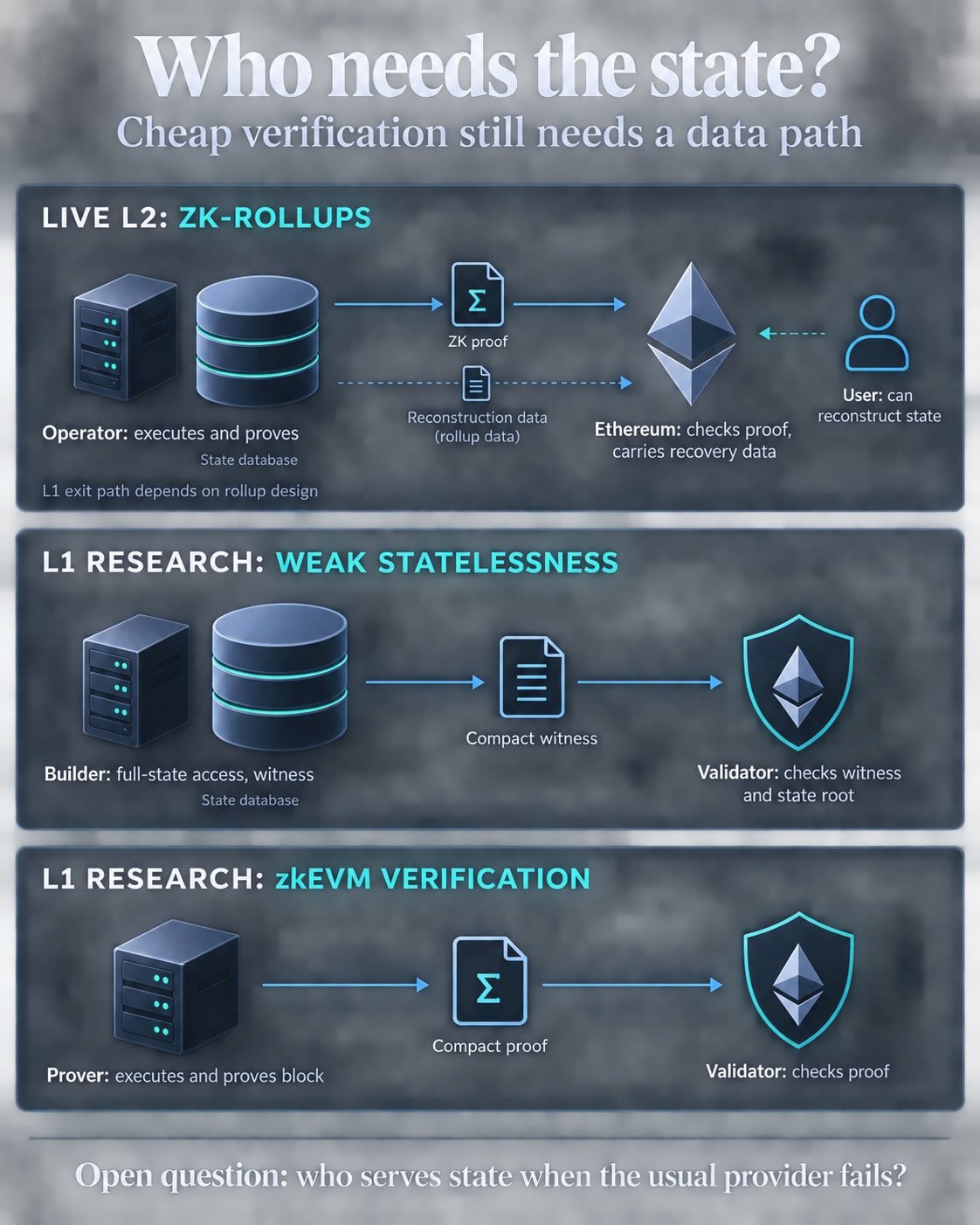
    Comparison of live ZK-rollup data and proof flows with proposed Ethereum L1 weak statelessness and zkEVM verification, showing which actors need state, witnesses, or proofs.Comparison of live ZK-rollup data and proof flows with proposed Ethereum L1 weak statelessness and zkEVM verification, showing which actors need state, witnesses, or proofs.

    Buterin said Ethereum has potential approaches to the problem, though designs will need to evolve alongside the applications eventually running on the network.

    The transition is already moving into Ethereum’s protocol roadmap. Buterin said Hegotá, currently planned for 2027, could be the network’s last “normal” fork recognizable to developers from Ethereum’s earlier era. Later upgrades are expected to lean increasingly on recursive proofs, automated formal verification, optimized consensus and quantum-resistant cryptography.

    PeerDAS has begun that transition, he said. What follows will test whether Ethereum can distribute substantially more computation without recreating the old requirement that every participant repeat the same work, and whether its state infrastructure can keep pace with the cryptography making that division possible.

    Featured,People,Technology,ethereum,Ethereum foundation,Privacyethereum,Ethereum foundation,Privacy#Ethereums #scaling #leap #making #stop #work1790596061

    Ethereum Ethereum foundation Ethereums leap making privacy scaling stop Work
    Share. Facebook Twitter Pinterest LinkedIn Tumblr Email
    行政
    • Website

    Related Posts

    Redemptions could shrink buying power

    September 28, 2026

    Crypto scammers built an entire fake blockchain to steal over $2 million

    September 28, 2026

    Researchers Propose “Shielded Bitcoin” to Bring Zcash-Style Privacy to BTC

    September 28, 2026

    Big institutional money is split on Bitcoin’s next move as massive market bets shift

    September 28, 2026
    Add A Comment

    Leave A Reply Cancel Reply

    Top Posts

    Millennials Are Quitting Job to Become Day Traders

    January 20, 2021

    Jack Dorsey Says Bitcoin Will Unite The World

    January 15, 2021

    Hong Kong Customs Arrest Four in Crypto Laundering Bust

    January 15, 2021

    Subscribe to Updates

    Get the latest sports news from SportsSite about soccer, football and tennis.

    Advertisement
    Demo

    Your source for the serious news. This demo is crafted specifically to exhibit the use of the theme as a news site. Visit our main page for more demos.

    We're social. Connect with us:

    Facebook Twitter Instagram Pinterest YouTube
    Top Insights

    Ethereum’s next scaling leap may come from making everyone stop doing the same work

    September 28, 2026

    Redemptions could shrink buying power

    September 28, 2026

    Michael Saylor Calls for a “Bill of Digital Rights” to Protect Crypto Freedoms

    September 28, 2026
    Get Informed

    Subscribe to Updates

    Get the latest creative news from FooBar about art, design and business.

    Facebook Twitter Instagram Pinterest
    • Home
    • Business
    • Markets
    • Technology
    • Contact us
    © 2026 ThemeSphere. Designed by WPfastworld.
    • Easterngifts
    • koreanbj
    • korean bj porn​
    • korean bj nude

    Type above and press Enter to search. Press Esc to cancel.