


Cardano’s proposed programmable-token standard could let a freeze on one asset temporarily block unrelated tokens held in the same transaction output.
CIP-113, merged into Cardano’s main improvement-proposal repository on Sept. 29, is designed to add issuer-controlled transfer rules to native assets without abandoning the network’s extended unspent transaction output, or eUTXO, model.
The Cardano Foundation has positioned programmable tokens as infrastructure for regulated financial assets, including stablecoins, securities and real-world assets that may require transfer restrictions, freezes and other compliance controls.
The framework could therefore broaden Cardano’s appeal to institutional issuers while introducing new dependencies for wallets and DeFi applications when several assets share the same output.
However, the milestone stops short of full activation. CIP-113’s official page still lists the proposal as “Proposed,” with its path to Active requiring issuance on Preview and mainnet, end-to-end testing and support from a widely adopted wallet.
Still, Matteo Coppola, chief executive officer of Fluid Tokens and a contributor to CIP-113, hailed the milestone, saying the merge followed years of development and puts the framework in Cardano projects’ hands.
“This means the official standard for programmable tokens on Cardano, including securities, is out,” Coppola said, adding that contributors had worked to make it production-ready.
Compliance rules can spill across a shared output
That institutional flexibility comes with a structural complication: on Cardano, the rules governing one programmable token can affect other assets bundled alongside it.
Under the eUTXO model, a transaction output can contain several tokens as well as ADA. Spending that output consumes it as a unit, so a restriction attached to one programmable asset can determine whether the entire transaction goes through.
If an output contains restricted token A, unrelated token B, and ADA, for example, a freeze or denylist rule on A can prevent the holder from spending that output to move B. Neither B nor the ADA has been independently frozen, but both become temporarily inaccessible because they share the same output with A.
CIP-113 provides a way to break that dependency through a restructuring mechanism known as “unfracking.”
The process allows one token policy to be separated from the rest of an output without changing ownership. If the transaction is permitted, A can be moved into its own output while B remains in another output controlled by the same holder. A stays restricted, while B is no longer subject to A’s transfer rule on a subsequent spend.
However, the holder does not automatically control the ability to separate the assets.
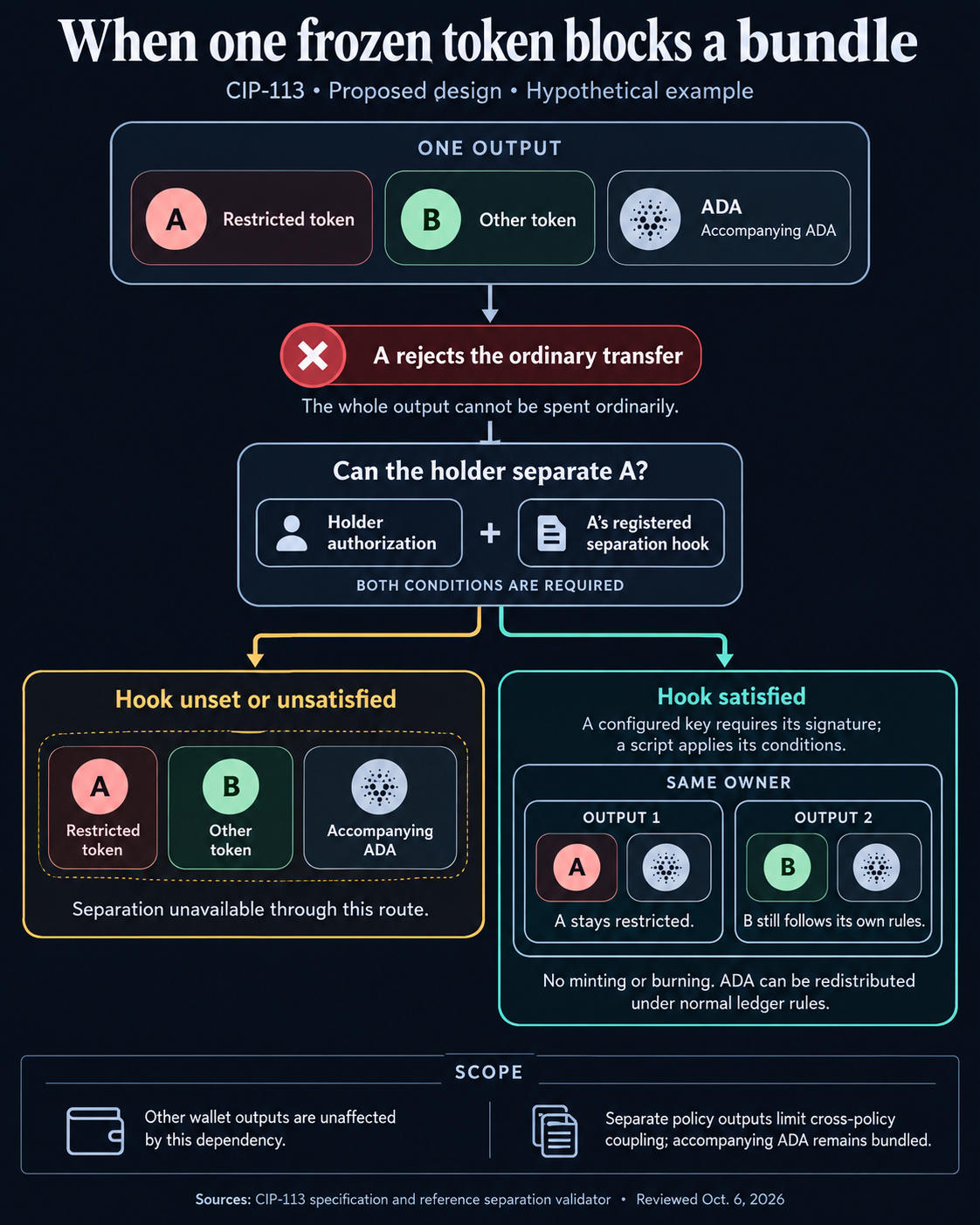
An unfracking transaction requires the holder’s authorization and must also satisfy the affected token’s registered separation rules. Those rules can require an additional signature, impose conditions through a script, or block the restructuring route entirely.
That means a holder cannot always free unrelated assets simply by signing a transaction. If A’s policy does not allow separation, B and the ADA sharing that output can remain inaccessible until the relevant conditions change.
The proposal draws a line between that kind of blockage and seizure. A token issuer’s control over A does not give it ownership of B or other assets in the same output, and the reference implementation is designed to preserve balances belonging to unrelated token policies during authorized third-party actions.
For wallets and DeFi applications, the practical consequence is that asset ownership alone may no longer determine immediate spendability. How tokens are grouped inside an output, and what separation permissions each policy allows, can become part of the risk attached to holding or accepting them.
Wallets and DeFi protocols inherit the design risk
Avoiding that dependency for wallets and DeFi protocols may require changing how assets are packaged before any restriction is triggered.
The CIP-113 reference implementation describes single-policy outputs as the preferred construction, although the validator does not require developers to use them. Keeping programmable assets separate would reduce the risk that one issuer’s compliance action prevents an unrelated token from moving.
ADA remains exposed to the same constraint. Cardano outputs containing tokens also carry ADA, meaning some of the network’s native asset can become temporarily inaccessible when it shares an output with a restricted programmable token.
That adds complexity for wallets. A displayed balance may show what a user owns without revealing what can immediately be spent. Applications supporting CIP-113 may need to track which policies share an output, the permissions currently attached to each asset, and whether a blocked token can be separated.
For lending protocols, the issue becomes a collateral-management risk.
A DeFi platform accepting a programmable token would need to assess whether its issuer can freeze transfers, whether the protocol can authorize separation, and whether those controls could interfere with withdrawals or liquidations. A restriction arriving during a market downturn could be particularly consequential if a lender cannot move collateral when it needs to close an undersecured position.
Those questions are becoming more relevant as Cardano tries to expand its stablecoin and tokenized-asset market. USDCx, backed one-for-one by USDC through Circle’s xReserve infrastructure, has already added another source of dollar liquidity to the network.
CIP-113 could widen that market by giving prospective issuers the compliance controls required for regulated stablecoins, securities, and other tokenized assets while retaining Cardano’s native-asset architecture.
The cost is that wallets and DeFi protocols may have to treat an asset’s permission structure as another layer of financial risk.
Wallet developers could segregate programmable policies by default, while lending protocols may impose lower collateral values, tighter parameters, or reject tokens whose freeze and separation rules create uncertainty around liquidation.
That puts the focus on the first production integrations. As projects adopt CIP-113, their decisions on output construction and issuer permissions will help determine whether regulated assets can plug into Cardano’s DeFi markets cleanly or require protocols to price the risk that compliance controls could restrict access to collateral when it is needed most.
Analysis,DeFi,Featured,Technology,Cardano,Cardano Foundation,paymentsCardano,Cardano Foundation,DeFi,payments#Cardano #added #kind #token #controls #Wall #Street #DeFi #hate1791284335
