


The NEAR blockchain’s total supply grew by about 2.69 million tokens in the 30.62 days to Oct. 22, while a proposed 36% cut in the issuance cap would slow future dilution and reduce token income for stakers.
The network’s supply rose from 1,306,946,399.1749655 NEAR at block 216701043 on Sept. 22 to 1,309,640,572.7751897 NEAR at block 221111299 on Oct. 22, an increase of 2,694,173.6002242 NEAR (0.20614%) over 31 days.
Net selling and liquid supply available to trade are separate measures. Purchases can support demand while acquired tokens remain part of total supply.
HSP-029, an Oct. 7 proposal in NEAR’s House of Stake governance system, would reduce maximum annual issuance from 2.5% to 1.6%. Slower dilution comes with fewer newly issued rewards, but the effect on price depends on demand and valuation.
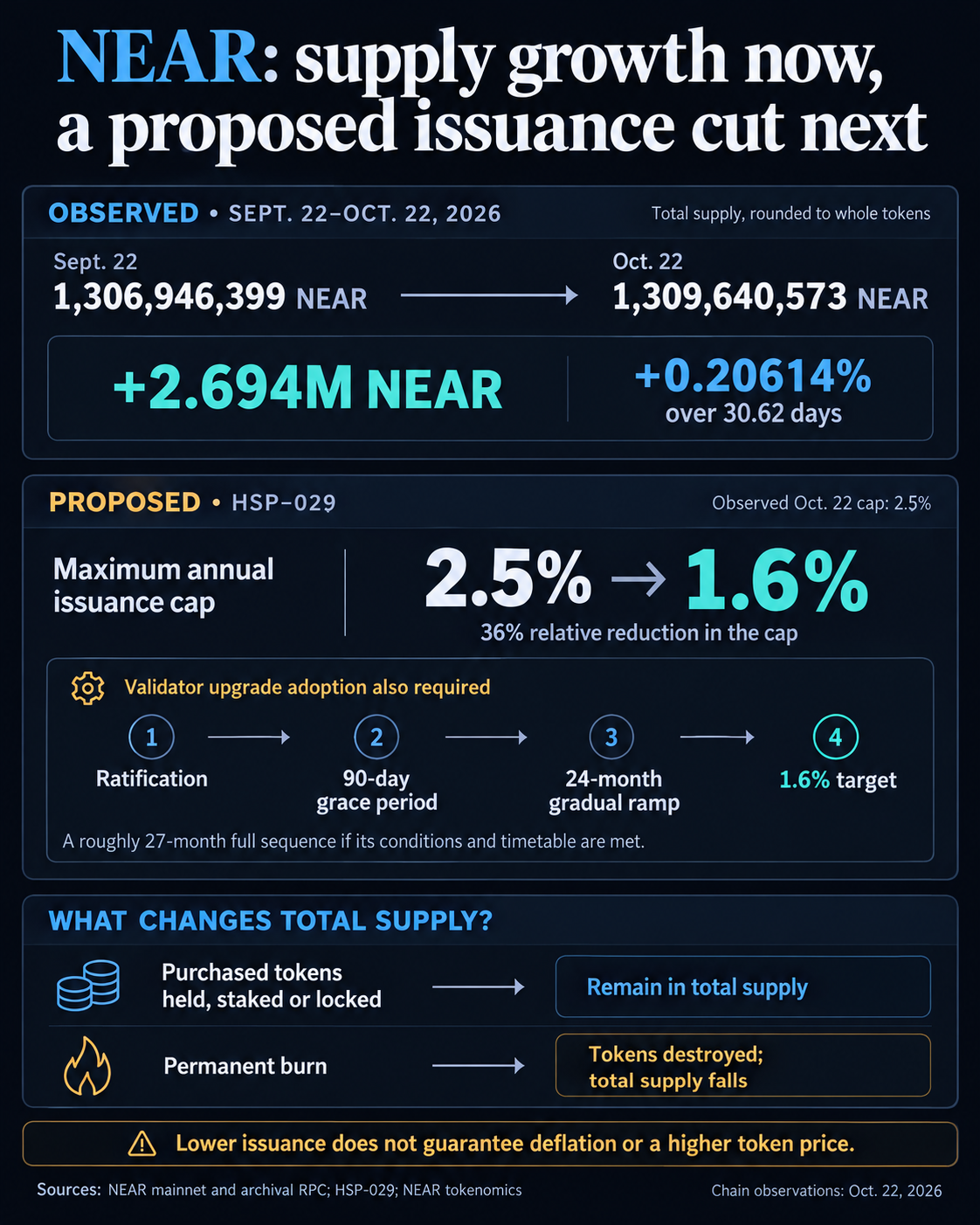
What the proposed cut changes
As of Oct. 22, NEAR’s protocol configuration still showed a 2.5% maximum annual issuance rate on version 86. The observed setting remained above the proposed 1.6% target.
HSP-029 would retain its stated allocation of 90% of issuance to staking participants and 10% to the treasury. It proposes a 90-day grace period after ratification, followed by a smooth 24-month ramp, with the cap adjusted each epoch.
The change from 2.5% to 1.6% is a 36% reduction of the starting cap. Total supply would still depend on the balance between newly issued tokens and permanent destruction.
Ratification would start the proposed 90-day grace period, and activating the ramp would also require validators to adopt a protocol upgrade. If those steps followed the timetable, the target would arrive roughly 27 months after ratification.
This follows an earlier issuance debate on a proposed reduction from 5% to 2.5% in June 2025. HSP-029 concerns a further reduction from the 2.5% cap observed this October.
NEAR’s Feb. 24 tokenomics explanation describes a governance-controlled set of options for product revenue, including purchases, staking, locking, and redeployment. Its definition of “buyback and earn” expressly leaves the acquired tokens within total supply.
Buying NEAR changes who holds it, while staking or locking can restrict its availability for trading. A permanent burn destroys tokens and reduces total supply. These actions affect different measures, so adding them together under a single deflation label can obscure what holders actually own.
The revenue dashboard’s fee definitions separate gross fees from the revenue retained after payouts to integration partners, solvers, and apps. Gross product fees cannot simply be counted as money spent buying NEAR.
The dashboard’s Oct. 22 all-time wallet breakdown assigned 1,543,672.9 NEAR to buybacks.multisignature.near. At block 221112441, the account itself held about 2,048,151.46 NEAR in its account balance.
Establishing how much was permanently destroyed requires tracing the disposition of those purchases. Subtracting either wallet figure from the September-October supply increase would mix these measures.
NEAR remained inflationary in total-supply terms over the measured interval. Buybacks could still affect demand or liquid circulation, while the token count expanded.
What lower issuance means for a staker
The Oct. 22 staking snapshot contained about 592.87 million NEAR staked against contemporaneous total supply of about 1,309.67 million, a participation rate of approximately 45.27%. There were 395 current validators, with the rounded stake and validator totals also shown on the validator explorer.
CryptoSlate’s calculations use the proposal’s 90% staker allocation and hold participation fixed at 45.27%. That gives a simple annual reward rate of about 4.97% at a 2.5% issuance cap and 3.18% at the eventual 1.6% target.
With an assumed 5% pool commission, the corresponding delegator rates are about 4.72% and 3.02%. The table compares annualized endpoint conditions before compounding, with the same participation and reward allocation in both cases.
| Illustration | 2.5% cap | Eventual 1.6% target |
|---|---|---|
| Simple annual delegator reward rate after 5% commission | 4.72% | 3.02% |
| Annual rewards on 1,000 NEAR delegated | 47.22 NEAR | 30.22 NEAR |
| Annual operator commission on 100,000 NEAR delegated, with no self-stake | 248.52 NEAR | 159.05 NEAR |
Realized APY and income during the ramp would reflect the gradually changing cap, participation, fees, and reward performance. If participation changes, the denominator changes too.
A separate monthly-compounding illustration captures the transition to those endpoints, with rewards reinvested each month. Starting with 1,000 NEAR, keeping participation at 45.27%, allocating 90% of issuance to stakers and assuming 5% commission produces about 1,111.86 NEAR after 27 months under an unchanged 2.5% cap.
Approximating the 90-day grace period as three months, then applying the 24-month linear ramp, produces about 1,093.18 NEAR.
Equalizing the terminal value of the two holdings would require the token price in the lower-issuance case to be about 1.71% higher than in the unchanged-cap case. The 1.71% is a condition for equal terminal value between the two hypothetical paths; future prices remain uncertain.
The model approximates the per-epoch ramp with monthly midpoint rates and holds participation constant. It also excludes taxes, uptime changes, and burn adjustments. These assumptions show the timing of the reward tradeoff while leaving market demand and future prices unresolved.
Operators face a revenue decision too
For an operator with no self-stake, at an unchanged 100,000 NEAR delegated and a 5% commission, the target cap reduces simple annual commission income from about 248.52 NEAR to 159.05 NEAR before operating costs.
At an illustrative $5 per NEAR, that commission on modeled issuance rewards is about $103.55 and $66.27 a month. Both fall below a hypothetical $200 monthly operating bill.
Operators differ in delegated stake, self-stake, commission rates, other income and costs. A holder who does not stake has a different tradeoff: fewer new tokens means slower ownership dilution without a staking-reward stream to lose.
Sal Ternullo identifies himself as SVRN’s CEO and discloses approximately 55 million NEAR held, more than 90% staked, alongside validator infrastructure and a paid MPC node interest.
For holders assessing the next step, the decisive signals are a ratification outcome, validator adoption, and an issuance parameter that follows the proposed schedule.
For the buyback strategy, the useful comparison is retained revenue, executed purchases, and permanent burns over the same period. The issuance decision determines the future reward budget.
Deflation also depends on permanent token destruction, while price depends on what buyers are willing to pay.
Analysis,Featured,Governance,Staking,regulationregulation#proposal #slashes #yield #dividing #network #validators1792730088
