
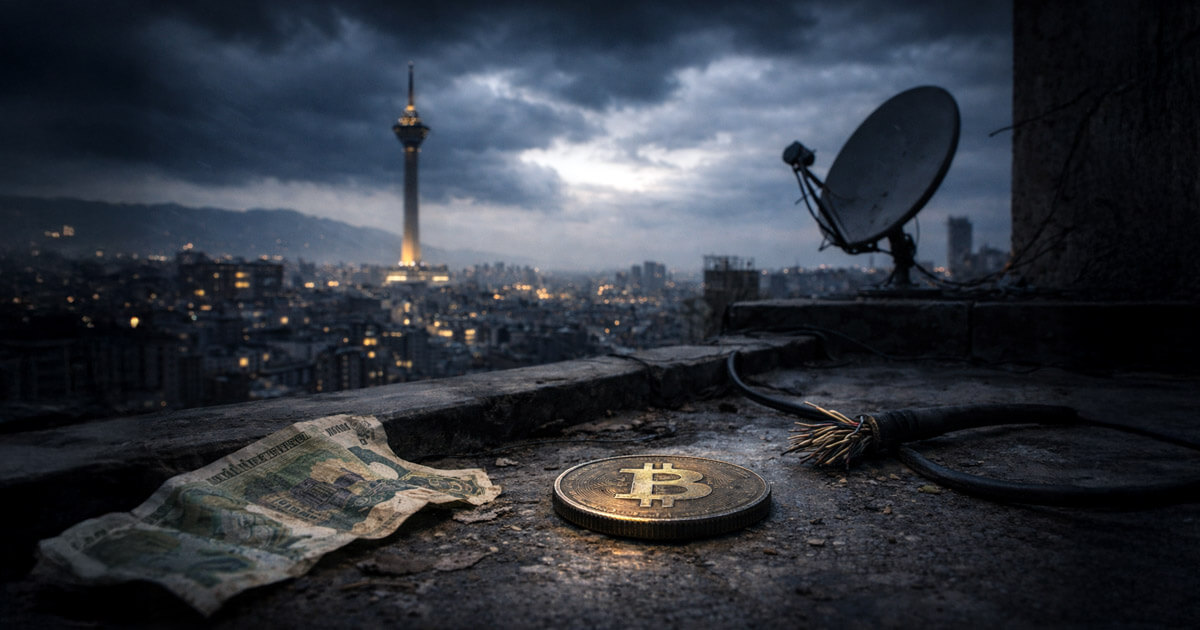

Iran’s currency, the rial, has collapsed to around 1 million per US dollar, a record that spotlights how quickly savings can be wiped out when trust in money breaks.
The currency lost nearly half its value across 2025, with official inflation reaching 42.5% in December. Recent protests erupting in Tehran’s Grand Bazaar, triggered by the sharp fall in the rial and the volatility that makes it impossible for merchants to price inventory or plan purchases.
The state responded with a nationwide communications blackout, and some Iranians turned to Starlink to skirt the restrictions, even though using the satellite service is banned and criminalized in Iran.
Prior to the almost total collapse on Jan. 9, the rial had fallen to around 42,000 per USD. It then shot up to just under 1 million per USD and has remained around that level since. This is a loss of around 95% of its purchasing power overnight.
However, due to volatility within the country and the lack of utility, the reality is even worse, with quotes ranging from around 1 million to 1.5 million per USD.

The crisis is economic and political, but it’s also infrastructural. When a government can shut down internet access to suppress protests, the question of whether Bitcoin functions as a safe haven depends not only on its design but on whether people can reach the network at all.
That dual challenge, consisting of currency debasement plus access denial, is the scenario Bitcoin’s architecture was meant to address, even if the reality in 2026 is messier than the whitepaper imagined.

What Bitcoin was actually created to do
The Bitcoin whitepaper, published in 2008, frames the system as “a purely peer-to-peer version of electronic cash,” enabling online payments to be sent “directly from one party to another without going through a financial institution.”
That design goal was technical, eliminating the need for a trusted third party to validate transactions, but the choice to pursue it was political. The genesis block, mined in January 2009, embeds a message: “The Times 03/Jan/2009 Chancellor on brink of second bailout for banks.”

The reference is to the UK government preparing a second rescue of the banking system during the financial crisis, and it’s widely interpreted as commentary on monetary fragility and the risks of relying on institutions that socialize losses while privatizing gains.
Bitcoin wasn’t invented for Iran specifically, but it was invented for a world where trust in financial intermediaries can fail, and where a person might need to transfer value without permission from a bank, a government, or a payment processor.
The rial collapse makes that use case concrete.
What the rial collapse reveals
The rial’s weakness is a symptom of structural dysfunction that makes daily economic life unworkable. The core issue for bazaar merchants is price volatility, not just depreciation.
When currency moves unpredictably, merchants can’t decide whether to buy or sell inventory, and households can’t plan purchases or save in local currency without watching their purchasing power evaporate.
Sanctions and institutional capture deepen the dysfunction. Sanctions combined with the Revolutionary Guards’ economic dominance limit the state’s ability to stabilize the economy, fueling a legitimacy crisis.
The World Bank expects Iran’s economy to contract in 2026 amid high inflation and currency pressure, a baseline outlook that suggests the current crisis is more than a temporary shock.
That breakdown creates demand for alternatives, such as US dollars, gold, stablecoins, and Bitcoin, but it also triggers state countermeasures. Iran’s Central Bank High Council has imposed caps of $5,000 on annual stablecoin purchases and $10,000 on holdings, a clear effort to curb digital dollarization and preserve the rial’s role as the only legal tender.
The caps show that when people try to escape monetary debasement, governments treat that escape as a threat and move to close the exits.

Bitcoin as a hedge versus Bitcoin as a lifeline
The “Bitcoin is a safe haven” framing conflates two distinct claims.
The first is Bitcoin as a hedge, a store of value that preserves purchasing power when fiat currencies weaken. The second is Bitcoin as a lifeline, a payment rail that functions when banks and payment processors are unavailable or compromised.
Bitcoin as a hedge has clear advantages: limited supply, self-custody, portability, and protocol-level censorship resistance.
However, it also has clear drawbacks.
Price volatility means Bitcoin can lose 20% or 30% of its value in a matter of weeks, making it a poor substitute for stable purchasing power in the short term (but still better than losing 95% in hours.) On- and off-ramps are constrained, especially in jurisdictions with capital controls or aggressive enforcement.
Regimes can target exchanges, ban peer-to-peer trading, or impose severe penalties for non-compliance.
Bitcoin as a lifeline is a different proposition. Cross-border transfers without banks become possible, and the network can theoretically function with satellite or mesh connectivity when the traditional internet is blocked.

Yet, if the government shuts down fiat on-ramps and off-ramps, usage shifts to over-the-counter markets where prices diverge, liquidity thins, and user safety becomes non-trivial.

Reuters reported that Starlink usage during Iran’s blackout makes this concrete: access to the network matters as much as the protocol’s design.
In many high-inflation environments, stablecoins become the first dollar substitute because they’re less volatile than Bitcoin and easier to use for daily transactions. Yet Iran has moved to cap stablecoin purchases and holdings precisely because they undermine the state’s monetary control.
That regulatory response illustrates the tension between what Bitcoin-style systems were built to enable and what governments will tolerate when those systems threaten the currency monopoly.
Three scenarios for what happens next
Iran’s trajectory will test whether censorship-resistant value transfer works in practice or gets contained by state power. Three scenarios capture the range of outcomes.
Crisis deepens, controls tighten. Prolonged unrest, harsher sanctions, more frequent blackouts, and tighter foreign exchange and crypto controls define this path.
The rial rate weakens further as confidence erodes, and crypto demand rises, but usage becomes more over-the-counter and informal. Starlink-style connectivity becomes a financial variable.
Watch for blackout frequency, enforcement actions against exchanges, and new restrictions on stablecoins or foreign exchange access.
Repression stabilizes the street but not the currency. A crackdown on protests fails to address structural inflation or institutional dysfunction.
The rial may stabilize temporarily at weak levels, but households still seek any non-rial store of value because trust in the currency remains broken. Watch for inflation prints, import restrictions, and the spread between official and parallel exchange rates.
Political reset or sanctions thaw. Leadership transition, negotiated sanctions relief, or trade normalization restores foreign exchange access and rebuilds some confidence in the currency.
The rial stabilizes or strengthens, and crypto demand shifts from necessity to speculation as households regain access to formal banking channels. Watch for signals of sanctions, oil export constraints, and reopenings of banking channels.
| Scenario | Triggers | What happens to IRR | What happens to crypto usage | Biggest risk to civilians |
|---|---|---|---|---|
| Deepening crisis / controls tighten | Prolonged unrest; harsher sanctions; more frequent internet blackouts; tighter FX/crypto restrictions; aggressive enforcement | Parallel IRR weakens further; official/parallel gap widens; volatility stays high | Demand rises but shifts more OTC/informal; higher spreads/premiums; reliance on alternative connectivity grows | Access + safety: loss of connectivity/rails, higher legal exposure, scams/robbery risk in OTC markets |
| Repression / no macro fix | Crackdowns stabilize streets but inflation persists; continued sanctions pressure; tighter import/price controls | Temporary stabilization at weak levels, punctuated by spikes; purchasing power still erodes | More “store-of-value” behavior (USD/gold/stablecoins/BTC) but with constrained on/off-ramps; slower, cautious adoption | Slow grind: falling real wages/savings, shortages, selective enforcement that punishes ordinary users |
| Thaw / reset | Negotiated sanctions relief; trade normalization; leadership/policy shift; improved FX access and banking channels | IRR stabilizes or strengthens; volatility declines; parallel premium compresses | Usage shifts from necessity → speculation/portfolio; more activity on formal rails; OTC premiums fall | Whiplash + unequal access: abrupt rule changes, winners/losers from re-opening, potential backlash against recent “exit” strategies |
What Bitcoin was built to fix, and what it can’t
Iran’s rial crisis isn’t an outlier; it’s part of a global pattern in which monetary instability drives safe-haven behavior. Gold reached record levels amid geopolitical and institutional uncertainty, while Bitcoin ticked up during periods of uncertainty in 2025.
That convergence shows people running to similar assets in different crises, reinforcing the thesis that demand for censorship-resistant value transfer rises as trust in institutions falls. However, the dual-use reality complicates the narrative.

When civilians use crypto defensively, states and sanctioned entities also experiment with crypto rails to evade restrictions and move value outside traditional financial systems.
That dynamic is why regulators remain aggressive even when humanitarian use cases are legitimate, as the same tools that help individuals escape currency controls can help regimes evade sanctions.
The rial collapse at 1 million per dollar is a reminder that money can stop working, and not in a theoretical sense, but in the practical sense that savings evaporate, merchants can’t price goods, and the state uses inflation and capital controls to preserve power at the expense of purchasing power.
Bitcoin’s architecture was designed for exactly that scenario: a system where value transfer doesn’t require permission from a financial institution or a government, and where the supply is fixed rather than subject to political discretion.
But the reality in 2026 is that states fight back. Iran’s stablecoin caps, internet blackouts, and enforcement actions show that governments treat alternative currencies as threats and move to close the exits when people try to escape monetary debasement.
The question isn’t whether Bitcoin’s design is censorship-resistant, as it is, but whether that resistance holds when governments can block internet access, target exchanges, criminalize usage, and impose severe penalties for non-compliance.
The answer depends on the infrastructure. If people can access the network through alternative connectivity like VPNs or satellite internet, and if peer-to-peer markets can function despite state opposition, then Bitcoin works as intended.
If access rails are shut down and enforcement makes use risky, the protocol’s design doesn’t matter because people can’t reach it.
That’s the test Iran’s crisis poses: whether the system built to fix broken money can survive the backlash from states that depend on monetary control to maintain power.
Analysis,Community,Culture,Featured,Politics,Stablecoins#Bitcoin #internet #blackouts #Irans #currency #collapsed #overnight1768302152
