
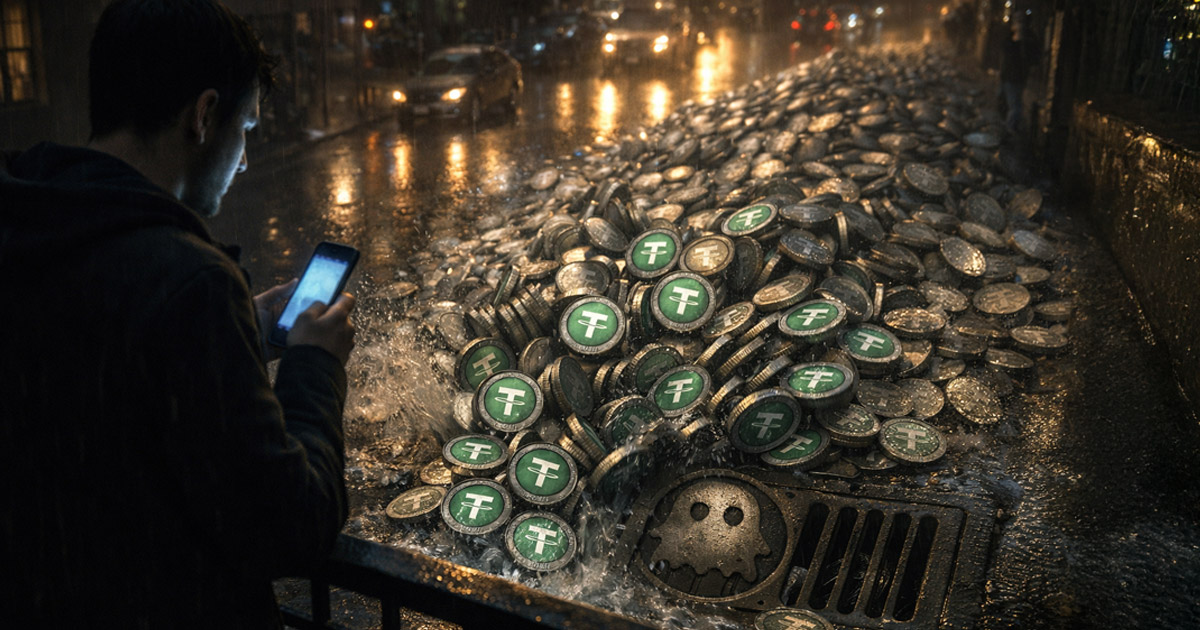

A crypto trader lost over $50 million in Aave-wrapped USDT on March 12 after sending a single large order through the DeFi lending protocol’s swap interface and clearing a slippage warning on a mobile device.
Data from Etherscan shows the wallet swapped $50.43 million aEthUSDT for 327.24 aEthAAVE through CoW Protocol in Ethereum block 24,643,151.
At the current AAVE price of $111.52, the returned tokens were worth roughly $36,100, leaving an implied loss of about $49.96 million relative to the original order size.
The trade drew immediate attention across crypto markets because of its scale and because it moved through one of decentralized finance’s largest venues. Aave is the largest DeFi lending protocol with over $1 trillion in total cumulative lending.
Following the incident, Aave revealed plans to contact the affected user and return about $600,000 in fees collected from the transaction. CoW Protocol said it would also refund any fees sent to CoW DAO.

Who is the victim?
Blockchain analytics platform Lookonchain said the wallet behind the swap may belong to Garrett Jin, a popular crypto trader known as the BitcoinOG1011short.
Lookonchain said on-chain tracing identified 13 wallets that may belong to Jin. It said those wallets received USDC or USDT from Binance on Feb. 16 and Feb. 20, then became active again on Thursday and moved funds to two new wallets.
One of those wallets, Lookonchain said, shared the same Binance deposit address as Garrett Jin.
The claim drew significant attention because Jin has already been linked to other large, closely watched crypto trades.
Last October, online sleuths tied him to a $735 million short position on Bitcoin opened through Hyperliquid shortly before President Donald Trump threatened additional tariffs on China.
The trade, which made up to $200 million in profit, later fueled speculation about advance knowledge because it arrived just before a broader market selloff.
However, Jin rejected that narrative, saying the capital belongs to clients. He added that his team runs nodes and provides in-house insights, and that he has no connection to the Trump family.
As of press time, Jin had yet to confirm any link to the $50 milion loss.

Ethereum middlemen share the windfall
While the trader absorbed the loss, other participants in Ethereum’s execution chain captured the spread released by the order.
Emmet Gallic, an analyst at Arkham Intelligence, said a maximal extractable value, or MEV, bot arbitraged the transaction across Uniswap and SushiSwap pools.
In Ethereum markets, MEV refers to profits captured by automated traders when they react to pricing gaps created during block execution.
Gallic said the bot paid Titan Builder 16,927 ETH, worth about $34.8 million. Titan Builder then paid 568 ETH, or about $1.2 million, to the Lido validator associated with the block proposal and kept about 16,359 ETH, or roughly $33.6 million. The bot operator was left with about $10 million in gains.

As a result, Titan Builder generated the highest revenue among crypto platforms in the last 24 hours, according to DeFiLlama data.
Aave and CoW say the user was warned about the transaction
Meanwhile, the DeFi protocols Aave and CoW have both defended their platforms in this loss, stating that the user received a clear warning notice before the order was executed.
Aave founder Stani Kulechov explained that the user had manually overridden a warning signal that flagged unusually high slippage and then proceeded with the swap on mobile.
According to him:
“The transaction could not be moved forward without the user explicitly accepting the risk through the confirmation checkbox.”
He described the result as “clearly far from optimal” and said Aave’s team would review stronger safeguards around similar trades.
CoW Protocol gave a similar account, while explaining that:
“There’s no indication of a protocol exploit or otherwise malicious behavior. The transaction executed according to the parameters of the signed order.”
CoW also said available public and private liquidity sources could not support a reasonable fill for an order of that size.
Their explanation placed the focus on execution conditions rather than software failure. The route searched for available liquidity, found a path, and carried the order across venues that repriced as the size moved through them.
The warning flow recorded the user’s approval before the trade reached the market.
Improving DeFi user experience
As a result, the episode has brought renewed attention to how DeFi interfaces handle oversized orders.
Suhail Kakar, a developer relations executive at Polymarket, said the incident showed a gap in DeFi user protections rather than a failure of the underlying contracts.
He said Aave and CoW Swap executed the trade as designed, but warned that a mobile confirmation flow should not stand between a user and a $49.9 million loss due to slippage.
Kakar added that wallets and frontends should more clearly show the expected dollar loss and introduce stronger controls for oversized orders, including mechanisms that split large trades into smaller transactions.
In response, Kulechov said Aave would implement stronger safeguards to prevent a recurrence, while CoW said the trade showed the need to keep improving the DeFi user experience.
According to CoW:
“Preventing users from making trades removes choice and can lead to terrible outcomes in some situations (e.g. a market crash). That said, trades like these show that DeFi UX still isn’t where it needs to be to protect all users. As a team, we are now reviewing how we balance strong safeguards with preserving user autonomy.”
DeFi,DEX,Featured,Lending,Trading,Aave,ethereumAave,DeFi,ethereum#warning #lose #swap #Ethereum #bots #walk #rest1773433288
