
What's Hot

    FCC robocall rule could make phone accounts a richer target for crypto attackers

    June 21, 2026

    Stablecoin regulation converts issuers into psuedo-banks while adding a barrier to entry for smaller players

    June 21, 2026

    Ethereum’s Jaredfromsubway MEV bot drained after approving its own $7.5M theft

    June 21, 2026
    Facebook Twitter Instagram
    • Business
    • Markets
    • Get In Touch
    • Our Authors
    Facebook Twitter Instagram
    Crypto News: Latest Cryptocurrency News and Analysis
    • Home
    • Business

      Fidelity Buys 7.4% Of Bitcoin Mining Company Marathon Digital Holdings

      February 11, 2021

      Twitter Reacts as Auto Driver Begins Accepting Crypto as Payment

      February 11, 2021

      HSBC Becomes Latest Bank to Suspend Payments to Crypto

      February 4, 2021

      Bitcoin Holds Support; Approaching $50K Resistance

      February 4, 2021

      Cryptocurrency Prices Today: Bitcoin Up Over $47,000, Ether Rises 3%

      February 3, 2021
    • Technology
      1. Business
      2. Insights
      3. View All

      Fidelity Buys 7.4% Of Bitcoin Mining Company Marathon Digital Holdings

      February 11, 2021

      Twitter Reacts as Auto Driver Begins Accepting Crypto as Payment

      February 11, 2021

      HSBC Becomes Latest Bank to Suspend Payments to Crypto

      February 4, 2021

      Bitcoin Holds Support; Approaching $50K Resistance

      February 4, 2021

      FCC robocall rule could make phone accounts a richer target for crypto attackers

      June 21, 2026

      Stablecoin regulation converts issuers into psuedo-banks while adding a barrier to entry for smaller players

      June 21, 2026

      Ethereum’s Jaredfromsubway MEV bot drained after approving its own $7.5M theft

      June 21, 2026

      Turkish lira stablecoins show why Europe’s regulated euro tokens may struggle

      June 21, 2026

      Bitcoin Climbs as Elon Musk Says Tesla ‘Likely’ to Accept it Again

      March 16, 2021

      Can Cryptocurrency Be Hacked, Stolen Or Scammed? How Can You Be Safe?

      February 11, 2021

      How Investors Can Get In On Crypto Without Actually Buying Any

      February 4, 2021

      Ethereum Just Underwent a Major Change – Hence, The 25% Jump in a Week!

      February 4, 2021
    • Insights
      1. Bitcoin
      2. Ethereum
      3. Eurozone
      4. Monero
      5. View All

      Algorand Races Ahead on Quantum Security, Targets Fully Quantum-Resistant Blockchain by 2027

      June 19, 2026

      CFTC Permanently Bans Celsius Founder Alex Mashinsky, Closing Landmark Crypto Lending Case

      June 19, 2026

      Bitcoin Microtransactions Surge to 80% of Network Activity as Ordinals and Runes Fuel Onchain Growth

      June 19, 2026

      Ethereum Foundation Loses Another Top Leader as Talent Exodus Fuels Governance Concerns

      June 19, 2026

      FCC robocall rule could make phone accounts a richer target for crypto attackers

      June 21, 2026

      Stablecoin regulation converts issuers into psuedo-banks while adding a barrier to entry for smaller players

      June 21, 2026

      Ethereum’s Jaredfromsubway MEV bot drained after approving its own $7.5M theft

      June 21, 2026

      Turkish lira stablecoins show why Europe’s regulated euro tokens may struggle

      June 21, 2026

      Cardano price analysis: can ADA avoid a drop to $0.13?

      June 19, 2026

      Shiba Inu (SHIB) struggles near key support as burn rate and Shibarium activity weaken

      June 19, 2026

      Monero extends losses as Fed hawkishness weighs on the crypto market

      June 19, 2026

      Zcash dips 4% as broader crypto market remains bearish

      June 19, 2026

      U.S. Mint Resumes 1776-2026 Proof Silver Eagle Sales June 24

      June 19, 2026

      U.S. Mint Opens Subscriptions for Comic Art Three-Medal Set

      June 19, 2026

      Gold CAC 1881-S Morgan Dollar Leads $619K Heritage Auction

      June 19, 2026

      U.S. Mint Liberty Bell-Shaped Coins and Medal Launch July 16

      June 16, 2026

      FCC robocall rule could make phone accounts a richer target for crypto attackers

      June 21, 2026

      Stablecoin regulation converts issuers into psuedo-banks while adding a barrier to entry for smaller players

      June 21, 2026

      Ethereum’s Jaredfromsubway MEV bot drained after approving its own $7.5M theft

      June 21, 2026

      Turkish lira stablecoins show why Europe’s regulated euro tokens may struggle

      June 21, 2026
    • Markets
    • Get In Touch
    Crypto News: Latest Cryptocurrency News and Analysis
    Home » Stablecoin regulation converts issuers into psuedo-banks while adding a barrier to entry for smaller players
    Ethereum

    Stablecoin regulation converts issuers into psuedo-banks while adding a barrier to entry for smaller players

    行政By 行政June 21, 2026No Comments5 Mins Read
    Share
    Facebook Twitter LinkedIn Pinterest Email

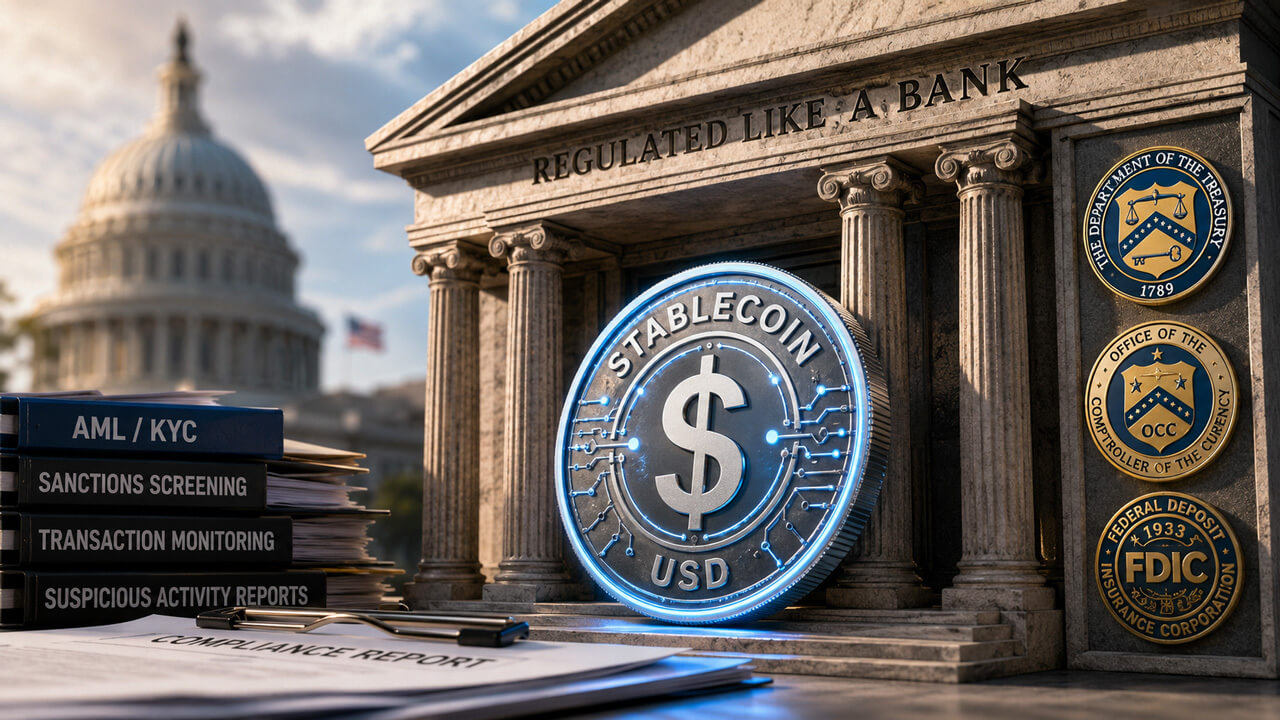
    Three federal agencies have proposed rules that would make stablecoin issuers operate like banks. The Treasury wants them to run anti-money-laundering and sanctions programs.

    The Office of the Comptroller of the Currency (OCC) wants a weekly confidential report and a quarterly financial report from each one, and the Federal Deposit Insurance Corporation (FDIC) wants Bank Secrecy Act obligations applied to the issuers it supervises.

    If adopted, these proposals will turn the issuance of a dollar-pegged token into a job that requires customer screening, transaction monitoring, suspicious activity reporting, reserve disclosures, and a steady stream of data to a primary regulator.

    The next phase of stablecoin regulation is therefore less about permission to issue a token and more about whether an issuer can carry the cost of being supervised like a financial institution.

    Much of this formalizes what large issuers already do. But for smaller ones, the compliance burden will become the biggest barrier to entering a market now worth roughly $320 billion. The legal clarity the industry spent years fighting for came with an operating cost that decides who can realistically compete.

    The GENIUS Act, signed into law in July 2025, is the federal framework for payment stablecoins, the dollar-pegged tokens designed to maintain a steady value and facilitate payments and settlement. It lets a company issue these tokens only as a “permitted payment stablecoin issuer,” or PPSI, meaning payment stablecoin issuers must be cleared by regulators under the federal regime.

    Treasury opened the rulemaking that fills in the details in late 2025, and the proposals landing through 2026 are where that permission will become a working compliance regime.

    Stablecoin issuers are turning into compliance companies

    A stablecoin issuer’s product looks simple, since one token is meant to equal one dollar, but the regulated version carries a long operational tail.

    Stablecoin compliance now means teams and systems to identify customers, monitor transactions, screen wallets and counterparties against sanctions lists, flag suspicious behavior, and document all of it for an examiner. The work moves from the edge of a crypto company to the center of the business.

    That change in demands took shape in April 2026, when the Treasury’s FinCEN and OFAC issued a joint proposed rule that would treat permitted issuers as financial institutions under the Bank Secrecy Act and, for the first time, require a category of US persons to maintain an effective sanctions-compliance program.

    The FDIC followed on May 22 with a parallel rule for the issuers it supervises, the ones that operate as subsidiaries of state nonmember banks and state savings associations.

    All of this changes the cost structure of the business. The competitive edge moves toward compliance capacity, so issuers that can afford lawyers, transaction-monitoring vendors, reporting systems, and durable banking relationships hold an advantage over newcomers building the same machinery from scratch.

    The supervision side became concrete in June 2026, when the OCC published draft reporting forms for issuers under its jurisdiction. Each issuer would file a weekly confidential report on every stablecoin it issues, covering issuance, redemptions, trading volume, and reserve assets, plus a quarterly report on financial conditions that looks much like the call reports that national banks file.

    Issuers with more than $50 billion outstanding would also produce audited annual financial reports, and the OCC would examine each one at least once every 12 months. Weekly data gives regulators early insight into reserve problems or redemption stress, and it turns a token project into a continuously monitored financial company.

    CryptoSlate Daily Brief

    Daily signals, zero noise.

    Market-moving headlines and context delivered every morning in one tight read.

    5-minute digest 100k+ readers

    Free. No spam. Unsubscribe any time.

    Whoops, looks like there was a problem. Please try again.

    You’re subscribed. Welcome aboard.

    The market is getting smaller and more institutional

    The same framework limits how regulated issuers can compete for users. The GENIUS Act bars permitted issuers from paying holders any interest or yield on the token, and the OCC proposal carries that ban into its rules, reserving scrutiny for affiliate arrangements designed to circumvent it.

    Yield has been one of crypto’s strongest tools for winning users, so issuers that can’t pay it directly will instead compete on liquidity, integrations, payment utility, and institutional access.

    Put those costs together, and the result is likely to be consolidation. Large issuers can absorb compliance costs, build reporting systems, hire former regulators, and retain their banking partners, while smaller ones may struggle to justify the expense unless they serve a defined niche or partner with a larger regulated platform.

    A state-chartered nonbank issuer that crosses $10 billion in circulation would generally have to move to a federal license, so scale itself would pull issuers toward federal supervision. The FDIC estimates that five to 30 of the institutions it supervises could win approval to issue through subsidiaries in the framework’s first few years.

    That smaller field comes with a tradeoff between credibility and flexibility. A regulated stablecoin will be more attractive to banks, brokers, payment companies, and corporate treasuries because it will have clear rules and a familiar regulator. The same oversight makes the token resemble a tokenized layer of the existing banking system more than the open financial infrastructure early advocates described.

    The companies that will benefit from this are those that already understand how supervised institutions work, which is part of why Tether has moved toward a compliant US product called USAT, while Circle has leaned further into its regulated posture.

    The GENIUS Act stablecoin rules were framed as a breakthrough for the sector, and they remain one.. Its implementation phase shows that legal clarity comes with a supervisory regime attached, and the next stage of growth will depend less on issuing a token and more on proving an issuer can survive inside the financial system.

    The companies that manage it may become core dollar infrastructure for banks and businesses, while the ones that can’t carry the load may be regulated out of the race before the framework takes full effect in 2027.

    Analysis,Banking,Featured,Regulation,Stablecoins,AML,compliance,FDIC,GENIUS Act,occ,regulation,stablecoin issuers,TreasuryAML,compliance,FDIC,GENIUS Act,occ,regulation,stablecoin issuers,Treasury#Stablecoin #regulation #converts #issuers #psuedobanks #adding #barrier #entry #smaller #players1782048638

    adding AML barrier Compliance converts Entry FDIC GENIUS Act issuers OCC Players psuedobanks regulation smaller Stablecoin stablecoin issuers Treasury
    Share. Facebook Twitter Pinterest LinkedIn Tumblr Email
    行政
    • Website

    Related Posts

    FCC robocall rule could make phone accounts a richer target for crypto attackers

    June 21, 2026

    Ethereum’s Jaredfromsubway MEV bot drained after approving its own $7.5M theft

    June 21, 2026

    Turkish lira stablecoins show why Europe’s regulated euro tokens may struggle

    June 21, 2026

    Morgan Stanley’s proposed 0.14% ETH and SOL fees could turn the next crypto ETF race into a price fight

    June 21, 2026
    Add A Comment

    Leave A Reply Cancel Reply

    Top Posts

    Millennials Are Quitting Job to Become Day Traders

    January 20, 2021

    Jack Dorsey Says Bitcoin Will Unite The World

    January 15, 2021

    Hong Kong Customs Arrest Four in Crypto Laundering Bust

    January 15, 2021

    Subscribe to Updates

    Get the latest sports news from SportsSite about soccer, football and tennis.

    Advertisement
    Demo

    Your source for the serious news. This demo is crafted specifically to exhibit the use of the theme as a news site. Visit our main page for more demos.

    We're social. Connect with us:

    Facebook Twitter Instagram Pinterest YouTube
    Top Insights

    FCC robocall rule could make phone accounts a richer target for crypto attackers

    June 21, 2026

    Stablecoin regulation converts issuers into psuedo-banks while adding a barrier to entry for smaller players

    June 21, 2026

    Ethereum’s Jaredfromsubway MEV bot drained after approving its own $7.5M theft

    June 21, 2026
    Get Informed

    Subscribe to Updates

    Get the latest creative news from FooBar about art, design and business.

    Facebook Twitter Instagram Pinterest
    • Home
    • Business
    • Markets
    • Technology
    • Contact us
    © 2026 ThemeSphere. Designed by WPfastworld.
    • Easterngifts
    • koreanbj
    • korean bj porn​
    • korean bj nude

    Type above and press Enter to search. Press Esc to cancel.