


On June 22, President Donald Trump signed two executive orders that put the federal government’s most sensitive civilian computer systems on a 2031 post-quantum security timetable while launching a national effort to accelerate the development of advanced quantum computers.
One order requires federal high-value assets and high-impact systems to adopt post-quantum cryptography for establishing encryption keys by the end of 2030 and for digital signatures by the end of 2031.
The second creates a program aimed at delivering a quantum computer capable of scientific applications beyond the reach of existing classical machines to a Department of Energy facility.
Charles Edwards, Caprioles’ founder, said:
“Quantum Computing is probably the most undervalued asset class in the world by orders of magnitude.”
Washington moves the quantum clock forward
Market observers pointed out that these orders suggest that the federal government sees the timeline for both quantum development and cryptographic migration compressing rapidly.
Alex Pruden, CEO of quantum-security company Project Eleven, noted:
“From the perspective of the American executive branch, offense (quantum computing) and defense (post-quantum cryptography) are now on the same five-year horizon. Migration to post-quantum cryptography isn’t tomorrow’s problem anymore. It’s today’s.”
Notably, the first order establishes the Quantum Computer for Application Development and Discovery Science effort, known as QC-ADDS.
It expresses an explicit intent to deliver at least one quantum machine capable of scientific applications beyond classical computing to a Department of Energy facility. Structurally, the order requires the department to define technical specifications within 90 days and examine the costs, partnerships, and potential delivery timelines within 180 days.
A separate five-year provision in the order mandates that the Secretaries of Commerce, Defense, and Energy, alongside the NASA Administrator, develop operational plans to deploy quantum-enabled sensors and networks.
The second order sets strict deadlines for civilian agencies, requiring federal high-value assets and high-impact civilian systems to adopt post-quantum cryptography for key establishment by December 31, 2030, and for digital signatures by December 31, 2031.
National security systems are excluded from these specific civilian deadlines and will be handled through a distinct, classified reporting process.
White House science advisor Michael Kratsios framed the push as an expansion of long-term strategic technology goals. According to him, the new directives aim to build a robust domestic supply chain and an American quantum workforce through expanded registered apprenticeships and the creation of National Quantum Workforce Development Institutes.
Additionally, the orders reconstitute the National Quantum Initiative Advisory Committee and expand the Quantum Counterintelligence Protection Team to guard domestic research against foreign espionage.
These steps follow an established pattern of technology policies enacted over the past 18 months, including the January 2025 establishment of the President’s Council of Advisors on Science and Technology and the November 2025 Genesis Mission, which focused on using artificial intelligence to accelerate scientific discoveries across quantum and advanced physics.
Notably, these Trump’s executive orders build upon letters of intent signed last month by the U.S. Commerce Department to award just over $2 billion in planned funding to nine quantum computing companies.
These are designed as industrial manufacturing investments rather than standard research grants. Under the planned packages, IBM is slated to receive $1 billion to establish a quantum-grade superconducting wafer foundry, while GlobalFoundries is designated to receive $375 million for a multi-architecture fabrication plant.
The remaining $636 million is distributed among seven firms specializing in superconducting, trapped ion, photonic, and neutral-atom quantum architectures.
Nearly 7 million Bitcoin sit in the quantum computing line of fire
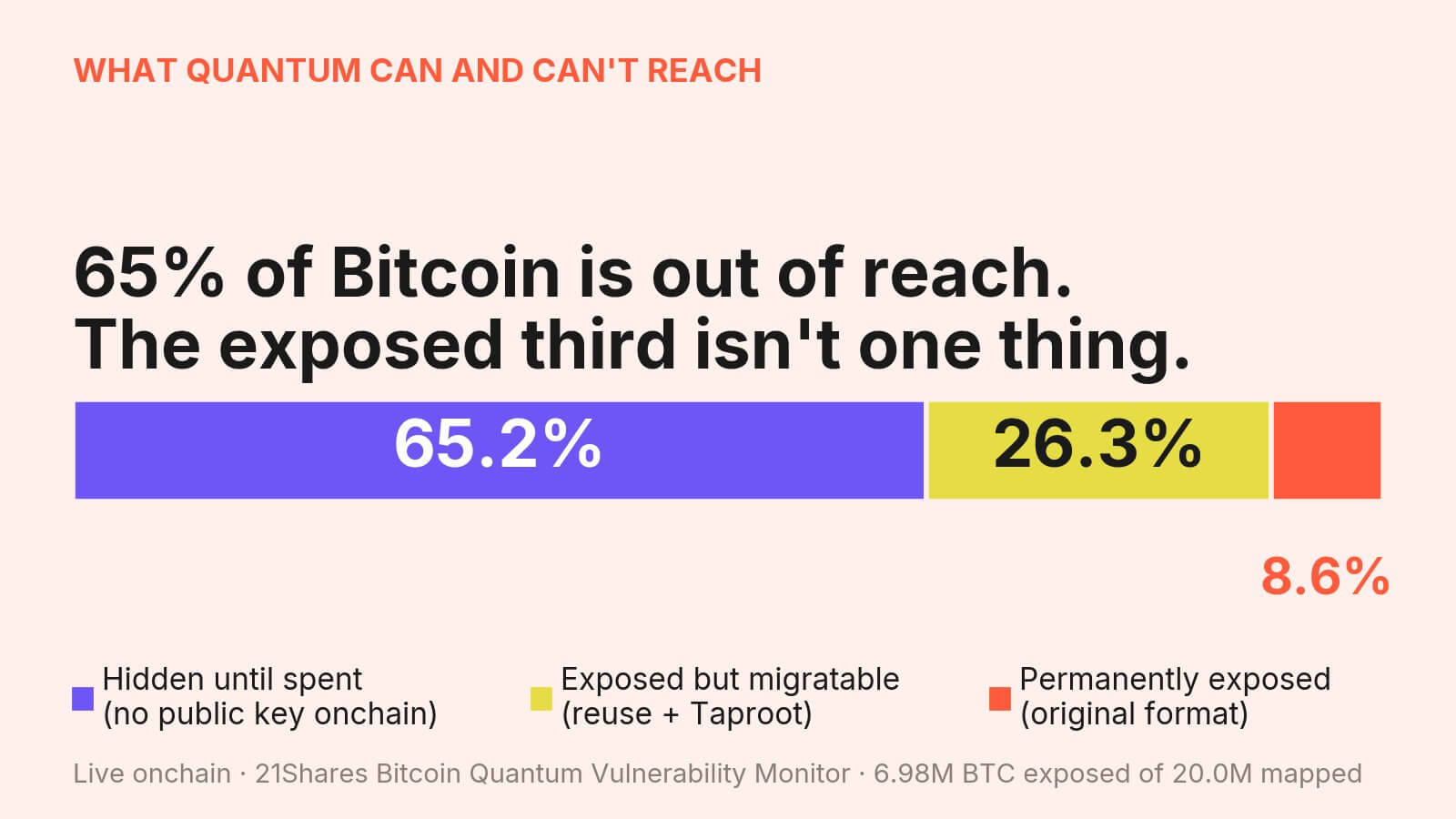
The compressed migration timetable immediately refocuses attention on the crypto industry, where almost 7 million BTC, worth nearly $449 billion of Bitcoin, currently sits in outputs whose public keys have been exposed and could theoretically be attacked by a sufficiently powerful quantum computer.
The security model of modern cryptocurrencies relies heavily on public-key cryptography. For a classical computer, deriving a private spending key from a publicly broadcast key requires exponential time, making it practically impossible.
However, a sufficiently powerful quantum computer running Shor’s algorithm can solve the underlying discrete-logarithm problem in polynomial time. This capability would allow an attacker to recover private keys from any public keys exposed on the blockchain, granting them full control over the associated funds.
While the underlying Bitcoin protocol remains structurally sound, the danger stems from how the blockchain network users interact with it.
A 21Shares report revealed that approximately 65% of all Bitcoin remains protected from immediate exposure because the network obscures its public keys until the coins are spent. This protocol feature limits the immediate attack surface.
However, these coins are not inherently quantum-safe; once a user spends from an address, the public key is revealed on-chain, opening a window of vulnerability if the remaining funds are not handled correctly.
Meanwhile, the risk is highly concentrated among addresses that have already broadcast their credentials. Data indicates that over 70% of this exposure is caused by address reuse, which is a practice where users repeatedly receive and spend funds from the same wallet address, permanently exposing the public key.
This vulnerability continues to grow despite shifting industry standards, with address-reuse exposure alone climbing by 28,306 BTC in May 2026 and by around 500,000 BTC over the past year. This dynamic reflects a steady influx of legacy habits offsetting improvements elsewhere.
Furthermore, this vulnerable capital is heavily consolidated. Dune analytics data shows that approximately 84.5% of the exposed Bitcoin sits in just 4,079 wallets.
According to 21Shares, most of these high-value targets remain completely anonymous, as nearly 80% carry no public label, making it difficult for compliance firms to pinpoint which institutions or large holders carry the most concentrated risk.
Dormant Satoshi-era coins complicate Bitcoin’s escape plan
Beyond active users practicing poor wallet hygiene, the Bitcoin network faces a deep structural challenge originating from its earliest blocks.
21Shares pointed out that approximately 1.08 million Bitcoin mined in 2009 have remained completely stationary for 16 years.
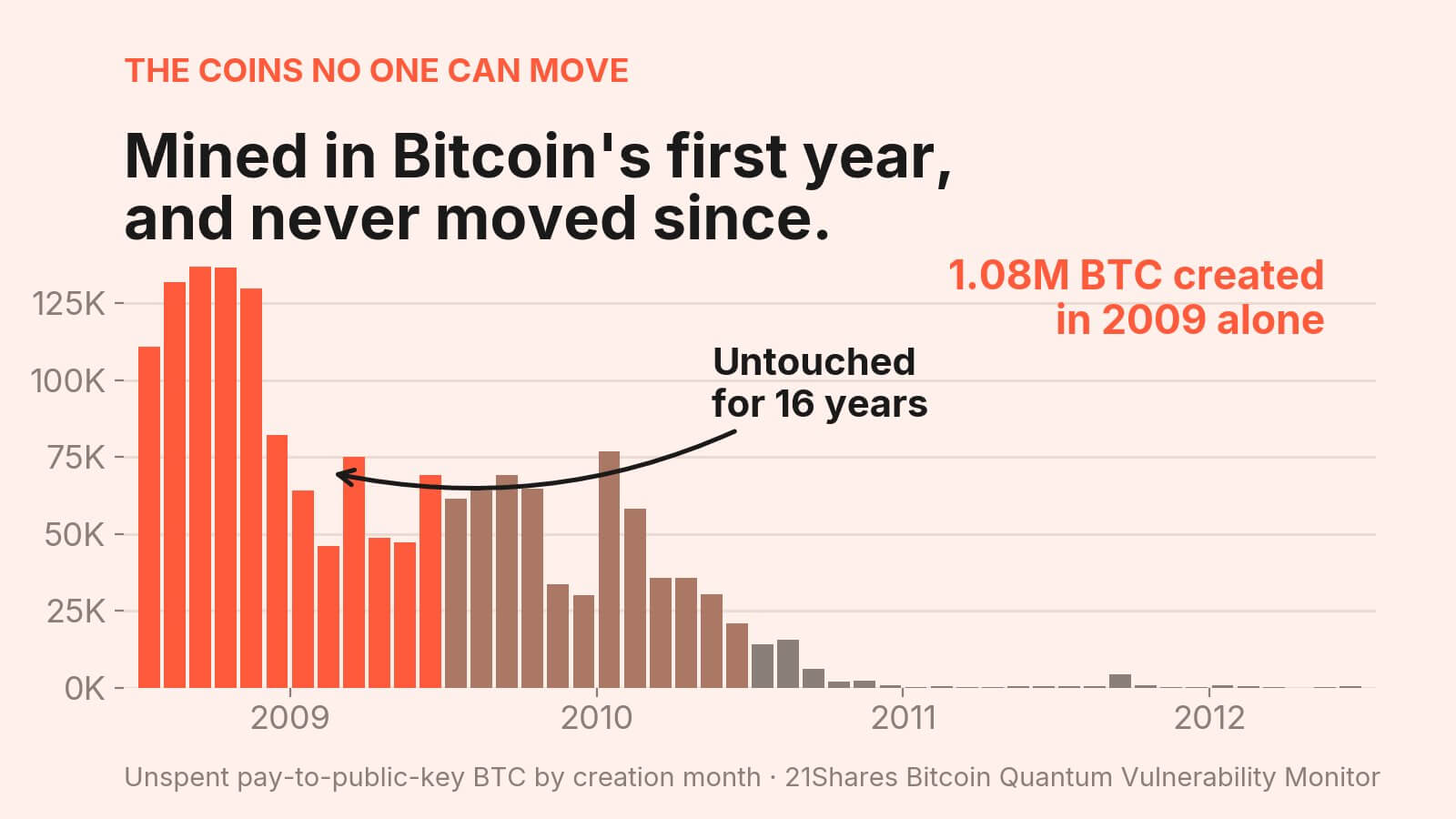
These coins are widely believed to belong to Bitcoin’s pseudonymous creator, Satoshi Nakamoto, and are held in Pay-to-Public-Key (P2PK) outputs. This early format permanently reveals the public key directly on the blockchain ledger, making it the most vulnerable tier of supply on the network.
Dune analytics data shows that the voluntary attrition of these legacy addresses is exceptionally slow.
According to 21Shares, the broader permanently exposed tier is bleeding down at a rate of only about 500 BTC per month as old keys are slowly migrated or lost. At this observed pace, analysts estimate that voluntarily clearing the broader stock of permanently exposed coins could take almost three centuries.
Karim AbdelMawla, a senior analyst with 21Shares, said:
“The market doesn’t need to wait for a working quantum computer. The day those 2009 coins are seen moving for the first time in 16 years, every holder reprices what Bitcoin’s security is worth. Coins held well aren’t the direct target. The repricing is, and it impacts the overall valuation of BTC regardless.”
This looming market risk has pushed developers to consider unprecedented technical interventions. In April, a debate emerged around BIP-361, which is a draft proposal to phase out conventional spending from vulnerable addresses and leave unmigrated legacy coins effectively unspendable.
BIP-361 outlines a multi-tiered approach. Its first phase would prevent users from sending additional funds to quantum-vulnerable addresses. A later phase, proposed to trigger roughly five years after activation, would restrict conventional Elliptic Curve Digital Signature Algorithm (ECDSA) and Schnorr signature spending, requiring a specialized quantum-safe rescue process.
Coins whose owners cannot satisfy the new cryptographic conditions would eventually become frozen.
Implementing such a proposal forces a choice the decentralized network has never faced: allow dormant coins to be stolen in the future by outside attackers, or change the foundational rules to freeze them, breaking the immutable promise that valid coins can always be moved by their rightful keyholders.
Bitcoin’s hardest problem will be getting holders to move
Despite the rapid deployment of government capital and the tightening of federal timelines, some researchers argue that immediate alarm over digital asset security is mathematically misplaced.
Martin Hiesboeck, the head of research at Uphold, pointed out that the global cryptographic community already possesses robust post-quantum cryptography (PQC) standards and is actively integrating them.
He noted:
“We are not flying blind. The near-term danger isn’t the technology we currently anticipate. We know the exact vulnerabilities — specifically how Shor’s algorithm impacts ECDSA and Schnorr signatures — and we are actively building the structural mitigations to swap out these legacy layers well before fault-tolerant systems arrive.”
Instead, Hiesboeck warned that the real risk lies in the systemic unpredictability of quantum hardware once it operates at true scale.
According to him, the true danger is not what can be mathematically modeled today, but rather the unmapped scope, unexpected computational efficiencies, and emergent hardware capabilities that cannot be foreseen before a fault-tolerant computer is built.
Recent technical updates suggest that while the gap is closing, a commercially relevant machine capable of exploiting blockchain vulnerabilities is still years away. Modern quantum hardware suffers from physical error rates that are roughly 10 million times too high for cryptographic attacks.
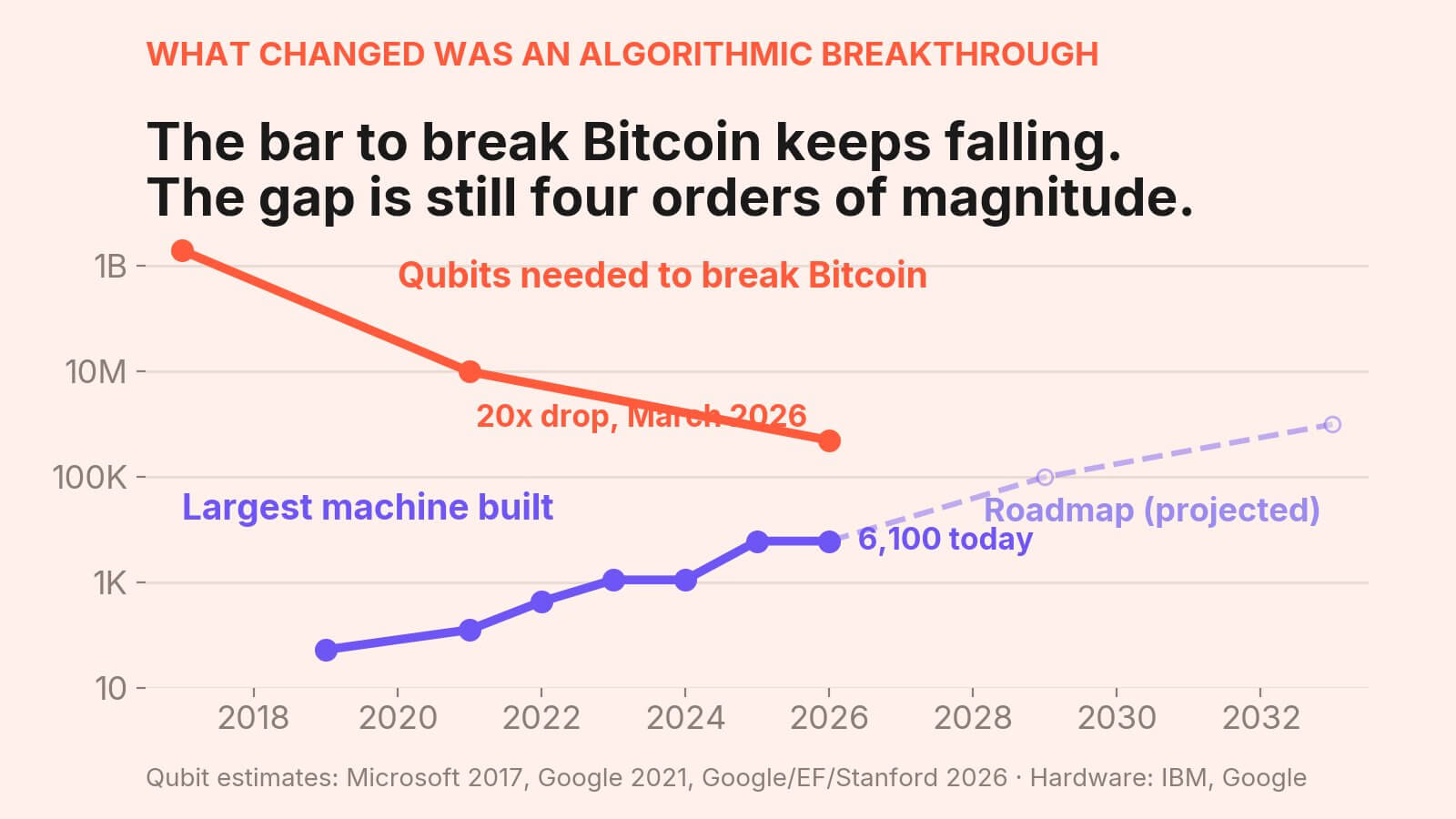
However, a technical report published by Google researchers in March demonstrated a method that cuts the physical resources required for such an attack by twentyfold. Following those findings, Ethereum researcher Justin Drake estimated the probability of a cryptographically relevant quantum computer arriving by 2032 at 1 in 10 or higher.
Even with several years of expected warning, upgrading a decentralized financial network has historically proven to be an exceptionally slow process.
The 21Shares analysis estimates that only 47.6% of Bitcoin’s total supply currently sits in Segregated Witness (SegWit) outputs, nine years after the upgrade was formally launched on the network.
So, developing a mathematically sound post-quantum signature fix may prove to be the straightforward part of the equation. The greater challenge is getting millions of independent users worldwide to coordinate and move their capital into quantum-safe addresses before capable hardware arrives.
Featured,Market,Politics,Quantum,Technology,Trading,Wallets,Bitcoin,quantum computingBitcoin,quantum computing#Trumps #quantum #computing #push #puts #billion #exposed #Bitcoin #limelight1782238959
