

On June 29, the US Supreme Court ruled that President Donald Trump had the authority to remove the Federal Trade Commission (FTC) Commissioner Rebecca Slaughter, rejecting the statutory limits that previously allowed FTC commissioners to be fired only for cause.
This decision overturned Humphrey’s Executor, the 1935 precedent that had protected certain independent agency commissioners from dismissal without cause for more than nine decades.
The ruling stated:
“Despite what Humphrey’s may say, independent agencies are not ‘independent’ in the sense that they are free of the President and thus responsive ‘only to the people of the United States.’”
Trump celebrated the court’s decision on his Truth Social platform, framing it as a significant expansion of executive authority.
He wrote:
This whole concept of ‘Power’ has been fought over for nearly 100 years, going all the way back to Franklin Delano Roosevelt, where a large slice of his Power was taken away. He fought to regain it, even wanting to ‘pack the Court,’ but was unsuccessful in doing so. This Decision gives tremendous additional Power back to the Presidency, where it belongs.
When questioned by reporters at the White House regarding whether he planned further dismissals across the federal bureaucracy, the president left the door open, remarking that the decision simply restores the rightful power of the Oval Office.
While the ruling centered on the FTC, its reasoning places new pressure on agencies with similar multimember structures and removal protections.
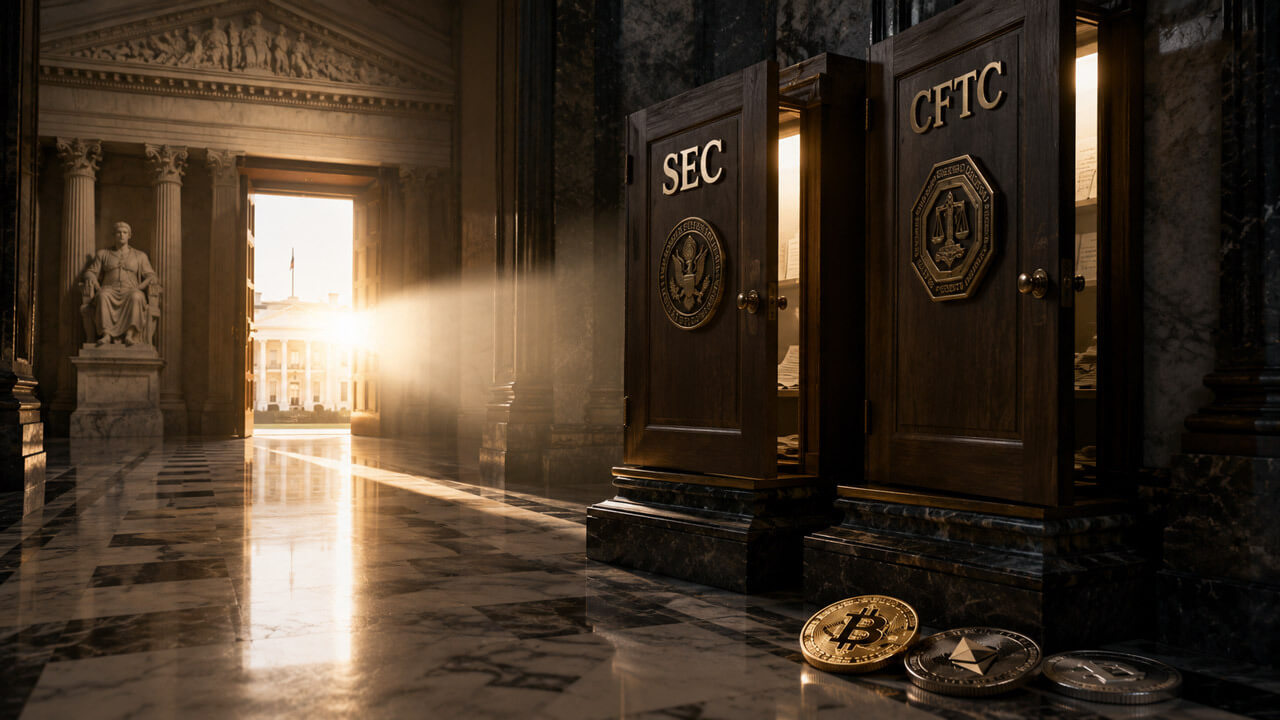
That includes the Securities and Exchange Commission (SEC) and Commodity Futures Trading Commission (CFTC), which have traditionally been designed to operate with staggered terms, bipartisan membership, and some distance from direct White House control.
That structure has been especially important in financial regulation, where markets often prize continuity.
Commissioners can influence enforcement priorities, rulemaking calendars, exemptions, settlement decisions, and interpretations of existing law. Even when statutes remain unchanged, agency leadership can determine how aggressively those statutes are applied.
For crypto companies, that distinction is familiar. The industry spent years arguing that the SEC under former Chair Gary Gensler used enforcement actions to set policy without providing workable rules.
The current administration has moved in the opposite direction, with regulators promising clearer categories for digital assets and greater coordination between the SEC and CFTC.
The Supreme Court’s decision could make that kind of policy swing easier to execute.
SEC and CFTC already sit at the center of crypto policy
The timing makes the ruling more important for digital assets.
The SEC and CFTC are already trying to coordinate more closely on crypto oversight. SEC Chairman Paul Atkins and CFTC Chairman Michael Selig held a joint event in January to discuss harmonization between the agencies and their role in shaping US financial leadership in the crypto era.
The SEC said the event was tied to efforts to deliver on Trump’s promise to make the United States the “crypto capital of the world.”
That language marked a clear break from the prior regulatory posture. Instead of competing publicly over jurisdiction or relying primarily on enforcement, the agencies have signaled a preference for clearer asset classifications, coordinated supervision, and rulemaking that provide exchanges, brokers, custodians, and token issuers with a clearer path to compliance.
However, Markus Levin, co-founder of XYO, told CryptoSlate that while the Supreme Court decision does not change the SEC’s or CFTC’s legal authority over crypto, it could give future administrations more influence over how those agencies carry out their mandates.
According to him, a White House that supports digital assets may move faster on market-structure rules, stablecoin policy, and tokenization initiatives, while a less supportive administration could shift the agencies back toward enforcement or delay implementation.
This means that a president who can remove commissioners more easily may be able to align the agencies more closely with the administration’s policy goals.
While that could reduce internal resistance, as it has during crypto-friendly rulemaking under the current administration, it could also give a future administration more room to reverse course.
Levin added:
What the industry should be concerned over is if the benefits of faster policymaking outweigh the risk of greater political influence over financial regulators. Businesses and institutional investors value regulatory frameworks that remain consistent across administrations. If the implementation of crypto rules becomes increasingly shaped by political cycles, firms may spend as much time adapting to shifting priorities as they do complying with the rules themselves.
CLARITY Act raises the stakes
The Supreme Court ruling lands while Congress is debating the Digital Asset Market CLARITY Act, the most significant market-structure bill now moving through Washington.
The Senate Banking Committee advanced the bill in May by a 15-9 vote. The legislation is designed to divide digital asset oversight between the SEC and the CFTC, while establishing disclosure, registration, and customer protection rules for parts of the crypto market.
In broad terms, the bill would give the CFTC a larger role over digital commodities and spot-market activity, while preserving the SEC’s authority over investment contracts and securities-linked digital assets.
That framework is intended to resolve years of uncertainty over which regulator oversees token listings, trading platforms and intermediaries.
While the Supreme Court decision does not determine whether CLARITY passes, it changes the institutional setting around the bill.
If Congress gives the SEC and CFTC a clearer mandate over crypto, the people leading those agencies will become even more important.
Commissioners and chairs would be responsible for writing rules, granting exemptions, approving registrations, policing exchanges, and deciding how much flexibility to give firms moving from offshore or state-level structures into a federal regime.
Under the old model, staggered terms and removal protections were meant to slow abrupt changes in agency direction. The court’s ruling weakens that buffer.
A crypto policy framework that depends heavily on SEC and CFTC implementation could therefore become more exposed to presidential politics.
Still, that does not make the ruling a simple win or loss for the industry.
In the near term, crypto firms may benefit if the current White House uses its influence to push regulators toward faster rulemaking, fewer enforcement-driven policy fights, and broader acceptance of tokenized markets. ETF sponsors, exchanges, stablecoin issuers, and institutional trading firms could all gain from a more coordinated federal approach.
The risk is that the same structure works in reverse. A future administration skeptical of digital assets could replace agency leadership, slow pending rules, reopen enforcement theories, or narrow exemptions that the industry had begun to rely on.
That prospect matters for firms making long-term investments in US infrastructure.
This is because exchanges, custodians and asset managers need rules durable enough to support compliance plans, capital commitments and product launches across election cycles.
Featured,Legal,Legislation,Macro,Politics,Regulation,CFTC,SEC,supreme court,trump,USCFTC,SEC,supreme court,trump,US#SEC #CFTC #crypto #plans #face #risk #Supreme #Court #ruling1782919673
