
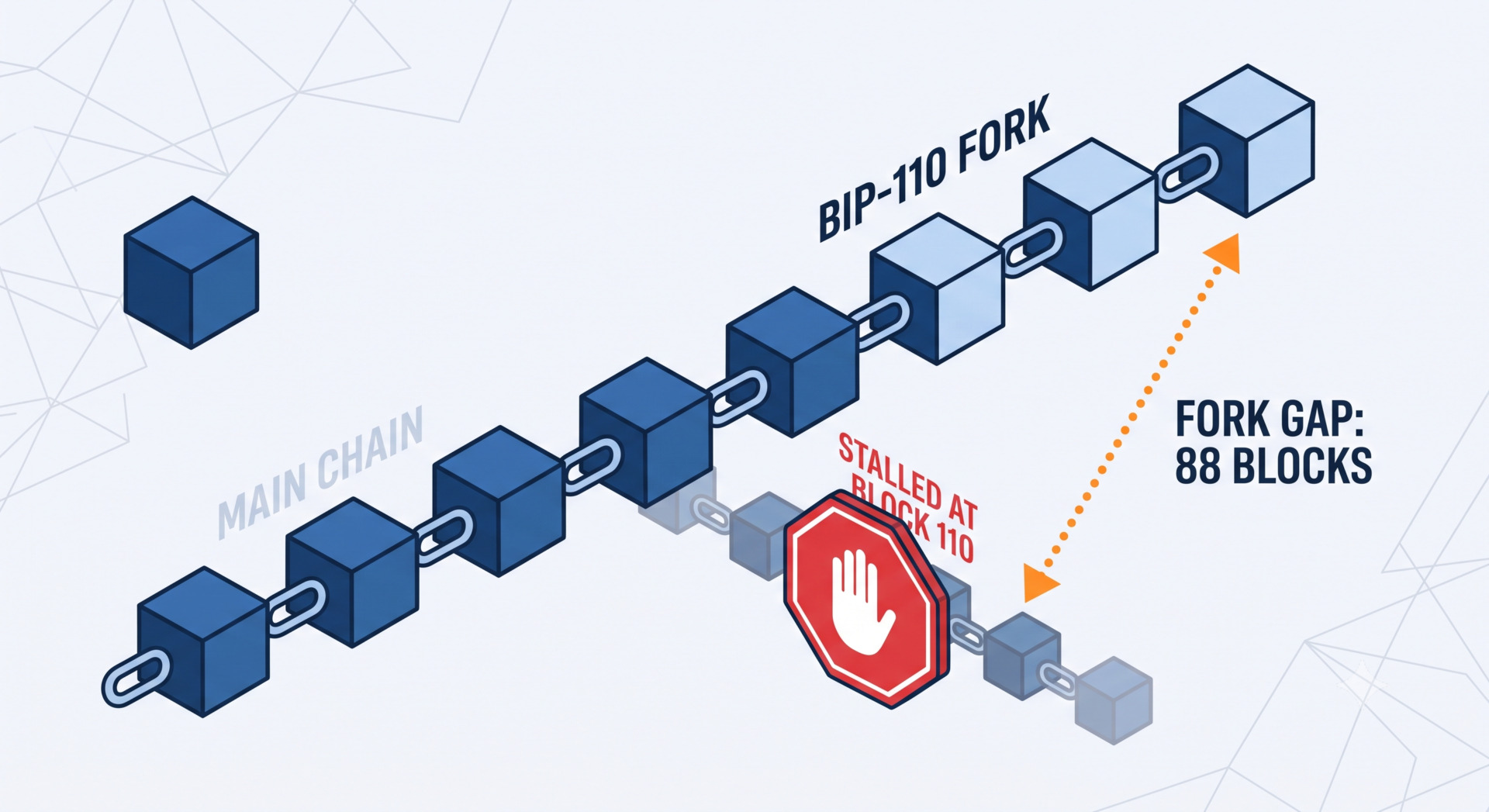

- The BIP-110-enforcing chain sat at block 961,633 against 961,802 on the main chain early on Monday, a gap of 169 blocks, according to bip110monitor.com and CNA’s own pulls from mempool.space and blockchain.info.
- That branch has mined two blocks in total, 961,632 and 961,633, and Ocean’s BIP-110 endpoint showed its most recent one about 26 hours old.
- Signalling ran at 2.53%, or 51 of 2,016 blocks, in the period that ended at the enforcement height, and the monitor puts the current period at 0.00%.
Bitcoin’s (BTC) BIP-110-enforcing chain has mined two blocks since it split from the main chain at block 961,632 on Saturday, and the gap between the two has widened to 169 blocks.
Block explorers mempool.space and blockchain.info both put the main chain at 961,831 early on Monday.
The BIP-110 branch stood at 961,633, on figures the monitoring site bip110monitor.com draws from the explorer mempool.guide. That site labels the branch frozen, and Ocean’s separate BIP-110 endpoint showed its most recent block roughly 26 hours old.
The main chain added around 170 blocks over the same stretch. Both chains carry a block at each of the two divergent heights, under different rules and with different hashes.
Read more: Coldcard Exploit Expands as Attackers Steal Up to $130M in Bitcoin
Why a Second Chain Exists
Block 961,632 marked the end of BIP-110’s voluntary signalling window and the start of mandatory enforcement, so nodes running the proposal now reject blocks that do not signal for it. Miners who want to work that chain have to opt in deliberately, either by running a BIP-110 node with DATUM or by pointing hardware at Ocean’s separate stratum endpoint. Almost none have.
Signalling in the difficulty period that ended at 961,632 reached 2.53%, or 51 of 2,016 blocks. Activation requires 55% within a single 2,016-block period, against the 95% threshold used for earlier soft forks. In the period now running, bip110monitor.com puts signalling at zero.
The activation window closes on 1 September, having opened on 1 December 2025. bip110monitor.com has tracked the proposal since block 937,440.
What the Proposal Would Change
BIP-110, the Reduced Data Temporary Softfork written by pseudonymous developer Dathon Ohm and introduced in December 2025, would cap data-carrying fields for about a year, limiting new script outputs to 34 bytes, capping witness items at 256 bytes and restricting Taproot features used to embed images and text on-chain.
Coins already in wallets before activation would be exempt from the new limits.
Strategy executive chairman Michael Saylor and Blockstream chief executive Adam Back both rejected the proposal in July. Likewise, Saylor argued it turns a dispute over spam into a consensus change that would invalidate transactions that are currently valid and paying fees. He also posted that there are “110 things more dangerous to Bitcoin than spam”.
Bitcoin’s total network hashrate was about 907.7 exahashes per second on Monday and mining difficulty about 127.5 trillion, according to mempool.space. The same fight over data limits ran through BIP-444 last October.
Read more: Boltz Halts Bitcoin Swaps Indefinitely as AI-Powered Attacks Overwhelm Service
Bitcoin,Cryptocurrency#Bitcoins #BIP110 #Chain #Stalls #Fork #Gap #Widens #Blocks1786346410
