
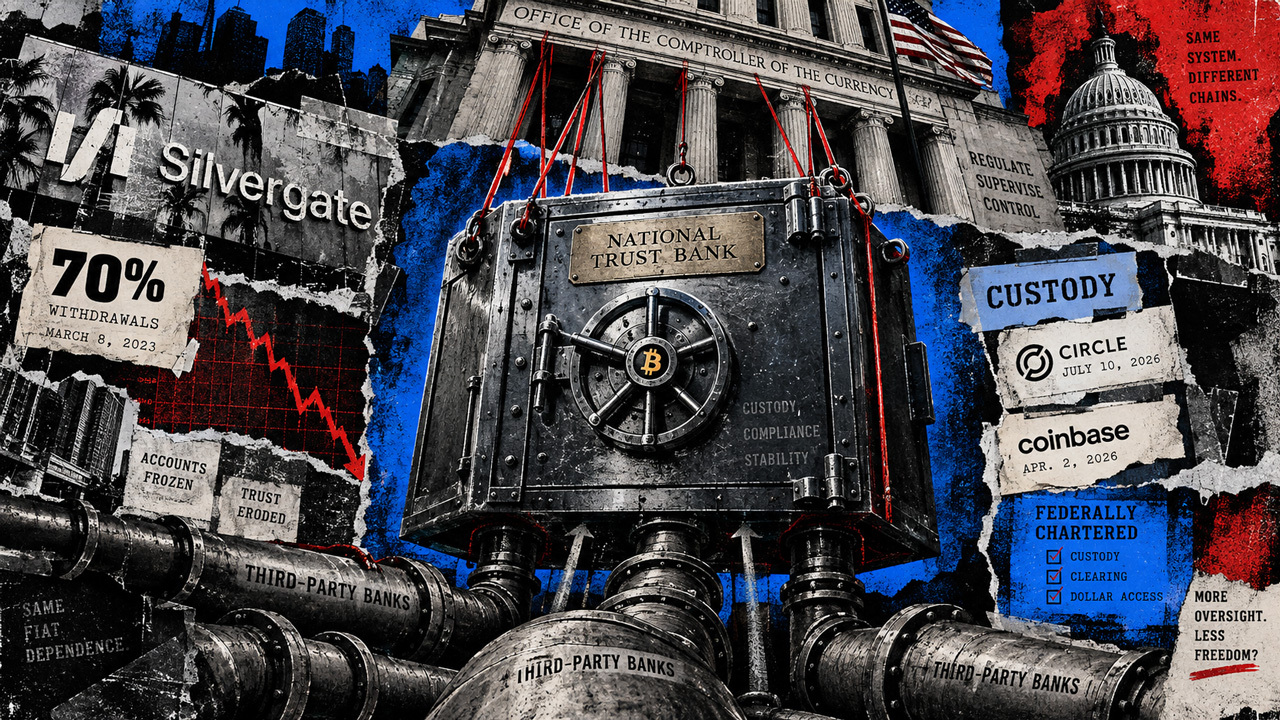

Silvergate’s former chief executive, Alan Lane, says the crypto-focused bank survived withdrawals of roughly 70% of its demand deposits before political pressure drove it to choose liquidation.
His account raises a question for the crypto companies obtaining federal bank charters: how much protection does becoming a bank actually provide?
In his Sept. 8 account, Lane blamed the former President Joe Biden administration for making continued operations untenable.
More than three years after the bank announced its voluntary wind-down, crypto companies are obtaining federal trust-bank charters that put their custody businesses directly under the Office of the Comptroller of the Currency.
Federal trust charters give companies an established legal framework for custody, the business of safeguarding customer assets. They also create a direct supervisory relationship with Washington and can leave firms dependent on other banks for cash.
Lane says Silvergate remained “solvent and liquid” after the late-2022 withdrawals and could have continued serving customers. He attributes the decision to announce liquidation on March 8, 2023, to political and regulatory pressure.
The Federal Reserve’s inspector general offered a different explanation in its September 2023 review. It attributed the liquidation to concentration in crypto-industry depositors, rapid growth and funding risks, alongside significant weaknesses in governance and risk management.
The Fed confirmed in July 2024 that Silvergate had completed its liquidation, repaid all customer deposits and ceased functioning as a bank. The Fed separately fined Silvergate $43 million for anti-money-laundering noncompliance.
| Risk dimension | Silvergate model | OCC trust-bank model | Forward-looking takeaway |
|---|---|---|---|
| Core business | Deposit-funded crypto banking | Fiduciary custody/asset safeguarding | The new charters reduce classic deposit-run exposure but shift focus to custody, compliance and operational resilience. |
| Main vulnerability | Concentrated crypto-industry deposits | Third-party bank dependence for fiat and business-plan limits | The choke point may move from the chartered entity to its banking partners. |
| Supervisory channel | Fed / San Francisco Fed | OCC direct supervision | Federal oversight existed before; the question is whether a different supervisor and rule set changes durability. |
| Failure mode | Liquidity stress, funding concentration, governance weakness | Activity restrictions, examiner conditions, partner-bank disruption | A charter can define permitted activity, but it does not eliminate supervisory pressure. |
| Reader takeaway | “Bank status did not save Silvergate” | “Trust-bank status may narrow the risk perimeter” | The real test is whether crypto firms can operate predictably through future policy swings. |
Silvergate was also already subject to federal oversight, through the Fed and its San Francisco Reserve Bank. The newer firms are choosing a different banking model and a different federal supervisor.
Silvergate’s vulnerability centered on a deposit-funded institution serving a concentrated industry, while a trust bank focused on safeguarding assets has a different job.
A charter for custody, with banks still attached
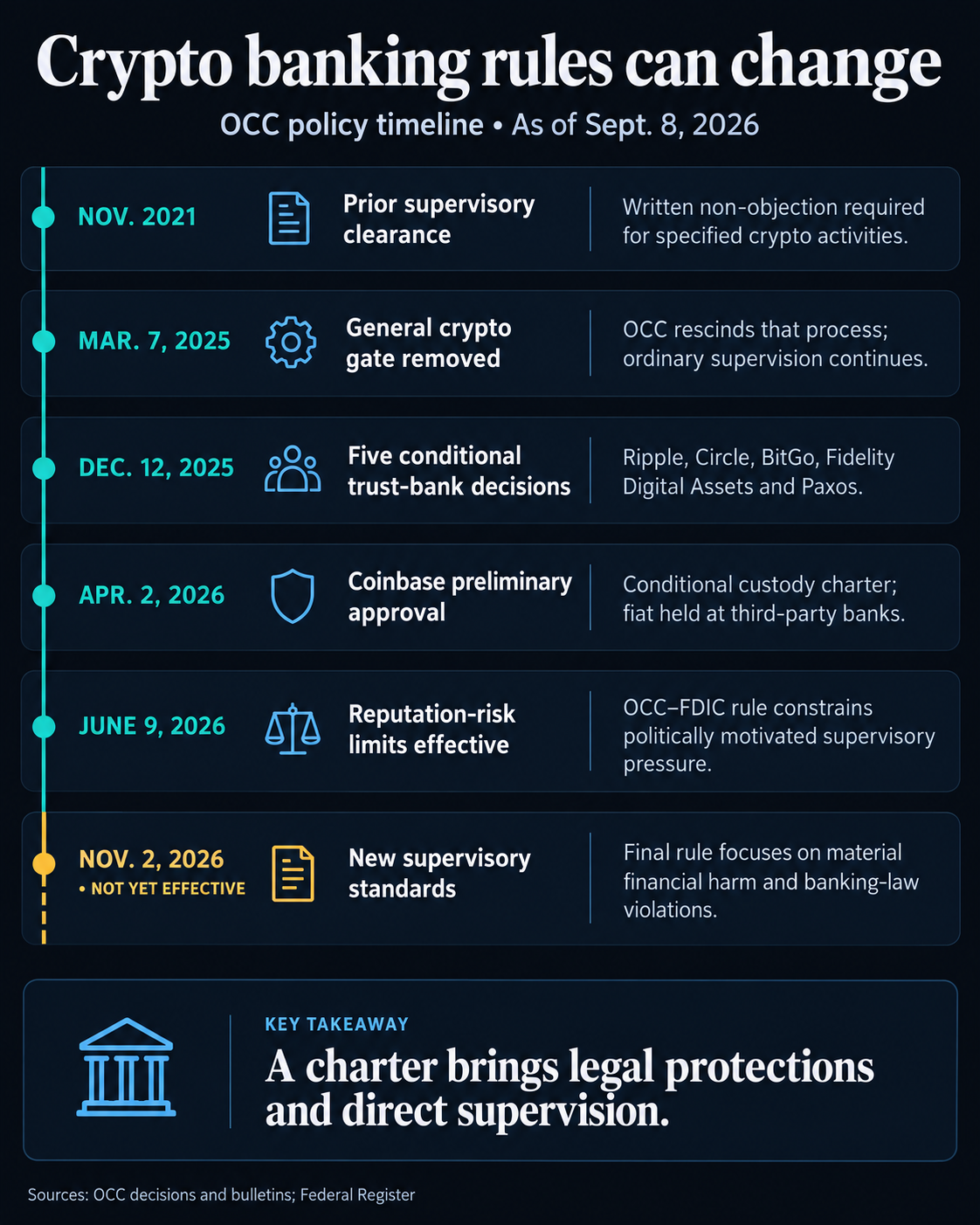
The OCC’s December 2025 decisions conditionally approved new trust-bank applications for Ripple and Circle’s proposed First National Digital Currency Bank, plus conversions for BitGo, Fidelity Digital Assets and Paxos.
Circle announced final approval on July 10 for the institution operating as Circle National Trust, describing custody for itself and its affiliates at opening, with reserve management a future capability.
The OCC’s pending application list includes Zerohash’s Aug. 19 application and earlier 2026 submissions from Payward National Trust Company, Agora National Trust Bank, and EDX Trust.
Coinbase’s April 2 decision granted preliminary conditional approval for fiduciary digital asset custody and related services. The proposed trust bank would not be an insured depository institution, and fiat held in custody would be in for-benefit-of accounts at third-party banks.
The structure brings authorized custody into a federally supervised affiliate while keeping an outside-bank connection for cash.
| Company / proposed bank | OCC status | Date marker | Type of move | Strategic implication |
|---|---|---|---|---|
| Circle / Circle National Trust | Final approval announced | July 10, 2026 | National trust bank | Stablecoin infrastructure and reserve/custody functions move closer to federal supervision. |
| Coinbase National Trust Company | Preliminary conditional approval | April 2, 2026 | New national trust charter | Institutional custody gets a federal wrapper, but with conditions before launch. |
| Ripple National Trust Bank | Conditional approval | Dec. 12, 2025 | New national trust charter | Shows the trust-bank route is becoming a repeatable crypto regulatory path. |
| BitGo, Fidelity Digital Assets, Paxos | Conditional approvals | Dec. 12, 2025 | Conversions to national trust banks | Existing custody businesses are seeking federal alignment rather than only state regimes. |
| Zerohash, Payward, Agora, EDX Trust | Pending applications | Mar.–Aug. 2026 | Pipeline applicants | The charter wave is broadening beyond the first approvals. |
The approval also preserves direct supervisory control. Before final approval, the OCC can modify, suspend, or rescind Coinbase’s preliminary decision if intervening developments warrant. Significant business-plan changes require advance notice and written non-objection during organization and the first three operating years, alongside capital and liquidity conditions.
The charter therefore defines the business a firm may conduct under specified conditions, while expansion remains subject to the applicable approval conditions.
In November 2021, the OCC imposed a written non-objection process for specified crypto activities. Banks had to go through their supervisors before proceeding with the covered activities.
On March 7, 2025, the agency rescinded that process and withdrew from two 2023 interagency crypto-risk statements as they applied to its banks.
The reversal changed the route into crypto activity while retaining examinations and obligations to operate safely and comply with the law. Coinbase’s bank-specific business-plan conditions show why removing a general crypto gate does not remove all approval requirements.
In preliminary findings released in December 2025, the OCC said the nine largest national banks it reviewed had maintained inappropriate restrictions or enhanced approvals for lawful business sectors during 2020-2023. Digital assets were among the affected sectors.
Those findings concern the reviewed banks’ policies, a separate issue from the causes of Silvergate’s liquidation.
Future supervisory leadership could take a tougher view of financial risks and compliance within its lawful authority. Companies could face tighter conditions on activities or more work to satisfy examiners even without a fight over the charter’s existence.
The 2025 policy reversal shows how much the supervisory approach can change within the same legal framework.
Rules constrain the supervisor
Rules adopted this year place new limits on how regulators can use reputation risk in supervising crypto firms. Those limits, together with each bank’s permitted activities, help determine how much protection a federal charter provides.
An OCC and FDIC reputation-risk rule, effective June 9, bars the agencies from taking adverse supervisory action based on reputation risk. It also bars them from pressuring institutions to cut off customers solely because they engage in politically disfavored but lawful activity. The rule constrains agency conduct while leaving private banks’ account decisions and supervision of financial and operational risks in place.
The agencies went further on Aug. 27, announcing new standards for unsafe or unsound practices and matters requiring attention, the supervisory findings that demand a bank’s response.
The standards focus on material financial harm or deposit-insurance risk and preserve a basis for addressing banking law violations. They exclude reputational concerns unrelated to financial condition.
| Scenario | Regulatory environment | What happens to crypto trust banks | Bitcoin / crypto-market implication |
|---|---|---|---|
| Base case | Reputation-risk limits hold; exams remain strict | Trust banks operate, but expansion requires careful compliance and capital/liquidity planning | More institutional custody capacity, but no sudden removal of banking friction. |
| Bull case | OCC approvals continue, and bank partners become more comfortable | More crypto firms migrate custody and stablecoin infrastructure into federally supervised entities | Stronger institutional confidence; custody risk premium falls. |
| Bear case | Supervisors use safety, soundness, AML, or third-party-risk concerns aggressively | Firms keep charters but face slower approvals, tighter conditions and constrained product expansion | Regulatory clarity exists on paper, but execution bottlenecks pressure crypto banking access. |
| Black swan | Major custody, AML or partner-bank failure triggers backlash | Charters remain legally protected, but examinations and enforcement escalate sharply | Market reprices counterparty risk across custodians, stablecoins and exchanges. |
That final rule was published Sept. 1 and takes effect Nov. 2. Separate OCC policies revised Aug. 27 emphasize escalation, tailoring and corrective measures focused on specific deficiencies.
They still preserve legally supportable enforcement when circumstances warrant.
One forfeiture route under 12 U.S.C. 93(a) requires specified violations and a court determination. The Administrative Procedure Act’s judicial-review standard provides for setting aside reviewable agency actions that are unlawful or arbitrary.
Those protections distinguish a change in political preference from a lawful basis for restricting a bank. They also leave regulators substantial authority over custody, compliance and financial resilience.
The November standards will provide an early test of how those protections work alongside individual charter conditions. For crypto firms, the test will be whether they can conduct their authorized businesses under predictable rules while maintaining the banking relationships those businesses still require.
Becoming a national trust bank can give a crypto company more control over custody and a firmer legal position. It also creates a direct relationship with Washington, making the durability of the rules governing that relationship more important.
Banking,Featured,Legal,Regulation,Circle,Coinbase,regulation,Ripple,xrpCircle,Coinbase,regulation,Ripple,xrp#federal #bank #protect #crypto #Washingtonor #give #Washington #control1788952344
