


The Bank of Russia has proposed a 1% crypto capital cap, limiting covered crypto and foreign-digital-instrument risk to a bank’s own funds while leaving some client custody positions outside the new calculation.
The Sept. 18 proposal would create N31 for individual credit institutions and N32 for banking groups on a consolidated basis. Each ratio compares covered exposure with the relevant institution’s capital, not its total assets. The rules remain in draft form.
The two-level structure subjects both a bank and its wider group to the same proposed percentage ceiling. N31 uses the individual institution’s own funds, while N32 uses consolidated group capital, keeping the measurement tied to the entity that carries the covered risk.
What the 1% crypto capital cap captures
The draft regulation reaches beyond coins held outright. Its numerator includes direct and indirect investments, derivatives tied to crypto prices, and instruments such as loans, bonds, guarantees, repos and credit lines when their settlement or value depends on crypto or foreign digital instruments.
Banks would receive limited recognition for hedges. Long and short positions may be netted only within the draft’s qualifying lower-risk category, which imposes conditions tied to the asset, settlement and maturity as well as freezing and liquidity risk. Direct holdings and other higher-risk exposures are measured more conservatively and cannot be fully neutralized by an offsetting position.
The treatment of customer assets turns on who bears the loss if assets are seized or transactions are restricted. A custody position enters N31 or N32 when the bank, or a digital depository in its group, is liable for that loss. If the bank does not bear that responsibility, the client position is excluded from the two 1% ratios.
That exclusion does not remove the position from prudential treatment. For covered bank and group capital-adequacy calculations, the draft assigns non-liable client custody positions a 50% risk weight. Own-account exposure and client positions for which the bank is liable receive a 1,250% risk weight.
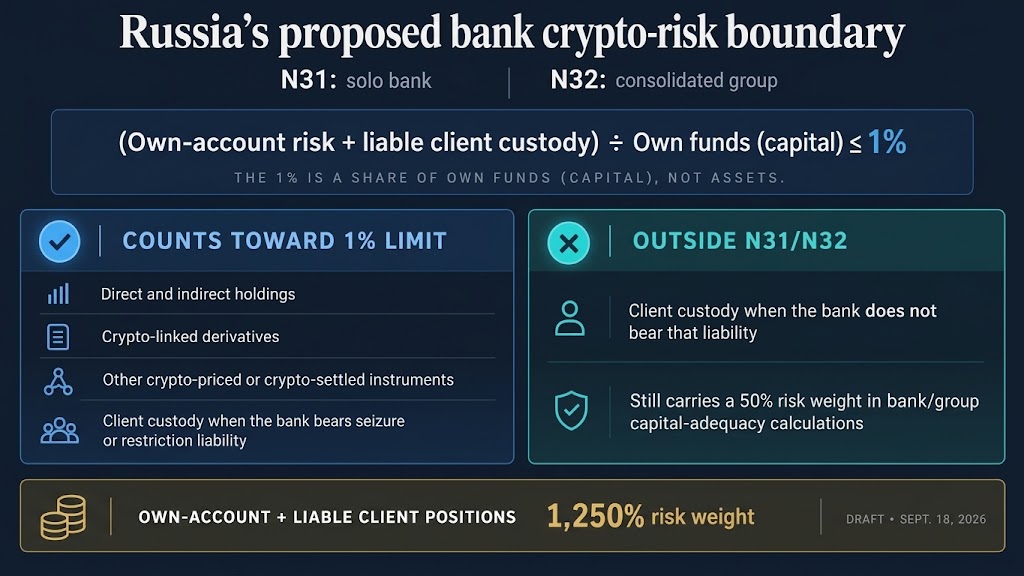
The distinction permits custody without automatically treating every customer asset as the bank’s own exposure, provided the institution does not bear the specified seizure or restriction liability. It simultaneously places a tight capital-based constraint on direct holdings and other crypto-linked risk carried by the bank.
The ratios are part of Russia’s broader crypto-market rulemaking, a framework CryptoSlate has previously described as still being completed. The central bank plans official publication in the fourth quarter of 2026, with the requirements taking effect 10 days later. Banks are expected to begin reporting instrument turnover and N31/N32 values in January 2027, although detailed forms are still being developed.
Banking,Featured,Regulation,Bitcoin,BTC,regulationBitcoin,BTC,regulation#crypto #capital #cap #Bank #Russias #proposal1789911467
