


Aave’s proposed institutional lending business would put crypto collateral on both sides of the financing chain. Institutions would pledge Bitcoin or Ether for dollar loans, while the organization governing the Aave lending protocol would initially borrow those dollars against a separate pool of its own crypto assets.
Aave Labs’ September 30 clarification identifies an Aave Labs entity as the contractual lender and confirms that the DAO-funded route would pay prevailing Aave V3 stablecoin borrowing rates. That makes the borrower’s ability to meet a margin call only one test of the business. The funding position could face its own collateral pressure or rising interest costs while an institutional loan remains current.
Aave’s governing organization, the DAO, is considering two proposed funding authorizations: a 25 million issuance bucket for GHO, Aave’s stablecoin, and up to $25 million of USDC or USDT borrowing against DAO assets. The scope includes BTC and ETH. The combined $50 million request is capacity for lending against BTC and ETH; actual outstanding loans remain undisclosed.
Aave Labs reports approximately $300 million of indicated demand and describes a $20 million lead BTC facility. The demand pipeline and lead facility are indicative, with actual drawdowns still to be reported.
A decline in crypto prices could weaken both collateral pools, while rising stablecoin borrowing costs could narrow the DAO’s interest spread. The resulting pressure would depend on the assets pledged, each position’s terms and how quickly institutional loan rates can be adjusted.
Two collateral books, two repayment obligations
The September 24 proposal would initially fund lending by pledging DAO-owned WETH and WBTC, with AAVE permitted up to 50% of collateral at each pledge. WETH and WBTC represent wrapped Ether and Bitcoin. The DAO would borrow USDC or USDT on Aave V3 and use that financing for institutional facilities.
Separately, the institutional borrower would place BTC or ETH with a qualified custodian. That collateral would secure the borrower’s loan under a Master Loan Agreement with an Aave Labs entity. A three-party Account Control Agreement would connect the lender, borrower and custodian.
These are different assets pledged for different debts. The DAO’s onchain pledge would be separate from the borrower’s custody account. The proposal says borrower collateral would never be rehypothecated, or pledged onward.
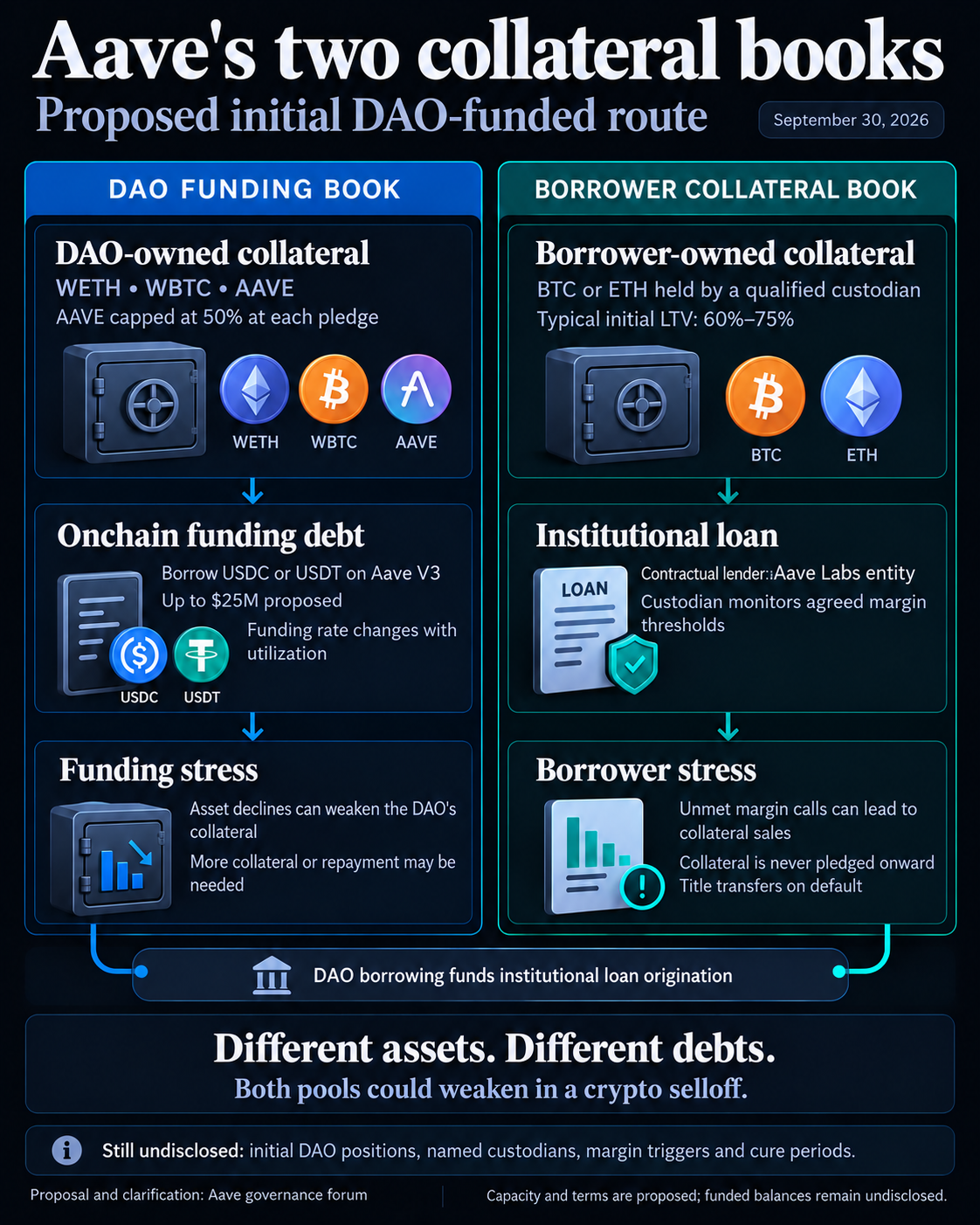
That structure allows an institution to obtain liquidity while retaining its crypto exposure, subject to margin terms. It also leaves the DAO with an onchain debt that has to remain adequately collateralized independently of the institution’s repayment schedule.
The proposed custodian would monitor borrower collateral, issue margin calls and liquidate if those calls were unmet. Legal security interests and title transfer on default are intended to let the lender direct a sale and repayment. The documents describe how enforcement would work; a record of enforcement under these facilities remains to be reported.
Typical initial loan-to-value ratios would be 60% to 75%, according to Aave Labs. A loan-to-value ratio compares the amount borrowed with the collateral’s value. Each facility’s margin trigger, cure period and liquidation terms would determine how far collateral could fall before enforcement.
A broad crypto decline could weaken both books. Falling BTC or ETH would increase pressure on an institution’s custodied collateral, while declines in the DAO’s WBTC, WETH or AAVE could reduce the cushion supporting its stablecoin borrowing.
The proposal explicitly recognizes the risk of AAVE weakening when BTC-backed loans come under stress. Its 50% cap limits AAVE’s share when collateral is pledged. Management of subsequent changes in that share would sit with the Aave Finance Committee, led by TokenLogic, which would also monitor funding-position health.
Onchain funding also has its own collateral requirements. Aave’s borrowing documentation explains that a borrower must maintain sufficient collateral and monitor its health factor, a measure of the position’s protection against liquidation. More collateral or partial repayment can be needed as that protection deteriorates.
For the proposed institutional business, this creates a liquidity question before it necessarily creates a credit loss. An institution might still be paying its loan while the DAO needs to strengthen the collateral securing its funding. Borrower collateral cannot be assumed immediately available to support the separate DAO position; access would depend on the facility’s security and enforcement arrangements.
Whether such pressure would actually arise depends on the initial DAO collateral mix, debt size, health factors and facility margin terms. Those details have not been published in the proposal and clarification. The structure supports a correlated-stress scenario, with the size and timing of any collateral sales dependent on those undisclosed positions and terms.
Floating funding can consume the loan spread
The second test is the cost of carrying the loans. Aave Labs gives indicative borrower pricing of 6% to 8% APR against approximately 4.5% funding costs, implying a 1.5 to 3.5 percentage-point interest spread for the DAO.
The September 30 reply makes clear that 4.5% is an indicative cost that can change. The balance-sheet route would pay the prevailing V3 rate for borrowed USDC or USDT. The GHO-funded route would carry the current rate paid to sGHO savers.
Aave rates depend on pool utilization, which measures how much of supplied liquidity is borrowed, and on governance parameters. Rates adjust as liquidity is borrowed or repaid. A change in inflation expectations or Federal Reserve policy would therefore not mechanically set the DAO’s Aave funding rate.
The institutional loan coupon has a different clock. In its September 30 response, TokenLogic says loan rates are fixed by contract and can remain stale during the notice period, typically 90 days. The described lead facility is evergreen, with either party able to call it or adjust its rate on 90 days’ notice.
An illustrative calculation shows the exposure. Holding a loan coupon at the bottom of the proposed range, 6%, would produce the following spreads:
| Assumed annual funding cost | Unchanged loan coupon | Interest spread before other costs |
|---|---|---|
| 4.5% | 6% | +1.5 percentage points |
| 6% | 6% | 0 percentage points |
| 7% | 6% | −1 percentage point |
The table illustrates sensitivity to assumed higher funding costs while holding the borrower’s coupon unchanged. A rise to 6% funding would exhaust the interest spread even if the borrower paid in full. At 7%, the unchanged loan coupon would be below the cost of funds. TokenLogic also notes that custody, operating, execution and credit costs still have to be paid, leaving the interest spread to cover those expenses before any profit.
Shifting toward GHO would change the funding exposure. The initial DAO-funded route would avoid converting GHO into the lending currency or drawing Stability Module inventory. The GHO route would have to convert issued GHO into the dollars borrowers primarily want while managing that conversion’s effect on liquidity and the peg.
The proposal prioritizes matched sGHO inflows, then secondary-market liquidity, with the Stability Module last. That module provides the dollar-stablecoin inventory available for GHO redemptions. The proposal calls for conversions to be routed with TokenLogic, sized and timed to market depth, and deferred if they cannot meet an agreed maximum peg deviation.
Aave Labs reported $59.9 million of Stability Module redemption inventory as of September 24. The figure provides a September 24 liquidity reference; the proposal supplies no updated September 30 inventory. TokenLogic’s new response says inventory is insufficient to support a loan of the proposed size and duration without liquidity management.
TokenLogic also says matched sGHO inflows must last at least as long as borrower drawings. Matching amounts at origination could still leave a funding gap if the money supporting a loan departed before repayment.
Disclosures would show how much pressure the DAO can absorb
The proposal’s published path remains community feedback, followed by Snapshot if sentiment is favorable and an AIP after a positive Snapshot. The current discussion does not disclose a completed approval, deployment transaction or live loan-level reporting.
Each proposed funding authorization would require the GHO Stewards’ two-of-three approval arrangement involving Aave Labs, TokenLogic and LlamaRisk. Aave Labs promises reporting on outstanding balances, collateral composition, LTV distribution, margin events, losses and funding positions. TokenLogic says a future Funding Update will detail the initial DAO collateral selection.
The precise lender entity and custodians remain unnamed. Numerical margin triggers and cure periods are also missing. The legal-party clarification identifies who would contract with a borrower, but leaves the allocation of losses and enforcement proceeds between that entity and the DAO unresolved.
Exit rights matter alongside those disclosures. Proposed term loans would mature within 12 months, while evergreen facilities would generally have notice-based call and repricing rights. Setting GHO facilitator capacity to zero could stop new minting, but would not retire outstanding GHO; removing the facilitator requires its outstanding bucket balance to reach zero.
The resulting test is broader than whether an institution can avoid selling Bitcoin at origination. Aave’s proposed financing could preserve that exposure while introducing a separate need for the DAO to support its own collateral and funding costs. The first funding update and loan-level report would show whether the two books have enough liquidity and contractual flexibility to withstand pressure together.
Analysis,DeFi,Featured,Lending,Aave,Bitcoin,BTC,ETH,ethereum,Tether,USDCAave,Bitcoin,BTC,ETH,ethereum,Tether,USDC#Aaves #lending #plan #lose #money #defaults1790793706
