

Ripple’s Brazilian foothold spans cross-border payments and securities records in a country Chainalysis ranked first for grassroots crypto adoption.
Ripple and CSD BR, a regulated financial market infrastructure operator, announced a first phase on Sept. 29 to mirror ownership records for BTG Pactual investment fund shares on the XRP Ledger (XRPL). CSD BR’s systems will remain the official record for registration, deposit, and settlement.
The announcement follows a Sept. 28 interview in which RippleX executive Markus Infanger told Estadão’s E-Investidor that about $2.7 billion of the $6.7 billion in tokenized real-world financial assets he counted on XRPL was in Brazil.
That puts roughly 40% of the reported asset value in one country, although the measure reflects assets rather than payment activity.
Together, the developments show how Ripple’s years of expansion have connected it to several parts of Brazil’s financial system. The opportunity spans institutions moving money, platforms distributing stablecoins, and firms managing investment assets, with different measures of success for each.
Ripple was building there before the ranking
Ripple opened its Brazilian office in 2019 and announced XRP-enabled payments with Travelex Bank in August 2022. Those relationships predate the new adoption ranking by years.
In October 2024, its Mercado Bitcoin payments partnership initially targeted internal treasury transfers between Brazil and Portugal. The release described corporate and retail international payments as future plans, rather than services already available to those customers.
By March 2026, Ripple was expanding its Brazilian institutional offering across payments, custody, prime brokerage and treasury management. It named Banco Genial, Braza Bank and Nomad among payments users, while Mercado Bitcoin, Foxbit and Ripio were among platforms listing or supporting its dollar stablecoin, RLUSD.
Alongside that expansion, Ripple announced plans to seek a Brazilian virtual asset service provider license.
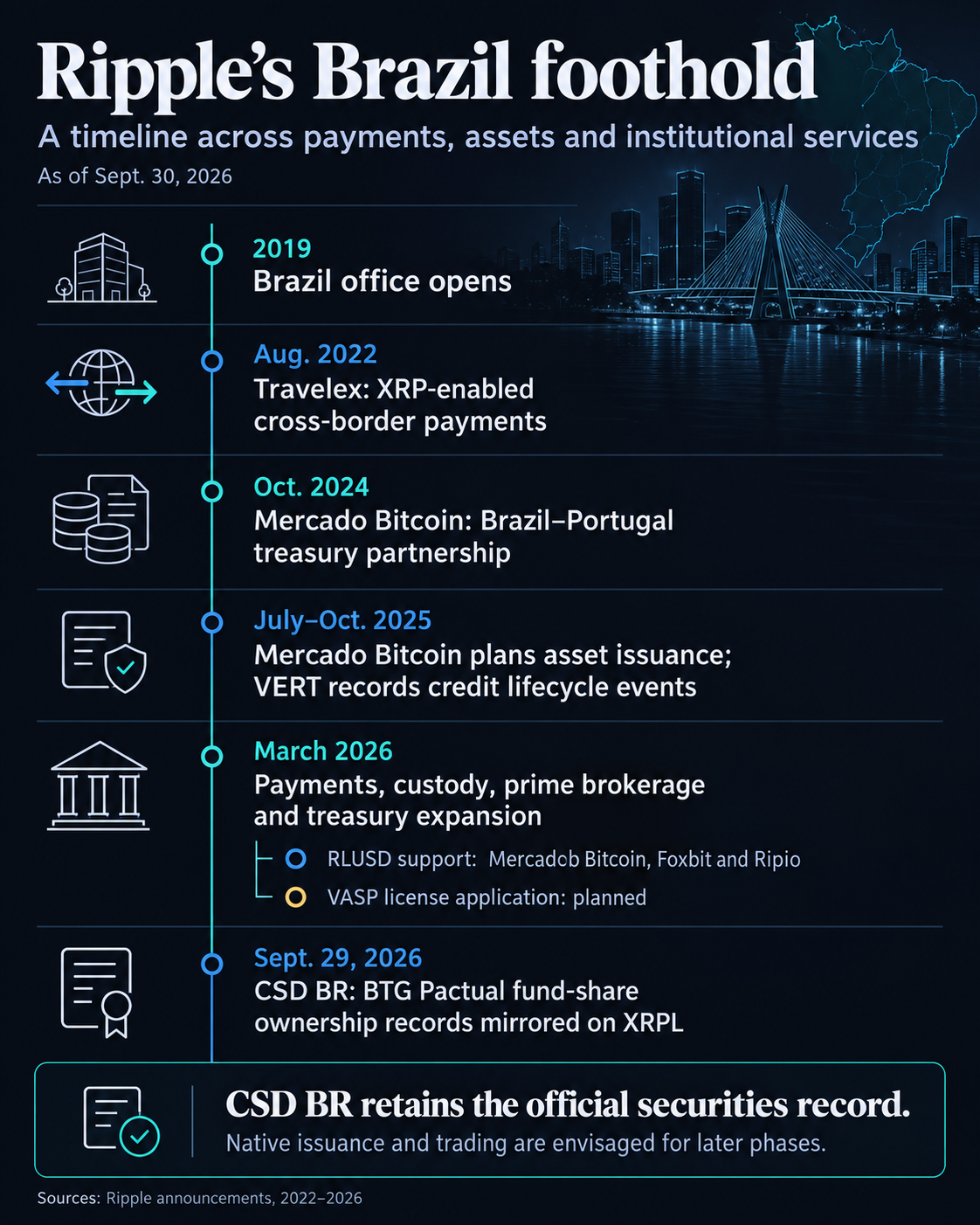
The same companies can connect several parts of the strategy. Mercado Bitcoin, for example, announced plans in July 2025 to tokenize more than $200 million in permissioned real-world assets on XRPL. The planned issuance adds an asset relationship to its payments and stablecoin connections.
Chainalysis’s 2026 adoption index puts Brazil first overall, second for cross-border flows, third for service flows and domestic peer-to-peer activity, and fourth for balances.
Its revised methodology rewards broad performance across those four measures. First place does not mean Brazil has the world’s largest crypto market by raw dollar volume, and the methodological change limits comparisons with earlier rankings.
Chainalysis estimated $252.5 billion in Brazilian crypto activity between July 1, 2025, and June 30, 2026. Its Latin America report also found that Brazil’s crypto economy contracted 1.6% during that period, so adoption leadership coexisted with a slowdown.
For Ripple, the more useful connection is what businesses do with crypto. The report describes Brazilian companies using stablecoins for liquidity management and cross-border transfers, purposes that overlap with its institutional offering.
Brazil’s Oct. 1 restrictions will bar virtual assets from settling aggregated eFX flows between providers and foreign counterparties, while individual international virtual-asset transfers remain permitted.
From represented assets to financial infrastructure
Infanger’s reported XRPL asset total gives the Brazilian footprint a reported scale. The $2.7 billion figure describes tokenized real-world asset value represented on XRPL.
In October 2025, Ripple said VERT’s credit platform recorded lifecycle events, documentation and payments on XRPL and its EVM sidechain. Its pension-receivables fund then held more than R$200 million in net assets.
The CSD BR announcement extends that approach into securities infrastructure. Its first phase mirrors BTG Pactual fund-share ownership records using XRPL tokens and Ripple custody, with access restricted to authorized Brazilian corporate and banking participants subject to identity and anti-money-laundering checks.
Native issuance and trading are envisaged for later phases after mirroring is validated. For now, the project gives Ripple a place inside existing financial processes without making the public blockchain the authoritative securities register.
That makes Brazil a practical test of Ripple’s wider institutional strategy. Its announcements show relationships across payments, stablecoins, custody and investment records, but provide no comparable aggregate Brazil-only payment volume, RLUSD circulation or active institutional usage.
Sustained transactions and broader use of the CSD BR system would show how far those connections develop beyond the reported asset values.
Adoption,Featured,Payments,Tokenization,Bitcoin,Chainalysis,Ripple,RLUSD,xrpBitcoin,Chainalysis,Ripple,RLUSD,xrp#Ripples #biggest #institutional #bet #Brazil1790852268
