




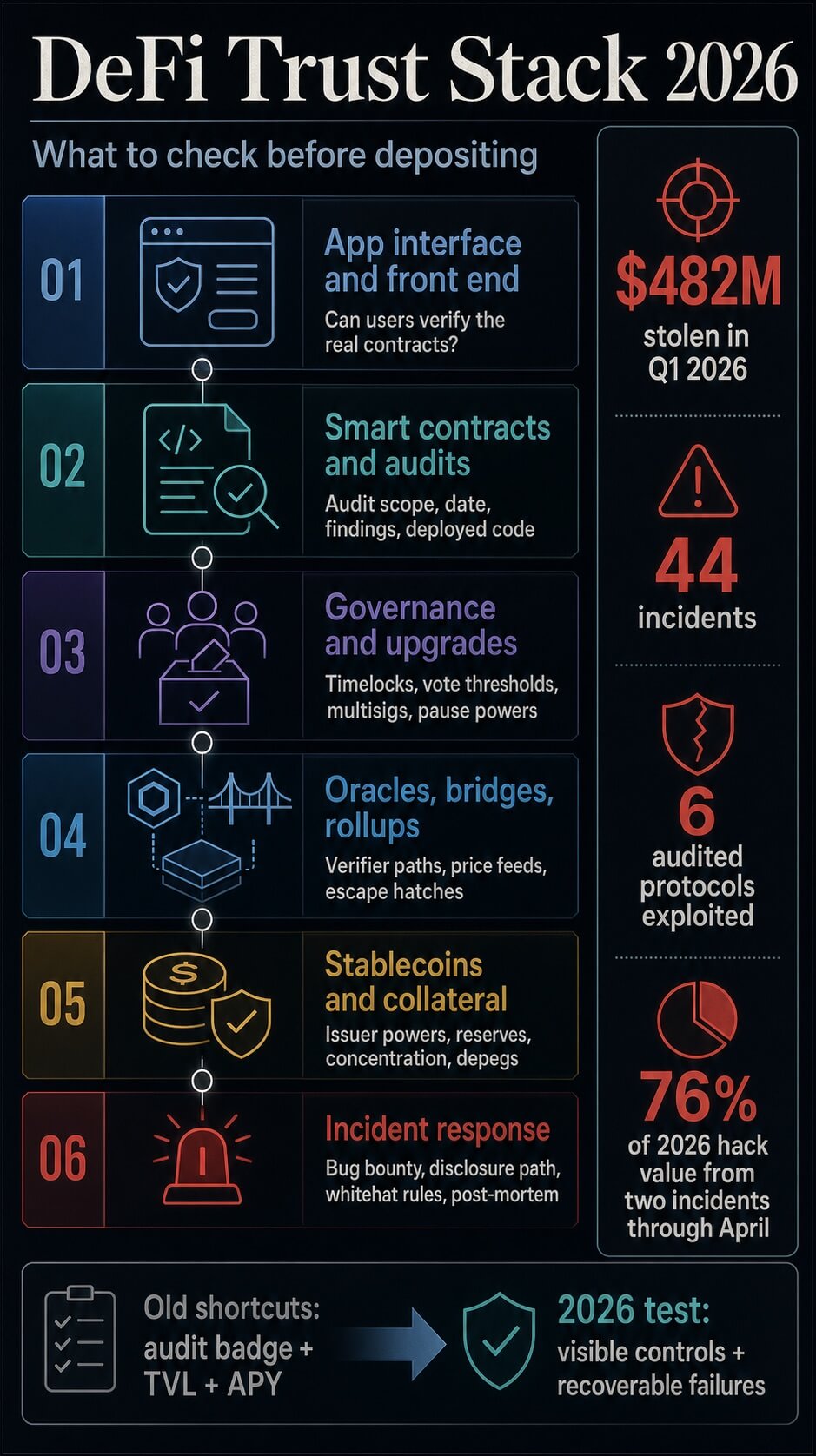
In 2026, choosing where to deposit in DeFi starts with a question that audits and total value locked (TVL) leave unresolved: what breaks under stress?
That is the shift behind any serious trust check this year. A Q1 2026 security report counted $482 million stolen across 44 incidents and said six audited protocols were still exploited.
An April 30 analysis of North Korea-linked crypto theft said two incidents accounted for 76% of all crypto hack value through April 2026, with the cases pointing to signer compromise, governance exposure, bridge verification, timelocks, and incident response as much as code quality.
For users, the lesson is blunt. A DeFi platform is a stack of contracts, keys, governance processes, token incentives, stablecoins, bridges, oracles, front ends, risk managers, and emergency powers.
Trusting it means deciding whether those layers are visible enough, tested enough, and conservative enough for the amount of capital at risk.
No checklist can promise that any DeFi platform is safe. The goal is to reject the weakest ones before yield, branding, or social media momentum does the thinking.

Start with what the old signals miss
The old shortcut was simple: look for an audit, check TVL, compare the yield, and see whether large wallets are using the protocol. Each signal has limited value, but none answers the full trust question.
An audit is only useful if it covers the contracts that currently hold funds. A protocol can be audited, then upgraded. It can depend on unaudited adapters, bridge contracts, oracle settings, or admin controls.
The v3 audit materials, for example, list scope and reports, which is the kind of detail users should look for. A generic audit badge without dates, scope, findings, and deployed-contract links is weaker.
TVL has the same problem. It can show liquidity while leaving resilience unresolved.
Revenue rankings help separate protocols retaining real fees from venues leaning mainly on emissions or incentive loops. A platform with large TVL but thin revenue, temporary rewards, or fragile collateral may look strong until users all want the exit at once.
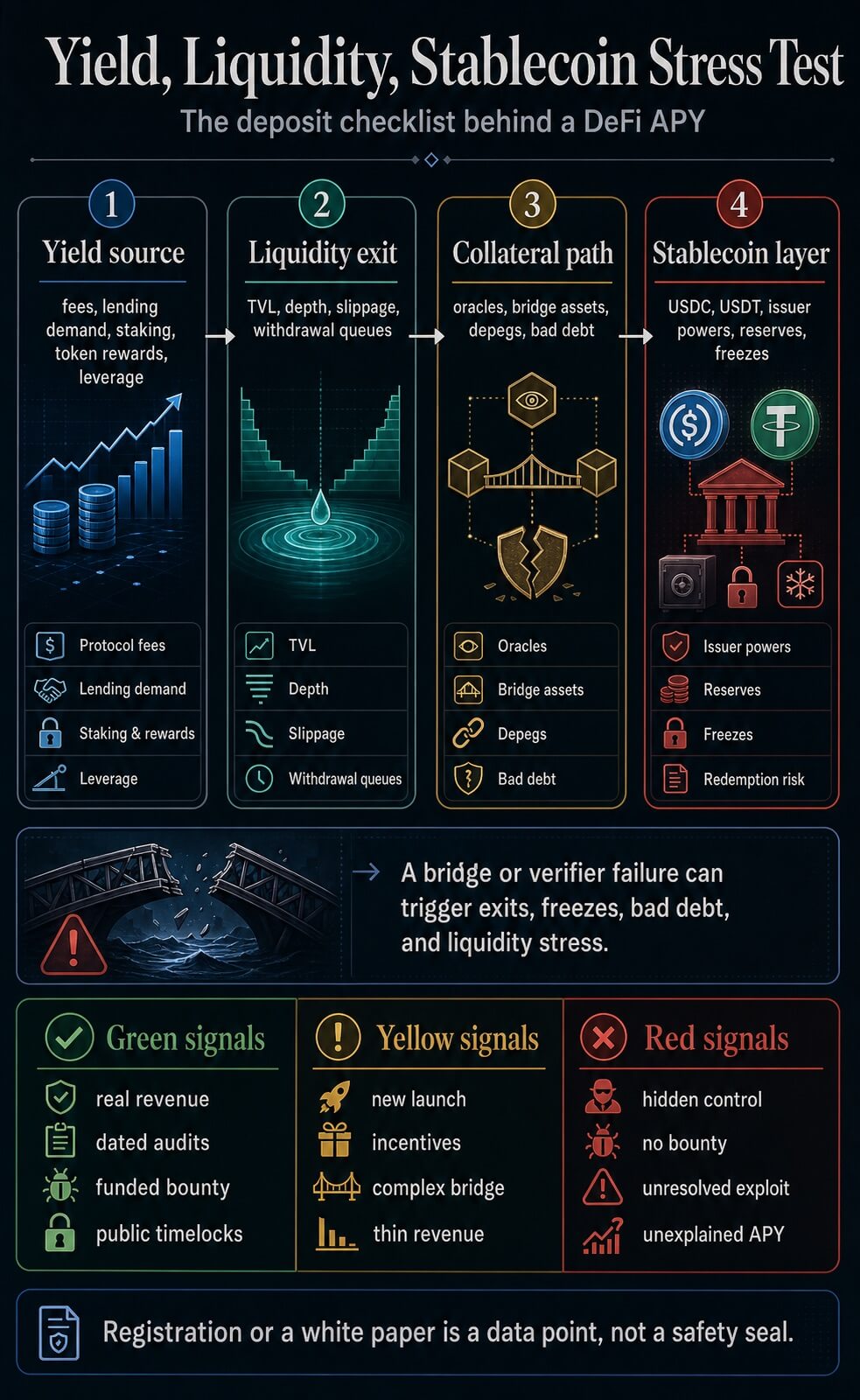
Yield is even less reliable as a trust signal. High APY often compensates users for risks that are hard to see: smart-contract risk, oracle risk, collateral risk, liquidation risk, bridge risk, or the risk that a reward token cannot hold value.
The first question is where the yield comes from and what has to keep working for depositors to withdraw.
| Old signal | 2026 trust question | Where to check |
|---|---|---|
| Audit badge | Did the audit cover the contracts, upgrades, and integrations holding funds now? | Protocol docs, audit reports, deployed contract links |
| High TVL | Can users exit without breaking liquidity or leaving bad debt behind? | TVL, revenue, liquidity depth, collateral composition |
| High APY | Is yield paid by real demand, fees, leverage, or temporary token incentives? | Fee dashboards, reward schedules, market utilization |
| DAO governance | Who can change risk parameters, pause markets, or upgrade contracts? | Governance forums, timelocks, multisig signers, voting thresholds |
| Cross-chain access | Which bridge, verifier, or rollup assumption can fail underneath the app? | Bridge docs, L2 risk pages, incident history |
Map the control surface before depositing
A practical DeFi trust review starts by identifying who or what can change the system.
Look for upgrade authority, timelocks, governance thresholds, multisig signers, pause powers, oracle control, liquidation rules, risk parameter processes, and emergency actions. If those are hard to find, that is information.
If they are visible but concentrated in a small group, that is also information.
Policy recommendations for DeFi focus heavily on governance, responsible persons, operational risk, conflict management, disclosures, and technology risk because these are often where users discover, too late, that a protocol is less decentralized than the interface suggests.
For a retail user, the practical question is whether a protocol specifies who can act in an emergency and what limits apply to that power.
A public governance process can show proposal phases and time-lock mechanics. Public risk-agent discussions show another kind of signal: risk changes, permissions, validations, and emergency controls debated in public.
These examples are disclosure models rather than endorsements of either protocol as a place to deposit.
The weakest version is a platform with no clear answer about who controls upgrades, how fast changes can be pushed, whether admin keys are held by a multisig, which signers are involved, or what happens if an oracle, bridge, or market breaks.
In that case, the user is trusting unknown operators alongside code.
The same review should extend below the app. If a DeFi product runs on a rollup, uses a bridge, or accepts cross-chain collateral, the underlying assumptions shape the risk.
The Stages framework is useful here because it separates progress in decentralization and trust minimization from a generic claim of safety. A high-quality app can still inherit risk from a bridge, sequencer setup, verifier, escape hatch, or emergency control underneath it.
The 2026 incident analysis makes that practical. The failures it highlights were broader than classic smart-contract bugs.
They included signer compromise, governance, multisig exposure, bridge-related mechanics, and fast response decisions. That is why a DeFi trust review has to ask what can fail around the contracts and inside them.
Check security history and response
Before depositing, search the platform, chain, bridge, and core collateral on incident trackers. Public hack dashboards and API surfaces are useful starting points rather than final verdicts.
A prior hack requires context; a clean record still leaves untested failure modes. The pattern is the useful part.
Look for repeat incidents, unresolved losses, weak disclosures, vague post-mortems, copied contract risk, and whether users were made whole. Also, look for how the team behaved when pressure arrived.
Prior coverage of long-tail hack damage showed how losses can keep affecting treasuries, reputations, and tokens after the initial theft. Recovery is part of the trust record.
A stronger platform should make its security posture easy to inspect. That includes recent audits, open bug bounty terms, public disclosure channels, incident-response contacts, and clear statements about what whitehat researchers may do in a crisis.
A bug bounty marketplace lets users compare programs by bounty size, covered assets, vault TVL, update dates, and response data. The Whitehat Safe Harbor framework adds another signal by giving participating protocols pre-authorized rescue terms.
These signals still leave residual risk. A bounty can be too small, too slow, or too limited. A safe-harbor policy can exist on paper and still be tested by real-world panic.
Funded bounties, visible disclosure paths, and pre-planned whitehat rules tell users something important: the protocol has thought about failure before failure arrives.
The Smart Contract Top 10 is a useful checklist for the questions audit badges often hide. Access control, business logic, oracles, flash-loan exposure, external calls, reentrancy, and upgradeability all belong in the review.
A non-technical user can ask whether the platform explains how these risks are mitigated without auditing the code line by line.
The quality of a post-mortem carries its own signal. A credible response identifies root cause, affected contracts, loss path, user impact, recovery plan, future controls, and the limits of what the team still does not know.
Vague language after a crisis points in the wrong direction.
Follow the money behind the yield
A platform that looks technically sound can still be a poor place to deposit if the economics are weak.
Start with the yield source. Is it lending demand, trading fees, liquidation revenue, real-world asset income, staking rewards, token emissions, points, leverage, or a loop built on borrowed liquidity?
Then ask what happens if incentives fall, collateral prices drop, utilization changes, or a bridge asset depegs.
Revenue quality shows whether users are paying for the product without a subsidy. Liquidity depth shows whether deposits can be withdrawn or swapped without extreme slippage.
Collateral quality determines whether one weak asset can transmit stress through an otherwise reputable interface.

Our KelpDAO-linked exploit coverage showed how quickly a bridge or verifier issue can create bank-run optics and pull liquidity across DeFi.
The specific facts may change from incident to incident, but the pattern is durable: users experience risk as frozen assets, widening discounts, paused markets, delayed exits, bad debt, and uncertainty about who is in charge.
Stablecoins deserve their own line in the checklist. A 2026 note on stablecoins in 2025 put the market at hundreds of billions of dollars and focused on reserve quality, run risk, concentration, and intermediation.
A DeFi platform using USDC, USDT, or another dollar token depends on more than its own contracts. It depends on issuer policies, reserve management, blacklist or freeze powers, and how much of the platform’s liquidity rests on the same asset.
Stablecoin use can be useful and liquid, but users still need to know which dollar tokens a platform relies on, what those issuers can do, whether alternative collateral exists, and how the protocol handles depegs, freezes, or market pauses.
Regulatory visibility deserves the same treatment. The MiCA information page gives EU users a way to understand authorization and listing surfaces, while warning that listed white papers are not reviewed or approved by EU authorities.
Registration, a white paper, or a known service provider can reduce some uncertainty. Treat it as one data point in the platform review rather than a safety seal.
Sort the signals before sizing the deposit
One practical way to use the evidence is to sort platforms into green, yellow, and red signals. That is an editorial aid rather than an industry standard.
Green signals include dated audits with scope, visible deployed contracts, meaningful timelocks, public governance, conservative collateral, clear oracle design, real revenue, deep liquidity, funded bug bounties, disclosure channels, incident-response plans, and a history of honest post-mortems.
Yellow signals include recent launches, high dependence on incentives, admin keys with unclear signer details, complex bridge exposure, aggressive collateral listings, limited bug-bounty coverage, thin revenue, or governance that exists but is hard for ordinary users to follow.
Red signals include anonymous or hidden control, no current audits, no clear upgrade process, no disclosure channel, no bounty for assets at risk, unexplained high yield, bridged collateral that the team cannot clearly explain, unresolved incidents, misleading TVL claims, or a front end that markets safety without showing the controls behind it.
Then size the deposit as a risk discipline rather than a formula. Keep custody risk separate from protocol risk. Test withdrawals before committing serious capital.
Avoid putting emergency funds into systems with withdrawal delays, complex collateral paths, or unknown admin powers. Re-check the platform after upgrades, governance votes, new collateral listings, bridge changes, or major market stress.
The best DeFi platforms in 2026 will ask users to trust less on faith. They will make trust inspectable: what can change, who can change it, what can fail, how users are warned, how researchers are paid, how liquidity exits, and what happens when the system’s optimistic version stops being true.
That is the core test. If a platform cannot explain its failure modes in plain English, users should not have to discover them with their own deposits.
Adoption,Analysis,Culture,DeFi,Featured#choose #safe #DeFi #platform #deposit1778088220
